Presented By: Michigan Robotics
Joint Deformation and Contact Reasoning for Robotic Manipulation
PhD Defense, Mark Van der Merwe
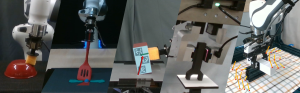

Co-Chairs: Nima Fazeli and Dmitry Berenson
Abstract:
Central to the success of many dexterous manipulation tasks is contact. Humans can intuitively reason about and control contacts to cook, clean, push, build and complete many, many more tasks. Our goal in designing autonomous robotic manipulators is ultimately to design robotic systems capable of ubiquitous reasoning and control of contact. In this thesis, we focus on contact-rich manipulation on systems exhibiting elastic deformation, either in the manipulator or the objects being manipulated. This compliance yields exciting opportunities, such as robust compliant contact interfaces, gradual force buildup and dissipation, and the potential for observability of contact via the deformation. Even with compliance in the system, contacts are rarely directly observable, forcing reliance on indirect, local, and noisy sensing. Additionally, the compliance in conjunction with contact introduces high-dimensional states and complex dynamics.
In this thesis, we explore methodologies to provide robots a sense of contact. We investigate data-driven methodologies for overcoming the complex, partially observable nature of contact. In particular, we look to exploit the tight relationship between deformation and contact, as elucidated by multi-modal sensory feedback. With our sense of contact in hand, we then explore downstream reasoning and behaviors in a variety of manipulation settings, such as tool use, non-prehensile and prehensile manipulation, and multi-task visuomotor policies.
Abstract:
Central to the success of many dexterous manipulation tasks is contact. Humans can intuitively reason about and control contacts to cook, clean, push, build and complete many, many more tasks. Our goal in designing autonomous robotic manipulators is ultimately to design robotic systems capable of ubiquitous reasoning and control of contact. In this thesis, we focus on contact-rich manipulation on systems exhibiting elastic deformation, either in the manipulator or the objects being manipulated. This compliance yields exciting opportunities, such as robust compliant contact interfaces, gradual force buildup and dissipation, and the potential for observability of contact via the deformation. Even with compliance in the system, contacts are rarely directly observable, forcing reliance on indirect, local, and noisy sensing. Additionally, the compliance in conjunction with contact introduces high-dimensional states and complex dynamics.
In this thesis, we explore methodologies to provide robots a sense of contact. We investigate data-driven methodologies for overcoming the complex, partially observable nature of contact. In particular, we look to exploit the tight relationship between deformation and contact, as elucidated by multi-modal sensory feedback. With our sense of contact in hand, we then explore downstream reasoning and behaviors in a variety of manipulation settings, such as tool use, non-prehensile and prehensile manipulation, and multi-task visuomotor policies.
Related Links

Explore Similar Events
-
Loading Similar Events...
