Presented By: Michigan Robotics
Electrohydrodynamic Jet Printing for Autonomous Hybrid Microelectronics Packaging: Process Characterization, Adaptive Routing, and Real-Time Sensing
PhD Defense, Kaifan Yue

Committee chair:
Professor Kira Barton
In FMCRB 2300 and on Zoom.
Abstract:
Today's microelectronics are built in billion-dollar fabrication facilities using processes that are fast but inflexible. What if we could instead print electronic circuits the way an inkjet printer puts ink on paper, but at a scale hundreds of times smaller than a human hair? This vision has driven growing interest in additive manufacturing approaches that can integrate heterogeneous components into functional circuits without the constraints of conventional lithographic fabrication. However, reliable high-resolution conductive printing, automated circuit assembly at the microscale, and real-time process monitoring remain largely unresolved challenges. This dissertation develops an integrated framework toward autonomous micro/nanoscale hybrid electronics packaging using electrohydrodynamic jet (e-jet) printing, organized around three progressive thrusts.
The first thrust establishes a characterization and design framework for submicron printed metal nanoparticle interconnects. The three-stage fabrication process from droplet generation, multilayer line formation, to thermal sintering is systematically investigated for silver and gold nanoparticle inks. Quantitative models linking process parameters to printed feature dimensions enable reliable submicron patterning, achieving conductive gold interconnects with line widths down to 300 nm. Integration with micromodular transistors validates the framework at the device level, with printed interconnects achieving performance comparable to lithography-defined wiring.
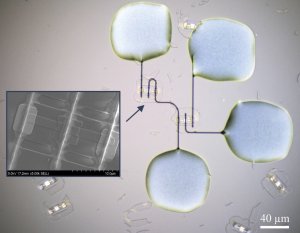
The second thrust develops an automated perception–planning–printing pipeline for adaptive circuit routing. Vision-based component detection and algorithmic route planning enable fully autonomous wiring of randomly placed micro-devices. The framework is validated through fabrication of functional inverter circuits and has been extended to memristive device integration and paper-based flexible substrates, confirming its applicability across heterogeneous device types and material systems.
The third thrust introduces optical density as a real-time volumetric sensing modality for micro-additive manufacturing. Quantitative correlations between in-situ optical measurements, physical line geometry, and electrical resistivity establish a direct inference chain from real-time sensing to functional performance. This sensing framework is integrated into a closed-loop control architecture for automated line width regulation.
Together, these contributions connect process science, manufacturing automation, and in-situ sensing into a cohesive framework for autonomous micro/nanoscale electronics fabrication, advancing printed hybrid microelectronics toward greater functionality, reliability, and scalability.
Professor Kira Barton
In FMCRB 2300 and on Zoom.
Abstract:
Today's microelectronics are built in billion-dollar fabrication facilities using processes that are fast but inflexible. What if we could instead print electronic circuits the way an inkjet printer puts ink on paper, but at a scale hundreds of times smaller than a human hair? This vision has driven growing interest in additive manufacturing approaches that can integrate heterogeneous components into functional circuits without the constraints of conventional lithographic fabrication. However, reliable high-resolution conductive printing, automated circuit assembly at the microscale, and real-time process monitoring remain largely unresolved challenges. This dissertation develops an integrated framework toward autonomous micro/nanoscale hybrid electronics packaging using electrohydrodynamic jet (e-jet) printing, organized around three progressive thrusts.
The first thrust establishes a characterization and design framework for submicron printed metal nanoparticle interconnects. The three-stage fabrication process from droplet generation, multilayer line formation, to thermal sintering is systematically investigated for silver and gold nanoparticle inks. Quantitative models linking process parameters to printed feature dimensions enable reliable submicron patterning, achieving conductive gold interconnects with line widths down to 300 nm. Integration with micromodular transistors validates the framework at the device level, with printed interconnects achieving performance comparable to lithography-defined wiring.
The second thrust develops an automated perception–planning–printing pipeline for adaptive circuit routing. Vision-based component detection and algorithmic route planning enable fully autonomous wiring of randomly placed micro-devices. The framework is validated through fabrication of functional inverter circuits and has been extended to memristive device integration and paper-based flexible substrates, confirming its applicability across heterogeneous device types and material systems.
The third thrust introduces optical density as a real-time volumetric sensing modality for micro-additive manufacturing. Quantitative correlations between in-situ optical measurements, physical line geometry, and electrical resistivity establish a direct inference chain from real-time sensing to functional performance. This sensing framework is integrated into a closed-loop control architecture for automated line width regulation.
Together, these contributions connect process science, manufacturing automation, and in-situ sensing into a cohesive framework for autonomous micro/nanoscale electronics fabrication, advancing printed hybrid microelectronics toward greater functionality, reliability, and scalability.
Related Links

Explore Similar Events
-
Loading Similar Events...
