Presented By: Michigan Institute for Data and AI in Society MIDAS
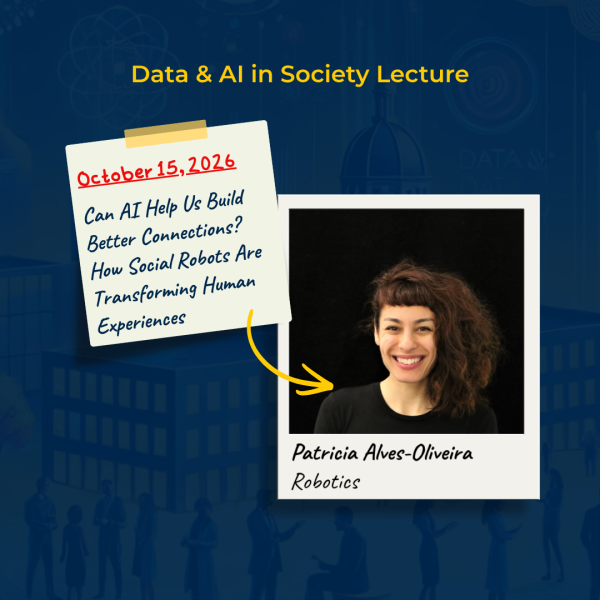
Can AI Help Us Build Better Connections? How Social Robots Are Transforming Human Experiences
Patricia Alves-Oliveira

Abstract
Robots can be highly capable, but without understanding human preferences, their utility remains fundamentally limited. This talk advances a framework for human augmentation through embodied social intelligence, grounded in three key dimensions. First, human-centered robot design, where I discuss methods to meaningfully involve people throughout a robot development lifecycle, while balancing the need for general-purpose systems with the specificity of human needs. Second, embodied AI systems, where I introduce my work on robotic hardware fabrication and context-agnostic algorithms that enable robust, real-world interaction. Third, robot evaluation in the wild, focusing on deployments in domains such as healthcare and the need for new metrics that combine experimental rigor with system performance. Drawing from my experience across academia and industry, including building Astro at Amazon and working on critical AI challenges at Meta, I highlight open problems at the intersection of AI, robotics, and human-centered design. Ultimately, I argue for a shift in robotics: from intelligence to relationships, from capability to meaning. Prioritizing human needs, values, and lived experiences is not a constraint; instead it is the path toward building robots that are truly effective, adaptive, and accepted.
Robots can be highly capable, but without understanding human preferences, their utility remains fundamentally limited. This talk advances a framework for human augmentation through embodied social intelligence, grounded in three key dimensions. First, human-centered robot design, where I discuss methods to meaningfully involve people throughout a robot development lifecycle, while balancing the need for general-purpose systems with the specificity of human needs. Second, embodied AI systems, where I introduce my work on robotic hardware fabrication and context-agnostic algorithms that enable robust, real-world interaction. Third, robot evaluation in the wild, focusing on deployments in domains such as healthcare and the need for new metrics that combine experimental rigor with system performance. Drawing from my experience across academia and industry, including building Astro at Amazon and working on critical AI challenges at Meta, I highlight open problems at the intersection of AI, robotics, and human-centered design. Ultimately, I argue for a shift in robotics: from intelligence to relationships, from capability to meaning. Prioritizing human needs, values, and lived experiences is not a constraint; instead it is the path toward building robots that are truly effective, adaptive, and accepted.
Related Links

Explore Similar Events
-
Loading Similar Events...
