Presented By: Michigan Robotics
Long-horizon and Multimodal Reasoning for Contact-rich Manipulation
PhD Defense, Zixuan Huang

Committee chair: Dmitry Berenson
Abstract:
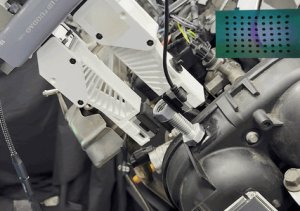
Contact-rich manipulation is central to many everyday robotic tasks, from assembly and tool use to cable routing and threading. Unlike free-space motion, these tasks require robots to deliberately make and maintain contact with objects and the environment, where small errors can cause large changes in forces, motion, and task outcome. Successful manipulation therefore requires reasoning about both how contact interactions evolve over time and how those interactions can be inferred from incomplete sensory observations.
This dissertation addresses two complementary challenges in contact-rich manipulation: long-horizon reasoning and multimodal reasoning. Long-horizon tasks such as cable routing require planning over extended sequences of contact interactions, where locally reasonable actions may lead to globally incorrect outcomes. Meanwhile, precise assembly and threading are often only partially observable from vision, motivating the integration of force and tactile sensing.
The first thrust develops diffusion-based subgoal generation methods that provide long-horizon guidance to model predictive control, including contact-aware representations that capture object–environment relationships. The second thrust develops multimodal generative models that jointly reason about actions, vision, force, touch, and proprioception, and investigates how control-relevant representations can be learned within world-action models. Together, these methods aim to enable robots to perform contact-rich manipulation with greater robustness, adaptability, and long-horizon reasoning capability.
Abstract:
Contact-rich manipulation is central to many everyday robotic tasks, from assembly and tool use to cable routing and threading. Unlike free-space motion, these tasks require robots to deliberately make and maintain contact with objects and the environment, where small errors can cause large changes in forces, motion, and task outcome. Successful manipulation therefore requires reasoning about both how contact interactions evolve over time and how those interactions can be inferred from incomplete sensory observations.
This dissertation addresses two complementary challenges in contact-rich manipulation: long-horizon reasoning and multimodal reasoning. Long-horizon tasks such as cable routing require planning over extended sequences of contact interactions, where locally reasonable actions may lead to globally incorrect outcomes. Meanwhile, precise assembly and threading are often only partially observable from vision, motivating the integration of force and tactile sensing.
The first thrust develops diffusion-based subgoal generation methods that provide long-horizon guidance to model predictive control, including contact-aware representations that capture object–environment relationships. The second thrust develops multimodal generative models that jointly reason about actions, vision, force, touch, and proprioception, and investigates how control-relevant representations can be learned within world-action models. Together, these methods aim to enable robots to perform contact-rich manipulation with greater robustness, adaptability, and long-horizon reasoning capability.
Related Links

Explore Similar Events
-
Loading Similar Events...
