Presented By: Michigan Robotics
Robotics Department Seminar Series - What Scale Won’t Buy: Physical Structure for Robots in an Era of Data
Patrick Wensing
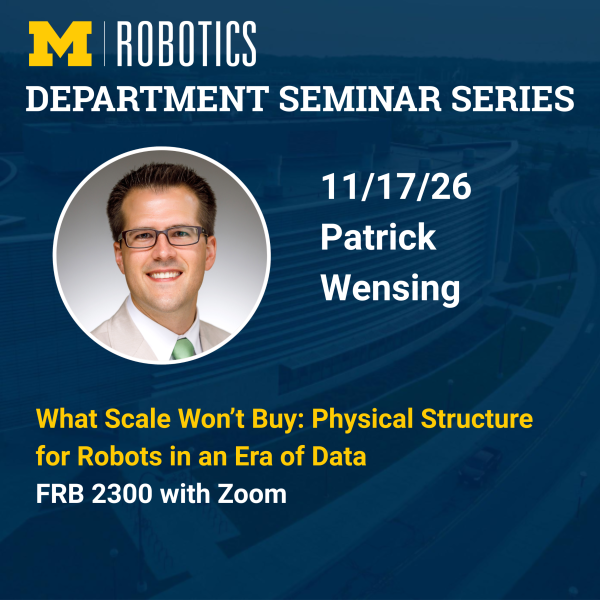

Robotics Department Seminar Series (https://robotics.umich.edu/events/robotics-seminar-series/)
Speaker: Wanzek Family Foundation Collegiate Professor of Engineering; Associate Professor in Aerospace and Mechanical Engineering, University of Notre Dame
Title: "What Scale Won’t Buy: Physical Structure for Robots in an Era of Data"
Date: Tuesday, November 17, 2026
Time: 4:00 - 5:00 pm ET
Location: FRB 2300 + Zoom
Zoom Link: https://myumi.ch/AxG9Z
Meeting ID: 997 8617 1873
Passcode: 671635
Abstract: Robot learning is in a period of extraordinary momentum. Humanoids now learn athletic, whole-body skills from simulation and human demonstration, while industry investment accelerates the push toward general-purpose machines. Much of this progress relies on synthetic or retargeted data and inherits whatever physics those pipelines get right or wrong. More data alone is not enough. Robots also need models that respect physics, demonstrations they can physically execute, and interfaces that let them work intuitively with people. This talk argues that physical structure is not a competitor to learning but part of its infrastructure.
I will first discuss differentiable simulation and data pipelines for the closed-chain mechanisms of real humanoids, along with physically consistent model identification grounded in the geometry of mass distributions. I will then present dynamics-aware retargeting and whole-body MPC that turn human motion into feasible robot behavior, including heavy-payload loco-manipulation where vision alone cannot determine payload dynamics. This emphasis on structure also extends to machines that must coordinate with the human body. In lower-limb prostheses, I will show how task-level priors drawn from human sensorimotor coordination allow humanlike joint behavior to emerge from whole-body coordination rather than being prescribed joint by joint. Across robots and people alike, scale makes good structure more valuable, not less.
Speaker Bio: Patrick Wensing is the Wanzek Family Foundation Collegiate Professor of Engineering and an Associate Professor in Aerospace and Mechanical Engineering at the University of Notre Dame, where he directs the Robotics, Optimization, and Assistive Mobility (ROAM) Lab. He received his Ph.D. in Electrical and Computer Engineering from The Ohio State University in 2014 and completed postdoctoral training at MIT in 2017, where he worked on control system design for the MIT Cheetah robots. His research focuses on dynamics, optimization, and control to advance the mobility of legged robots and assistive devices. Dr. Wensing is a recipient of the NSF CAREER Award (2020) and the IROS Toshio Fukuda Young Professional Award (2023), and his work has been recognized with multiple best paper awards. He currently serves as an Editor for the IEEE Transactions on Robotics and as a member of the IEEE RAS Executive Committee.
Speaker: Wanzek Family Foundation Collegiate Professor of Engineering; Associate Professor in Aerospace and Mechanical Engineering, University of Notre Dame
Title: "What Scale Won’t Buy: Physical Structure for Robots in an Era of Data"
Date: Tuesday, November 17, 2026
Time: 4:00 - 5:00 pm ET
Location: FRB 2300 + Zoom
Zoom Link: https://myumi.ch/AxG9Z
Meeting ID: 997 8617 1873
Passcode: 671635
Abstract: Robot learning is in a period of extraordinary momentum. Humanoids now learn athletic, whole-body skills from simulation and human demonstration, while industry investment accelerates the push toward general-purpose machines. Much of this progress relies on synthetic or retargeted data and inherits whatever physics those pipelines get right or wrong. More data alone is not enough. Robots also need models that respect physics, demonstrations they can physically execute, and interfaces that let them work intuitively with people. This talk argues that physical structure is not a competitor to learning but part of its infrastructure.
I will first discuss differentiable simulation and data pipelines for the closed-chain mechanisms of real humanoids, along with physically consistent model identification grounded in the geometry of mass distributions. I will then present dynamics-aware retargeting and whole-body MPC that turn human motion into feasible robot behavior, including heavy-payload loco-manipulation where vision alone cannot determine payload dynamics. This emphasis on structure also extends to machines that must coordinate with the human body. In lower-limb prostheses, I will show how task-level priors drawn from human sensorimotor coordination allow humanlike joint behavior to emerge from whole-body coordination rather than being prescribed joint by joint. Across robots and people alike, scale makes good structure more valuable, not less.
Speaker Bio: Patrick Wensing is the Wanzek Family Foundation Collegiate Professor of Engineering and an Associate Professor in Aerospace and Mechanical Engineering at the University of Notre Dame, where he directs the Robotics, Optimization, and Assistive Mobility (ROAM) Lab. He received his Ph.D. in Electrical and Computer Engineering from The Ohio State University in 2014 and completed postdoctoral training at MIT in 2017, where he worked on control system design for the MIT Cheetah robots. His research focuses on dynamics, optimization, and control to advance the mobility of legged robots and assistive devices. Dr. Wensing is a recipient of the NSF CAREER Award (2020) and the IROS Toshio Fukuda Young Professional Award (2023), and his work has been recognized with multiple best paper awards. He currently serves as an Editor for the IEEE Transactions on Robotics and as a member of the IEEE RAS Executive Committee.
Related Links

Livestream Information
ZoomNovember 17, 2026 (Tuesday) 4:00pm
Meeting ID: 99786171873
Meeting Password: 671635
Explore Similar Events
-
Loading Similar Events...
