Presented By: Ecology and Evolutionary Biology
EEB Thursday Seminar Series - Why are there so many mushrooms?
David Hibbett, Clark University
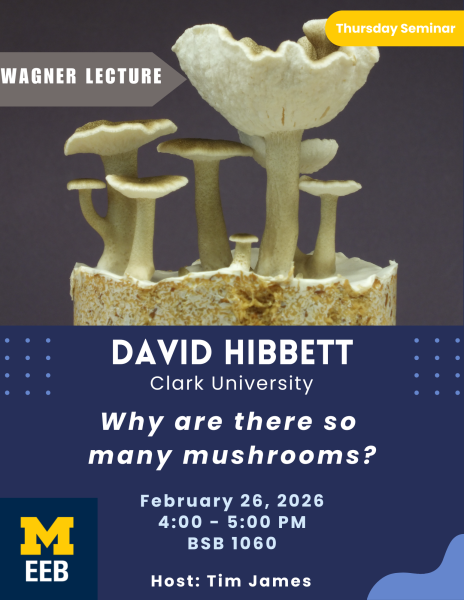

Seminar Summary - Complex multicellular forms have evolved only a handful of times in the histroy of life, with multiple origins in Fungi. The greatest diversity of forms is in Agaricomycetes, a clade of roughly 40,000 species of gilled mushrooms, crust and coral fungi, polypores, puffballs, and others. I will present
research on diversification of fruiting body forms in Agaricomycetes, drawing on phylogenetics and comparative methods, development, and paleomycology. I will also discuss ongoing work on the “tiger sawgill”, Lentinus tigrinus, which is a semi-aquatic mushroom that displays an intraspecific polymorphism with both gilled (agaricoid) and puffball-like (secotioid) forms. Our work on L. tigrinus addresses the genetic bases and ecological context of a fungal morphological innovation.
research on diversification of fruiting body forms in Agaricomycetes, drawing on phylogenetics and comparative methods, development, and paleomycology. I will also discuss ongoing work on the “tiger sawgill”, Lentinus tigrinus, which is a semi-aquatic mushroom that displays an intraspecific polymorphism with both gilled (agaricoid) and puffball-like (secotioid) forms. Our work on L. tigrinus addresses the genetic bases and ecological context of a fungal morphological innovation.

Explore Similar Events
-
Loading Similar Events...
