Presented By: Department of Philosophy, Department of Political Science
Department Colloquium: Dilip Ninan (Tufts)
The Puzzle of Known Violation

Title: The Puzzle of Known Violation
Abstract:
Suppose it is true that I should sell all my possessions and give the money to the poor. Then it would seem to follow that I should sell all my possessions. This piece of reasoning is underwritten by a principle known as Inheritance: if p entails q, then "should p" entails "should q". But Åqvist (1967) pointed out some apparent counterexamples to Inheritance: "Max should have known he was breaking a rule" does not entail "Max should have been breaking a rule" even though "Max knew he was breaking a rule" entails "Max was breaking a rule". I argue that Åqvist's observation is an instance of something more general: for many p and q where p entails and presupposes q, "should p" does not entail "should q". I sketch a semantics that accommodates this fact while still preserving the truth of many instances of Inheritance. Finally, I show that our discussion has consequences for a rather different debate in philosophy, as it seems to undermine a recent argument against the knowledge account of assertion.
Research/Areas of Interest
Philosophy of Language, Metaphysics, Philosophy of Mind
Education
PhD in Philosophy, Massachusetts Institute of Technology, Cambridge, United States, 2008
MSc in Economic and Social History, University of Oxford, Oxford, United Kingdom, 2002
BPhil in Philosophy, University of Oxford, Oxford, United Kingdom, 2001
BA in Philosophy, University of Western Ontario, London, Canada, 1999
Biography
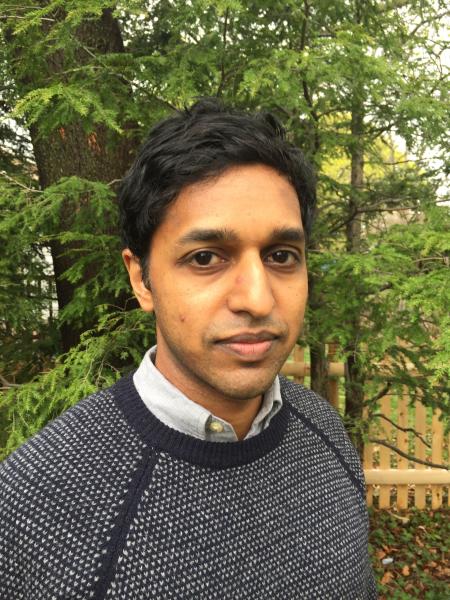
Dilip Ninan received his Ph.D. from MIT, B.Phil. from Oxford University, and B.A. from the University of Western Ontario. Before coming to Tufts, he spent three years as a postdoctoral research fellow at the University of St Andrews in Scotland.
His research interests include the philosophy of language, formal semantics, metaphysics, and the philosophy of mind. He has worked on the representation of de se and de re attitudes, the nature of personal identity over time, and on foundational questions in semantics.
When not philosophizing, he enjoys reading, running, cooking, and skiing.
Abstract:
Suppose it is true that I should sell all my possessions and give the money to the poor. Then it would seem to follow that I should sell all my possessions. This piece of reasoning is underwritten by a principle known as Inheritance: if p entails q, then "should p" entails "should q". But Åqvist (1967) pointed out some apparent counterexamples to Inheritance: "Max should have known he was breaking a rule" does not entail "Max should have been breaking a rule" even though "Max knew he was breaking a rule" entails "Max was breaking a rule". I argue that Åqvist's observation is an instance of something more general: for many p and q where p entails and presupposes q, "should p" does not entail "should q". I sketch a semantics that accommodates this fact while still preserving the truth of many instances of Inheritance. Finally, I show that our discussion has consequences for a rather different debate in philosophy, as it seems to undermine a recent argument against the knowledge account of assertion.
Research/Areas of Interest
Philosophy of Language, Metaphysics, Philosophy of Mind
Education
PhD in Philosophy, Massachusetts Institute of Technology, Cambridge, United States, 2008
MSc in Economic and Social History, University of Oxford, Oxford, United Kingdom, 2002
BPhil in Philosophy, University of Oxford, Oxford, United Kingdom, 2001
BA in Philosophy, University of Western Ontario, London, Canada, 1999
Biography
Dilip Ninan received his Ph.D. from MIT, B.Phil. from Oxford University, and B.A. from the University of Western Ontario. Before coming to Tufts, he spent three years as a postdoctoral research fellow at the University of St Andrews in Scotland.
His research interests include the philosophy of language, formal semantics, metaphysics, and the philosophy of mind. He has worked on the representation of de se and de re attitudes, the nature of personal identity over time, and on foundational questions in semantics.
When not philosophizing, he enjoys reading, running, cooking, and skiing.

Explore Similar Events
-
Loading Similar Events...
