Presented By: Quantum Research Institute
Quantum Research Institute | Modeling Biology on a Quantum Computer: Deciphering the Mechanism of ATP Hydrolysis Using Quantum Hardware
Brenda Rubenstein (Brown University)
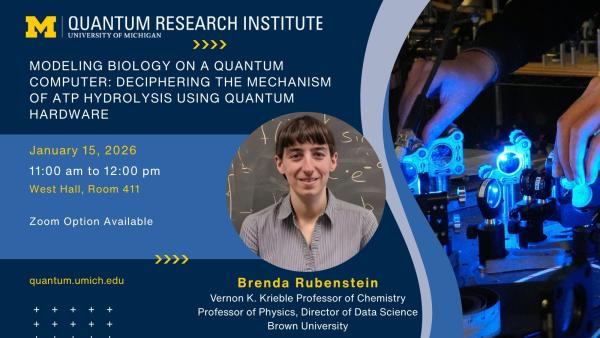

In-person: West Hall 411
Zoom: https://umich.zoom.us/j/91050980639?jst=2
Abstract:
The ability to model biochemical reaction dynamics on quantum hardware would open the door
to the virtually exact description of enzymatic catalysis, accelerating the discovery of novel
therapeutics. However, noisy hardware, the costs of computing gradients, and the number of
qubits and gates required to simulate large systems present major challenges to realizing the
potential of dynamical simulations using quantum hardware. In this talk, I will discuss our recent
efforts to model ATP hydrolysis, a paradigmatic and clinically-important biochemical reaction,
using quantum hardware. Key to our modeling is employing transfer learning to learn
approximate force fields based on abundant data and then correcting those force fields using
data from quantum hardware. Using this technique and new embedding and downfolding
methods, I will show how we can gain novel mechanistic insights into a variety of hydrolysis-
related reactions and how these techniques can be adapted to other problems in biochemistry.
Throughout this talk, I will underscore the opportunities and challenges associated with using
quantum hardware and how these can be addressed via the fruitful marriage of quantum
computation and machine learning.
Bio:
Dr. Brenda Rubenstein is currently the Krieble Professor of Chemistry at Brown University. She
was named to Popular Science magazine’s 2021 Brilliant 10 list of the top early career scientists
and C&EN’s 2019 Talented 12 list of early career chemists, and has received a number of
research and teaching honors including the Camille Dreyfus Teacher Scholar Award, a Cottrell
Teacher Scholar Award, and a Sloan Research Fellowship. While the focus of her work is on
developing new electronic structure methods, she is also deeply engaged in rethinking
computing architectures and computational biophysics. Prior to arriving at Brown, she was a
Lawrence Distinguished Postdoctoral Fellow at Lawrence Livermore National Laboratory. She
received her Sc.B.s in Chemical Physics and Applied Mathematics at Brown University, her
M.Phil. in Computational Chemistry while a Churchill Scholar at the University of Cambridge,
and her Ph.D. in Chemical Physics at Columbia University.
Zoom: https://umich.zoom.us/j/91050980639?jst=2
Abstract:
The ability to model biochemical reaction dynamics on quantum hardware would open the door
to the virtually exact description of enzymatic catalysis, accelerating the discovery of novel
therapeutics. However, noisy hardware, the costs of computing gradients, and the number of
qubits and gates required to simulate large systems present major challenges to realizing the
potential of dynamical simulations using quantum hardware. In this talk, I will discuss our recent
efforts to model ATP hydrolysis, a paradigmatic and clinically-important biochemical reaction,
using quantum hardware. Key to our modeling is employing transfer learning to learn
approximate force fields based on abundant data and then correcting those force fields using
data from quantum hardware. Using this technique and new embedding and downfolding
methods, I will show how we can gain novel mechanistic insights into a variety of hydrolysis-
related reactions and how these techniques can be adapted to other problems in biochemistry.
Throughout this talk, I will underscore the opportunities and challenges associated with using
quantum hardware and how these can be addressed via the fruitful marriage of quantum
computation and machine learning.
Bio:
Dr. Brenda Rubenstein is currently the Krieble Professor of Chemistry at Brown University. She
was named to Popular Science magazine’s 2021 Brilliant 10 list of the top early career scientists
and C&EN’s 2019 Talented 12 list of early career chemists, and has received a number of
research and teaching honors including the Camille Dreyfus Teacher Scholar Award, a Cottrell
Teacher Scholar Award, and a Sloan Research Fellowship. While the focus of her work is on
developing new electronic structure methods, she is also deeply engaged in rethinking
computing architectures and computational biophysics. Prior to arriving at Brown, she was a
Lawrence Distinguished Postdoctoral Fellow at Lawrence Livermore National Laboratory. She
received her Sc.B.s in Chemical Physics and Applied Mathematics at Brown University, her
M.Phil. in Computational Chemistry while a Churchill Scholar at the University of Cambridge,
and her Ph.D. in Chemical Physics at Columbia University.

Livestream Information
ZoomJanuary 15, 2026 (Thursday) 11:00am
Meeting ID: 910509806392
Explore Similar Events
-
Loading Similar Events...
