Presented By: Quantum Research Institute
Quantum Research Institute | Quantum computers and their potential to enable scientific discovery
Bert de Jong (Lawrence Berkeley National Laboratory)
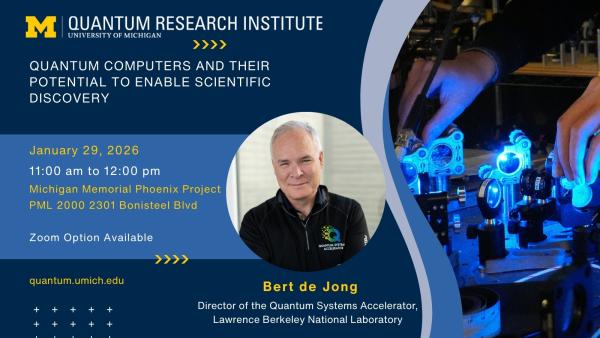
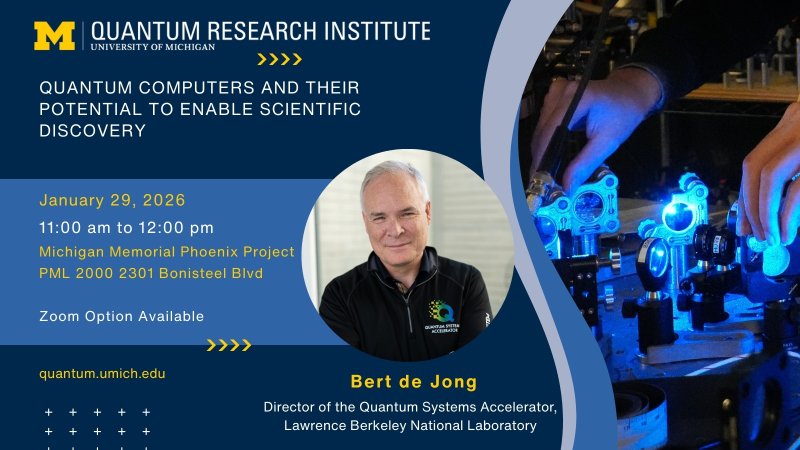
In-person: Michigan Memorial Phoenix Project, 2301 Bonisteel Blvd, Ann Arbor, MI 48109, USA, PML2000
Zoom: https://umich.zoom.us/j/98530700330?jst=2
Abstract:
Quantum technologies are advancing rapidly with a pathway to scientific discovery and quantum utility by 2030 for the Department of Energy community. Harnessing quantum technologies as they scale up will require next-generation software and integration with HPC and AI. Software frameworks to couple HPC and AI to quantum computers, as well as connecting end users to such a hybrid computing environment will be essential to ensure the technology can be harnessed optimally to deliver on industry and scientific discovery needs. I will show research progress and discuss the opportunities for scientific advantage for quantum technologies and potential pathways to integrate HPC, AI and networking.
Short bio:
Bert de Jong is the Director of the Quantum Systems Accelerator, which is part of the National Quantum Initiative. Additionally, de Jong is the Team Director of the Accelerated Research for Quantum Computing (ARQC) Team MACH-Q, funded by DOE ASCR, which focuses on developing software stacks for near-term quantum computing devices. Additionally, de Jong has a program in AI and machine learning to understand biomolecular processes, and discover new materials and molecular crystals for gas adsorption. de Jong serves as the Department Head for Computational Sciences and leads the Applied Computing for Scientific Discovery Group. This group advances scientific computing by developing and enhancing applications in key disciplines, as well as developing HPC, quantum and AI tools and libraries for addressing general problems in computational science.
Zoom: https://umich.zoom.us/j/98530700330?jst=2
Abstract:
Quantum technologies are advancing rapidly with a pathway to scientific discovery and quantum utility by 2030 for the Department of Energy community. Harnessing quantum technologies as they scale up will require next-generation software and integration with HPC and AI. Software frameworks to couple HPC and AI to quantum computers, as well as connecting end users to such a hybrid computing environment will be essential to ensure the technology can be harnessed optimally to deliver on industry and scientific discovery needs. I will show research progress and discuss the opportunities for scientific advantage for quantum technologies and potential pathways to integrate HPC, AI and networking.
Short bio:
Bert de Jong is the Director of the Quantum Systems Accelerator, which is part of the National Quantum Initiative. Additionally, de Jong is the Team Director of the Accelerated Research for Quantum Computing (ARQC) Team MACH-Q, funded by DOE ASCR, which focuses on developing software stacks for near-term quantum computing devices. Additionally, de Jong has a program in AI and machine learning to understand biomolecular processes, and discover new materials and molecular crystals for gas adsorption. de Jong serves as the Department Head for Computational Sciences and leads the Applied Computing for Scientific Discovery Group. This group advances scientific computing by developing and enhancing applications in key disciplines, as well as developing HPC, quantum and AI tools and libraries for addressing general problems in computational science.

Livestream Information
ZoomJanuary 29, 2026 (Thursday) 11:00am
Meeting ID: 985307003302
Explore Similar Events
-
Loading Similar Events...
