Presented By: Quantum Research Institute
Quantum Research Institute | Have we seen a demonstration of experimental quantum advantage?
Bill Fefferman (University of Chicago)
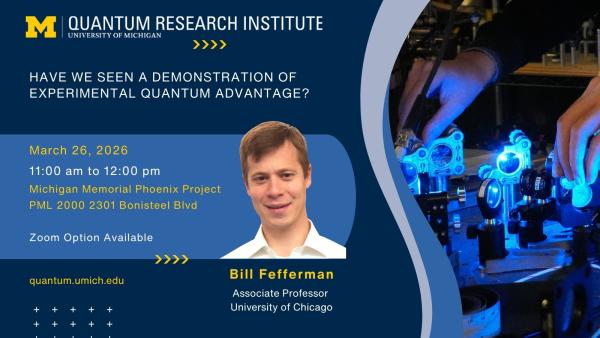

In-Person: Michigan Memorial Phoenix Project, 2301 Bonisteel Blvd, Ann Arbor, MI 48109, USA, PML2000
Zoom: https://umich.zoom.us/j/94764879233?jst=2
Abstract: A major goal for the field of quantum computation is “quantum advantage" -- the first experimental demonstration of a quantum computation that is beyond the capabilities of any classical computer. While we have now seen many quantum advantage claims made by experimental groups around the world, many of these claims have been disproven.
In this talk, we'll discuss the status quo regarding the latest experimental quantum advantage claims and the evidence for their classical hardness. We’ll then discuss the classical verification problem, and propose a new quantum advantage proposal that uses ideas from quantum error correction to enable a large gap between classical verification and simulation.
Bio:
I am an Associate Professor in the Department of Computer Science at the University of Chicago.
Previously, I held research positions at the University of California at Berkeley, advised by Umesh Vazirani, and in QuICS, at the University of Maryland/NIST.
I received my Ph.D. in computer science from the Department of Computer and Mathematical Sciences and the Institute for Quantum Information and Matter at Caltech, co-advised by Alexei Kitaev and Chris Umans.
Zoom: https://umich.zoom.us/j/94764879233?jst=2
Abstract: A major goal for the field of quantum computation is “quantum advantage" -- the first experimental demonstration of a quantum computation that is beyond the capabilities of any classical computer. While we have now seen many quantum advantage claims made by experimental groups around the world, many of these claims have been disproven.
In this talk, we'll discuss the status quo regarding the latest experimental quantum advantage claims and the evidence for their classical hardness. We’ll then discuss the classical verification problem, and propose a new quantum advantage proposal that uses ideas from quantum error correction to enable a large gap between classical verification and simulation.
Bio:
I am an Associate Professor in the Department of Computer Science at the University of Chicago.
Previously, I held research positions at the University of California at Berkeley, advised by Umesh Vazirani, and in QuICS, at the University of Maryland/NIST.
I received my Ph.D. in computer science from the Department of Computer and Mathematical Sciences and the Institute for Quantum Information and Matter at Caltech, co-advised by Alexei Kitaev and Chris Umans.

Livestream Information
ZoomMarch 26, 2026 (Thursday) 11:00am
Meeting ID: 947648792332
Explore Similar Events
-
Loading Similar Events...
