Presented By: Quantum Research Institute
Quantum Research Institute | Quantum Spin-Mechanics with Color Centers in Diamond: A Potential Platform for Quantum Computing
Hailin Wang (University of Oregon)
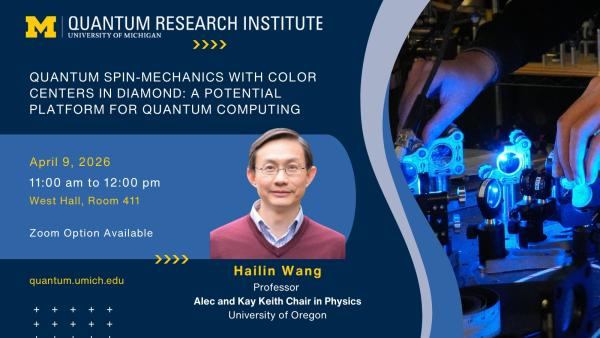

In-Person: West Hall 411
Zoom: https://umich.zoom.us/j/91761768567?jst=2
Abstract:
In a spin-mechanical system, electron spins are coupled to vibrations of a nanomechanical resonator. Coherent interactions between single spins and single phonons take place in the quantum regime of spin-mechanics. A network of these resonators can enable phonon-mediated coupling between distant electron spin, leading to a mechanical quantum network of spin qubits and providing an experimental platform for developing spin-based quantum computers.
In this talk, I will discuss our recent advance in achieving ultracoherent GHz diamond nanomechanical resonators and in developing mechanical quantum networks of spin qubits in diamond. Localization and localization phase transitions induced by deterministic onsite potentials in a mechanical network are also exploited for the realization of extended network connectivity, which is deemed essential for large-scale fault tolerant quantum computers.
Bio:
Hailin Wang received B.S. and Ph.D. degrees in physics from the University of Science and Technology of China and the University of Michigan in 1982 and 1990, respectively. He was a research investigator at the University of Michigan and subsequently a staff consultant at AT&T Bell Laboratories. He joined the University of Oregon in 1995 where he is now a professor of physics. Dr. Wang has made important contributions to the current understanding of coherent as well as incoherent optical processes in semiconductor nanostructures. He also made the first experimental demonstration of amplitude squeezed light from an injection-locked diode laser and developed a fused silica optical resonator that feature highly directional evanescent tunneling. His work on exciton spin coherence and biexciton coherence has recently led to the first demonstration of electromagnetically induced transparency for interband optical transitions in semiconductors. His current research interest includes optical manipulation of quantum coherences in semiconductors and especially its application in both classical and quantum information processing. Dr. Wang is a recipient of an NSF-CAREER award and is a fellow of the Optical Society of America.
Zoom: https://umich.zoom.us/j/91761768567?jst=2
Abstract:
In a spin-mechanical system, electron spins are coupled to vibrations of a nanomechanical resonator. Coherent interactions between single spins and single phonons take place in the quantum regime of spin-mechanics. A network of these resonators can enable phonon-mediated coupling between distant electron spin, leading to a mechanical quantum network of spin qubits and providing an experimental platform for developing spin-based quantum computers.
In this talk, I will discuss our recent advance in achieving ultracoherent GHz diamond nanomechanical resonators and in developing mechanical quantum networks of spin qubits in diamond. Localization and localization phase transitions induced by deterministic onsite potentials in a mechanical network are also exploited for the realization of extended network connectivity, which is deemed essential for large-scale fault tolerant quantum computers.
Bio:
Hailin Wang received B.S. and Ph.D. degrees in physics from the University of Science and Technology of China and the University of Michigan in 1982 and 1990, respectively. He was a research investigator at the University of Michigan and subsequently a staff consultant at AT&T Bell Laboratories. He joined the University of Oregon in 1995 where he is now a professor of physics. Dr. Wang has made important contributions to the current understanding of coherent as well as incoherent optical processes in semiconductor nanostructures. He also made the first experimental demonstration of amplitude squeezed light from an injection-locked diode laser and developed a fused silica optical resonator that feature highly directional evanescent tunneling. His work on exciton spin coherence and biexciton coherence has recently led to the first demonstration of electromagnetically induced transparency for interband optical transitions in semiconductors. His current research interest includes optical manipulation of quantum coherences in semiconductors and especially its application in both classical and quantum information processing. Dr. Wang is a recipient of an NSF-CAREER award and is a fellow of the Optical Society of America.

Livestream Information
ZoomApril 9, 2026 (Thursday) 11:00am
Meeting ID: 917617685672
Explore Similar Events
-
Loading Similar Events...
