Presented By: Weiser Center for Europe and Eurasia
WCEE Film Series on Ukraine. Lina (2024, 30 min, dir. Mykola Nosok & Oleksiy Oliyar)
Panel Discussion
Panel discussion featuring: Sylvia Ellison, Senior Advisor, Save Ukraine; Ambassador Craig L. Johnstone, Co-Founder of The Humanity Funds; Danielle Leavitt, WCEE Postdoctoral Fellow, 2025-27; and Nathaniel A. Raymond, Executive Director, Humanitarian Research Lab, Yale School of Public Health
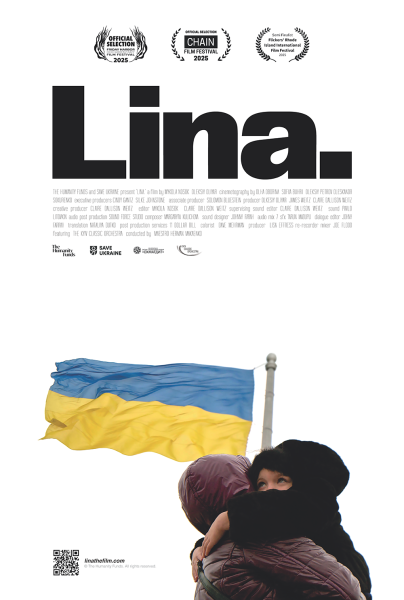
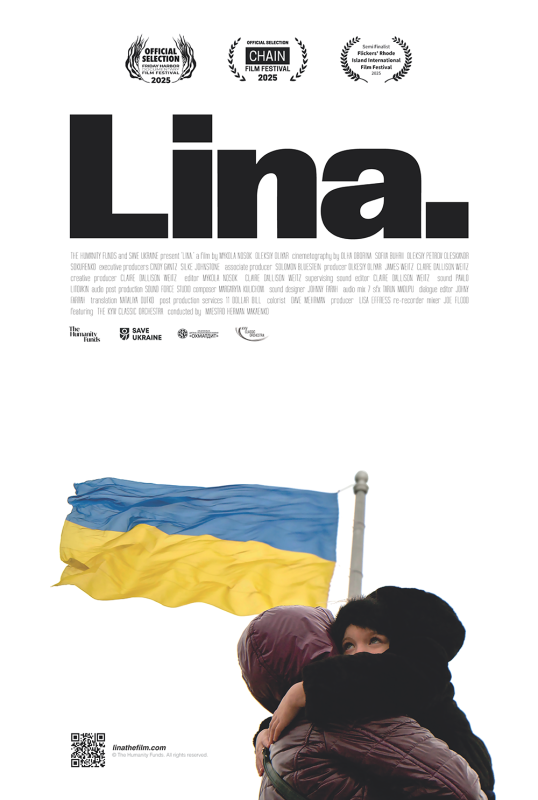
This is the story of five-year-old Lina, the seventh child of a family of eight children, who is caught between the frontlines of free Kherson and Russian occupied Kherson. Lina's mom will take you through a rollercoaster of emotions from a spine-chilling rescue, taking the family deep into Russia to reaching free Ukraine. There they strive for a normal life - only to discover that this brutal war has left deep scars on Lina.
Trailer: https://myumi.ch/VVXZM
Sylvia Ellison is a senior humanitarian and development leader with deep experience designing and delivering programs in crisis and conflict settings. As Vice President of Save Ukraine - US, she informs and drives positioning strategy, U.S. government engagement, and partnerships that strengthen the rescue, rehabilitation, and reintegration of children and families affected by war. Previously at Creative Associates International, Sylvia's portfolio included leading organizational learning and systems strengthening efforts as well as designing and implementing basic education, youth, anti-trafficking, workforce development, and stabilization initiatives across multiple countries including Albania, Afghanistan, Bulgaria, Jordan, Romania, Sri Lanka, Uganda, Morocco, and Yemen. Formally trained in the AK Rice approach to group relations and organizational systems consulting, Sylvia also serves on the board of Creative Learning.
Ambassador Craig L. Johnstone, Co-Founder of The Humanity Funds, served in Vietnam from 1965-1970 and was the sixth Ambassador to Algeria. In 2007, he served as the UN Deputy High Commissioner for Refugees. He continues to pursue his passion for helping refugees and people affected by war by co-founding the Humanity Funds, a nonprofit dedicated to helping women and children in conflict zones.
Nathaniel A. Raymond is Executive Director of the Humanitarian Research Lab at the Yale School of Public Health (YSPH) and a Lecturer in the Department of the Epidemiology of Microbial Diseases (EMD) at YSPH. He was formerly a Lecturer of Global Affairs at the Jackson School for Global Affairs from 2018 - 2022. His research interests focus on the health implications of forced displacement; methodologies for the assessment of large-scale disasters, including pandemics; and the human rights and human security implications of information communication technologies (ICTs) for vulnerable populations, particularly in the context of armed conflict. Previously, he was the founding Director of the Signal Program on Human Security and Technology at the Harvard Humanitarian Initiative (HHI) of the Harvard T.H. Chan School of Public Health from 2012 – 2018. From 2010 to 2012, he was Director of Operations for the George Clooney-founded Satellite Sentinel Project at HHI, which utilized high resolution satellite imagery to detect and document attacks on civilians in Sudan and South Sudan.
Danielle Leavitt, WCEE Postdoctoral Fellow, 2025-27 is a historian of modern Ukraine and the Soviet Union, with a particular interest in Russian and Ukrainian relations, human age, generation, and gender. Her work examines the function of generation and human age in Soviet history and works to insert the stories of underrepresented populations, such as the elderly and women, into consequential debates about stagnation, cultural life, Soviet collapse, post-Soviet economic and political development, and the Russo-Ukrainian war.
If there is anything we can do to make this event accessible to you, please contact us at [email protected]. Please be aware that advance notice is necessary as some accommodations may require more time for the university to arrange.
This is the story of five-year-old Lina, the seventh child of a family of eight children, who is caught between the frontlines of free Kherson and Russian occupied Kherson. Lina's mom will take you through a rollercoaster of emotions from a spine-chilling rescue, taking the family deep into Russia to reaching free Ukraine. There they strive for a normal life - only to discover that this brutal war has left deep scars on Lina.
Trailer: https://myumi.ch/VVXZM
Sylvia Ellison is a senior humanitarian and development leader with deep experience designing and delivering programs in crisis and conflict settings. As Vice President of Save Ukraine - US, she informs and drives positioning strategy, U.S. government engagement, and partnerships that strengthen the rescue, rehabilitation, and reintegration of children and families affected by war. Previously at Creative Associates International, Sylvia's portfolio included leading organizational learning and systems strengthening efforts as well as designing and implementing basic education, youth, anti-trafficking, workforce development, and stabilization initiatives across multiple countries including Albania, Afghanistan, Bulgaria, Jordan, Romania, Sri Lanka, Uganda, Morocco, and Yemen. Formally trained in the AK Rice approach to group relations and organizational systems consulting, Sylvia also serves on the board of Creative Learning.
Ambassador Craig L. Johnstone, Co-Founder of The Humanity Funds, served in Vietnam from 1965-1970 and was the sixth Ambassador to Algeria. In 2007, he served as the UN Deputy High Commissioner for Refugees. He continues to pursue his passion for helping refugees and people affected by war by co-founding the Humanity Funds, a nonprofit dedicated to helping women and children in conflict zones.
Nathaniel A. Raymond is Executive Director of the Humanitarian Research Lab at the Yale School of Public Health (YSPH) and a Lecturer in the Department of the Epidemiology of Microbial Diseases (EMD) at YSPH. He was formerly a Lecturer of Global Affairs at the Jackson School for Global Affairs from 2018 - 2022. His research interests focus on the health implications of forced displacement; methodologies for the assessment of large-scale disasters, including pandemics; and the human rights and human security implications of information communication technologies (ICTs) for vulnerable populations, particularly in the context of armed conflict. Previously, he was the founding Director of the Signal Program on Human Security and Technology at the Harvard Humanitarian Initiative (HHI) of the Harvard T.H. Chan School of Public Health from 2012 – 2018. From 2010 to 2012, he was Director of Operations for the George Clooney-founded Satellite Sentinel Project at HHI, which utilized high resolution satellite imagery to detect and document attacks on civilians in Sudan and South Sudan.
Danielle Leavitt, WCEE Postdoctoral Fellow, 2025-27 is a historian of modern Ukraine and the Soviet Union, with a particular interest in Russian and Ukrainian relations, human age, generation, and gender. Her work examines the function of generation and human age in Soviet history and works to insert the stories of underrepresented populations, such as the elderly and women, into consequential debates about stagnation, cultural life, Soviet collapse, post-Soviet economic and political development, and the Russo-Ukrainian war.
If there is anything we can do to make this event accessible to you, please contact us at [email protected]. Please be aware that advance notice is necessary as some accommodations may require more time for the university to arrange.

Explore Similar Events
-
Loading Similar Events...
