Presented By: Michigan Institute for Plasma Science and Engineering (MIPSE)
MIPSE Seminar | Pulser IFE: A Practical and Affordable Approach to Fusion Energy
Dr. Patrick Knapp, Pacific Fusion

Abstract:
The Pacific Fusion Corporation, founded in 2023, is developing the targets and drivers needed to achieve high gain fusion for the first time in the laboratory and to simultaneously resolve significant hurdles to commercialization. We are building a 60-MA pulsed power driver based on the Impedance-matched Marx Generator (IMG) technology, a driver technology with unprecedented efficiency. Magnetically driven targets, coupled to such an efficient generator, provide flexibility in design, low risk scaling, and a mature physics foundation. We will discuss the theoretical foundations that underpin our approach to fusion energy. To support our target design objectives we are developing and using the FLASH code. We have extensively improved and validated FLASH to support our mission. Additionally, to support experiments on our facility we have designed a state of the art diagnostic suite to enable optical, x-ray, and nuclear measurements of burning plasmas in the ~100 MJ regime. Our diagnostics are based on a foundation of statistical inference, allowing us to motivate designs based on their ability to quantitatively constrain key performance metrics.
About the Speaker:
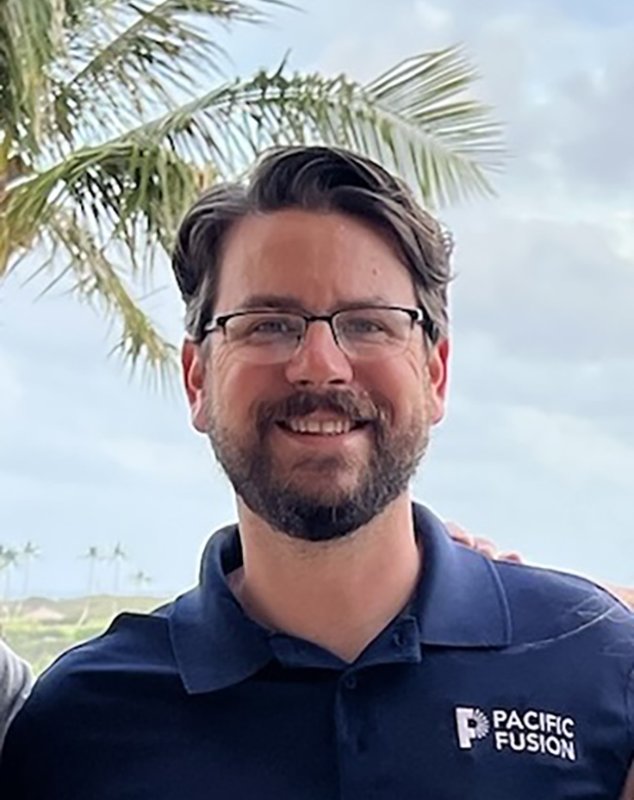
Dr. Patrick Knapp is an experimental physicist and the experiments lead at the Pacific Fusion Corporation, where he leads the effort to develop experimental platforms and analysis tools in support of achieving facility gain and fusion energy on the grid with pulser fusion. He earned a BS in Electrical and Computer Engineering from Syracuse University in 2004, and the PhD in Electrical Engineering from Cornell University in 2011. Dr. Knapp dedicated eleven years as a staff member at Sandia National Laboratories, where he directed over 100 experiments on the Z machine. During his tenure, he was instrumental in developing multiple novel x-ray instruments, establishing the Magnetized Liner Inertial Fusion (MagLIF) platform, and creating a methodology to measure fuel magnetization utilizing secondary DT neutrons. Furthermore, he devised a novel Bayesian inference method to ascertain key performance metrics from MagLIF experiments. Prior to joining Pacific Fusion in July 2024, Dr. Knapp worked at Los Alamos National Laboratory, where he spearheaded the development of a Pulsed Power ICF program and applied Pulsed Power to critical stockpile stewardship challenges. His responsibilities at Pacific Fusion involve designing experiments aimed at derisking novel target technologies and generating validation data for the FLASH radiation-magnetohydrodynamics code. He also leads the development of post-processing and synthetic data pipelines, which are essential for the informed design and optimization of the diagnostic suite for the forthcoming facility gain Demonstration System.
This seminar is free and open to the public. It will be conducted in person and on Zoom, please check MIPSE website for details: https://mipse.umich.edu/seminars_2526.php
The Pacific Fusion Corporation, founded in 2023, is developing the targets and drivers needed to achieve high gain fusion for the first time in the laboratory and to simultaneously resolve significant hurdles to commercialization. We are building a 60-MA pulsed power driver based on the Impedance-matched Marx Generator (IMG) technology, a driver technology with unprecedented efficiency. Magnetically driven targets, coupled to such an efficient generator, provide flexibility in design, low risk scaling, and a mature physics foundation. We will discuss the theoretical foundations that underpin our approach to fusion energy. To support our target design objectives we are developing and using the FLASH code. We have extensively improved and validated FLASH to support our mission. Additionally, to support experiments on our facility we have designed a state of the art diagnostic suite to enable optical, x-ray, and nuclear measurements of burning plasmas in the ~100 MJ regime. Our diagnostics are based on a foundation of statistical inference, allowing us to motivate designs based on their ability to quantitatively constrain key performance metrics.
About the Speaker:
Dr. Patrick Knapp is an experimental physicist and the experiments lead at the Pacific Fusion Corporation, where he leads the effort to develop experimental platforms and analysis tools in support of achieving facility gain and fusion energy on the grid with pulser fusion. He earned a BS in Electrical and Computer Engineering from Syracuse University in 2004, and the PhD in Electrical Engineering from Cornell University in 2011. Dr. Knapp dedicated eleven years as a staff member at Sandia National Laboratories, where he directed over 100 experiments on the Z machine. During his tenure, he was instrumental in developing multiple novel x-ray instruments, establishing the Magnetized Liner Inertial Fusion (MagLIF) platform, and creating a methodology to measure fuel magnetization utilizing secondary DT neutrons. Furthermore, he devised a novel Bayesian inference method to ascertain key performance metrics from MagLIF experiments. Prior to joining Pacific Fusion in July 2024, Dr. Knapp worked at Los Alamos National Laboratory, where he spearheaded the development of a Pulsed Power ICF program and applied Pulsed Power to critical stockpile stewardship challenges. His responsibilities at Pacific Fusion involve designing experiments aimed at derisking novel target technologies and generating validation data for the FLASH radiation-magnetohydrodynamics code. He also leads the development of post-processing and synthetic data pipelines, which are essential for the informed design and optimization of the diagnostic suite for the forthcoming facility gain Demonstration System.
This seminar is free and open to the public. It will be conducted in person and on Zoom, please check MIPSE website for details: https://mipse.umich.edu/seminars_2526.php
Related Links

Explore Similar Events
-
Loading Similar Events...
