Presented By: Earth and Environmental Sciences
Smith Lecture: William Guenthner
Crystals to Cratons: Kinetics and Applications of Zircon (U-Th)/He Deep Time Thermochronology
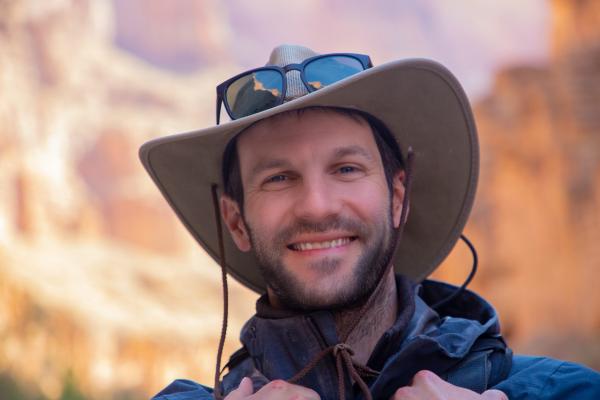

Zircon (U-Th)/He (ZHe) thermochronology has been extensively used to study the timing and rates of cooling associated with rock exhumation in active orogenic belts, sedimentary basin evolution, and hydrothermal fluid migration. More recently, the ZHe thermochronometer has been used, at times in concert with other low- to medium-temperature systems, in Precambrian rocks to resolve “deep-time” thermal histories that span billions of years and provide insights into mid- to upper-crustal geological processes occurring at temperatures below 350 °C. Most prominently, this deep-time approach has been used to investigate the erosional origin of the Great Unconformity surface, a continent-scale nonconformity that separates lowermost Paleozoic strata from underlying Precambrian basement. However, to continue extracting useful deep-time thermochronologic information with the ZHe method requires a more robust understanding of the kinetics of 4He diffusion in zircon. In this talk, I will present results from a study of the deep-time thermal history of basement rocks in the US Upper Midwest cratonic interior. Here, we have further investigated the origin of the Great Unconformity surface, and the long-term (in)stability of the Laurentian craton. I will also show ongoing work to improve our understanding of the kinetics of the ZHe system with a multiple pathway approach to modeling 4He diffusion in zircon.

Explore Similar Events
-
Loading Similar Events...
