Presented By: Michigan Robotics
Toward Improved Neuroprosthetic Control of Multiple Degrees of Freedom for Fingers and Wrist via Implanted Neural Interfaces
Robotics PhD Defense, Dylan Wallace

Committee Chair: Cynthia Chestek
Abstract:
Modern prosthetic and robotic hands offer significant opportunities to restore limb function for individuals with limb loss or impairment. However, the current standard of control for many of these devices does not provide sufficiently rich control signals to match the number of movements these hands can perform. Implanted neural interfaces offer a promising approach to obtain control signals with substantially higher spatial and temporal resolution than noninvasive technologies. These interfaces have the potential to improve control of multiple degrees of freedom in the fingers and hand, and to incorporate additional degrees of freedom such as the wrist. This dissertation investigates how implanted neural interfaces can be used to improve control of multiple degrees of freedom in the hand and wrist.
First, we examine an augmentation to an intracortical brain–machine interface decoder designed to reduce errors during control of multiple finger groups. Two non-human primates were implanted with intracortical microelectrode arrays in the hand-knob area of primary motor cortex and trained to control a virtual hand using intracortical neural signals. Neural activity from the arrays was associated with finger kinematics to create a decoder controlling the index and middle-ring-small finger groups. Movement errors were classified using the same intracortical data and incorporated into a subsequent closed-loop control session to detect and correct errors in real time. Incorporating error correction resulted in a significantly lower orbiting time around targets, with an average reduction of 26%. This reduction represents an important improvement in control and may provide even greater benefit in human users, where control errors occur more frequently.
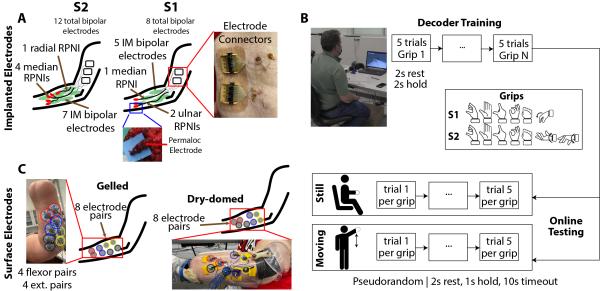
Next, we investigate a peripheral nervous system interface technology rather than intracortical signals. Regenerative Peripheral Nerve Interfaces (RPNIs) provide a rich source of peripheral nerve control signals for individuals with limb loss by amplifying efferent nerve activity for muscles lost with the limb. Two participants with upper limb loss between the elbow and wrist received RPNIs and implanted electrodes in both the RPNIs and residually innervated muscles. Classifiers were trained to decode implanted neural signals into discrete finger and wrist movements, and performance was compared to classifiers trained using surface electrodes. Implanted electrodes provided an average improvement in classification accuracy of over 38% during arm movement. This improvement translated to a reduction in task completion time of over 27% in one participant during an activity of daily living performed using the implanted classifier compared to the surface-based classifier.
Finally, we evaluated continuous control of the hand and wrist in the same two participants. Participants controlled a virtual hand using a reduced set of hand and wrist rotation targets. Implanted electrodes provided high-correlation control signals for both hand and wrist and outperformed surface electrodes in closed-loop control. In one participant, implanted and surface decoders were trained and tested in both sitting and arm-out-front postures. Surface decoders tested in a posture different from training exhibited an increase in trial time compared to implanted decoders in a different posture, along with a reduction in success rate between surface and implanted decoders.
Together, these results demonstrate that implanted neural interfaces enable more precise and accurate control of finger and wrist movements. Future work will focus on further improving control through advanced machine learning methods, improved training data labeling, and translation to fully implantable systems suitable for use outside the laboratory.
In-person and on Zoom (Passcode: 680207)
Abstract:
Modern prosthetic and robotic hands offer significant opportunities to restore limb function for individuals with limb loss or impairment. However, the current standard of control for many of these devices does not provide sufficiently rich control signals to match the number of movements these hands can perform. Implanted neural interfaces offer a promising approach to obtain control signals with substantially higher spatial and temporal resolution than noninvasive technologies. These interfaces have the potential to improve control of multiple degrees of freedom in the fingers and hand, and to incorporate additional degrees of freedom such as the wrist. This dissertation investigates how implanted neural interfaces can be used to improve control of multiple degrees of freedom in the hand and wrist.
First, we examine an augmentation to an intracortical brain–machine interface decoder designed to reduce errors during control of multiple finger groups. Two non-human primates were implanted with intracortical microelectrode arrays in the hand-knob area of primary motor cortex and trained to control a virtual hand using intracortical neural signals. Neural activity from the arrays was associated with finger kinematics to create a decoder controlling the index and middle-ring-small finger groups. Movement errors were classified using the same intracortical data and incorporated into a subsequent closed-loop control session to detect and correct errors in real time. Incorporating error correction resulted in a significantly lower orbiting time around targets, with an average reduction of 26%. This reduction represents an important improvement in control and may provide even greater benefit in human users, where control errors occur more frequently.
Next, we investigate a peripheral nervous system interface technology rather than intracortical signals. Regenerative Peripheral Nerve Interfaces (RPNIs) provide a rich source of peripheral nerve control signals for individuals with limb loss by amplifying efferent nerve activity for muscles lost with the limb. Two participants with upper limb loss between the elbow and wrist received RPNIs and implanted electrodes in both the RPNIs and residually innervated muscles. Classifiers were trained to decode implanted neural signals into discrete finger and wrist movements, and performance was compared to classifiers trained using surface electrodes. Implanted electrodes provided an average improvement in classification accuracy of over 38% during arm movement. This improvement translated to a reduction in task completion time of over 27% in one participant during an activity of daily living performed using the implanted classifier compared to the surface-based classifier.
Finally, we evaluated continuous control of the hand and wrist in the same two participants. Participants controlled a virtual hand using a reduced set of hand and wrist rotation targets. Implanted electrodes provided high-correlation control signals for both hand and wrist and outperformed surface electrodes in closed-loop control. In one participant, implanted and surface decoders were trained and tested in both sitting and arm-out-front postures. Surface decoders tested in a posture different from training exhibited an increase in trial time compared to implanted decoders in a different posture, along with a reduction in success rate between surface and implanted decoders.
Together, these results demonstrate that implanted neural interfaces enable more precise and accurate control of finger and wrist movements. Future work will focus on further improving control through advanced machine learning methods, improved training data labeling, and translation to fully implantable systems suitable for use outside the laboratory.
In-person and on Zoom (Passcode: 680207)
Related Links

Explore Similar Events
-
Loading Similar Events...
