Presented By: Center for Armenian Studies
CAS Workshop. Photographic Genres, in and Beyond Archives
Organizer: Hazal Özdemir (Manoogian Postdoctoral Fellow in Armenian History, U-M)
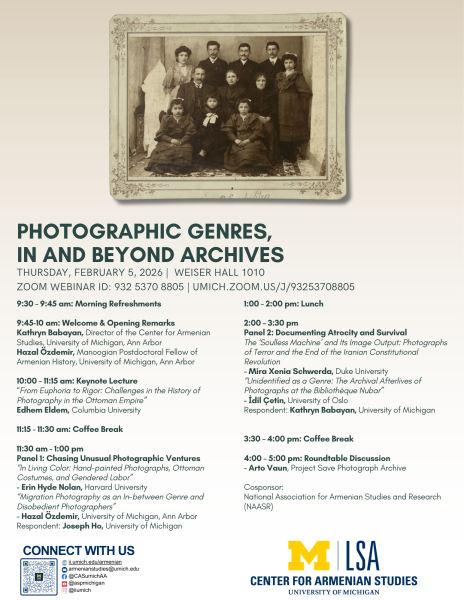

This workshop explores the multiple deployments of photography in the early twentieth-century global Middle East. The goal is to understand how visual practices intersect with power, communication, and documentation. Collectively, participants ask how photography became a tool for denaturalization and the persecution of undesirable and marginalized subjects in imperial settings, such as minorities, revolutionaries, and convicts in the Ottoman and Qajar empires. How did state This workshop explores the multiple deployments of photography in the early twentieth-century global Middle East. We will discuss how visual practices intersect with power, communication, and documentation. Collectively, participants ask how photography became a tool for denaturalization and the persecution of undesirable and marginalized subjects, whether minorities, revolutionaries, and convicts in the Ottoman and Qajar empires. How did state surveillance of mobility produce knowledge about imperial subjects?
Participants will examine a diverse range of photographic genres, from family records to convict photographs, and studio portraits to complicate photography’s role in regulating class and gender dynamics as well as criminality across the region.
Questions of ownership and the ethical status of imperial archives that preserve photographs of marginalized or indigenous communities are critical to our discussions of power. How can we responsibly reconstruct the pasts of marginalized, displaced, and persecuted individuals by the Ottoman or Qajar state using photographs taken by the very same state? In what ways did photographs serve as instruments of state bureaucracy and as a form of resistance to it? In other words, how do blurred boundaries between photographic genres offer subjects opportunities to assert their identity and recreate personal or collective memories?
Workshop Program
9:30 - 9:45 am: Morning Refreshments
9:45-10 am: Welcome & Opening Remarks
Kathryn Babayan, Director of the Center for Armenian Studies, University of Michigan, Ann Arbor
Hazal Özdemir, Manoogian Postdoctoral Fellow of Armenian History, University of Michigan, Ann Arbor
10:00 – 11:15 am: Keynote Lecture
“From Euphoria to Rigor: Challenges in the History of Photography in the Ottoman Empire”
Edhem Eldem, Columbia University
11:15 - 11:30 am: Coffee Break
11:30 am - 1:00 pm: Panel 1: Chasing Unusual Photographic Ventures
“In Living Color: Hand-painted Photographs, Ottoman Costumes, and Gendered Labor”
- Erin Hyde Nolan, Harvard University
“Migration Photography as an In-between Genre and Disobedient Photographers”
- Hazal Özdemir, University of Michigan, Ann Arbor
Respondent: Joseph Ho, University of Michigan
1:00 - 2:00 pm: Lunch
2:00 – 3:30 pm: Panel 2: Documenting Atrocity and Survival
The ‘Soulless Machine’ and Its Image Output: Photographs of Terror and the End of the Iranian Constitutional Revolution
- Mira Xenia Schwerda, Duke University
“Unidentified as a Genre: The Archival Afterlives of Photographs at the Bibliothèque Nubar”
- İdil Çetin, University of Oslo
Respondent: Kathryn Babayan, University of Michigan
3:30 – 4:00 pm: Coffee Break
4:00 – 5:00 pm: Roundtable Discussion
- Arto Vaun, Project Save Photograph Archive
Cosponsor:
National Association for Armenian Studies and Research (NAASR)
Online Access:
Webinar ID: 932 5370 8805
https://umich.zoom.us/j/93253708805
*Accommodation: If there is anything we can do to make this event accessible to you, please contact us. Please be aware that advance notice is necessary as some accommodations may require more time for the university to arrange. Email: -- [email protected]
Participants will examine a diverse range of photographic genres, from family records to convict photographs, and studio portraits to complicate photography’s role in regulating class and gender dynamics as well as criminality across the region.
Questions of ownership and the ethical status of imperial archives that preserve photographs of marginalized or indigenous communities are critical to our discussions of power. How can we responsibly reconstruct the pasts of marginalized, displaced, and persecuted individuals by the Ottoman or Qajar state using photographs taken by the very same state? In what ways did photographs serve as instruments of state bureaucracy and as a form of resistance to it? In other words, how do blurred boundaries between photographic genres offer subjects opportunities to assert their identity and recreate personal or collective memories?
Workshop Program
9:30 - 9:45 am: Morning Refreshments
9:45-10 am: Welcome & Opening Remarks
Kathryn Babayan, Director of the Center for Armenian Studies, University of Michigan, Ann Arbor
Hazal Özdemir, Manoogian Postdoctoral Fellow of Armenian History, University of Michigan, Ann Arbor
10:00 – 11:15 am: Keynote Lecture
“From Euphoria to Rigor: Challenges in the History of Photography in the Ottoman Empire”
Edhem Eldem, Columbia University
11:15 - 11:30 am: Coffee Break
11:30 am - 1:00 pm: Panel 1: Chasing Unusual Photographic Ventures
“In Living Color: Hand-painted Photographs, Ottoman Costumes, and Gendered Labor”
- Erin Hyde Nolan, Harvard University
“Migration Photography as an In-between Genre and Disobedient Photographers”
- Hazal Özdemir, University of Michigan, Ann Arbor
Respondent: Joseph Ho, University of Michigan
1:00 - 2:00 pm: Lunch
2:00 – 3:30 pm: Panel 2: Documenting Atrocity and Survival
The ‘Soulless Machine’ and Its Image Output: Photographs of Terror and the End of the Iranian Constitutional Revolution
- Mira Xenia Schwerda, Duke University
“Unidentified as a Genre: The Archival Afterlives of Photographs at the Bibliothèque Nubar”
- İdil Çetin, University of Oslo
Respondent: Kathryn Babayan, University of Michigan
3:30 – 4:00 pm: Coffee Break
4:00 – 5:00 pm: Roundtable Discussion
- Arto Vaun, Project Save Photograph Archive
Cosponsor:
National Association for Armenian Studies and Research (NAASR)
Online Access:
Webinar ID: 932 5370 8805
https://umich.zoom.us/j/93253708805
*Accommodation: If there is anything we can do to make this event accessible to you, please contact us. Please be aware that advance notice is necessary as some accommodations may require more time for the university to arrange. Email: -- [email protected]

Explore Similar Events
-
Loading Similar Events...
