Presented By: Center for Armenian Studies
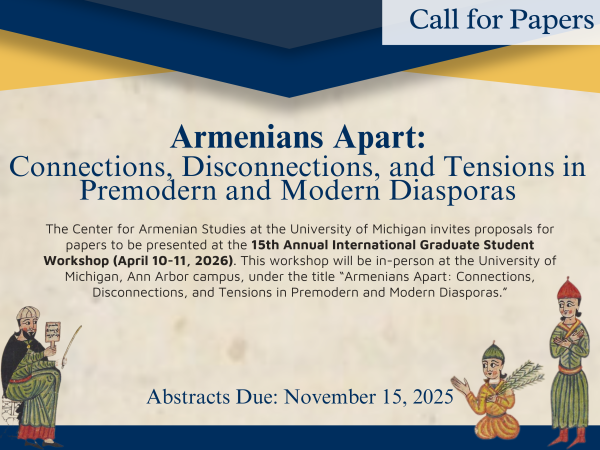
15th Annual International Graduate Student Workshop in Armenian Studies. Armenians Apart: Connections, Disconnections, and Tensions in Premodern and Modern Diasporas
Organized by: Armen Abkarian (U-M) and Michael Pifer (U-M)

Center for Armenian Studies, University of Michigan
April 10-11, 2026
Webinar ID
969 6198 7579
https://umich.zoom.us/j/96961987579
Diaspora studies tend to emphasize a set of loosely shared commonalities across space and time. This international graduate student workshop leans the other direction, and instead asks: what can aspects of life that are not easily shared across a broader space teach us about the formation and maintenance of “diasporas,” premodern or modern?
Collectively, this workshop seeks to explore tensions and overlooked connections across the Armenian diaspora, as well as to envision fresh possibilities for writing local history against a broader geographic, cultural, or historical backdrop. How might medieval and modern diasporic peoples envision belonging (or not belonging) to something larger from the vantage point of local history? How does being local shape conceptions of other peoples, including one’s own people, in other places? What overlooked networks of connection also run through diasporas, linking Armenians to something else, such as other peoples, empires, trade routes, linguistic communities, or cross-cultural forms of art?
In short: what might being apart, in whatever sense, do? And where does apartness end, and togetherness begin again?
In asking these questions, Armenians Apart seeks to consider the linkages, possibilities, and drawbacks in thinking about “diaspora” as a cohort, bringing the modern globe and the premodern world, defined by connections that do not always translate to our contemporary moment, into productive dialogue. Although this conference is centered in Armenian Studies, it draws together cognate fields and case studies, particularly those that raise fresh questions or propose theoretical interventions that resonate with the themes of the workshop.
DAY ONE:
Weiser Hall 555
8:20: INTRODUCTIONS and Welcome: Kathryn Babayan, Armen Abkarian, Michael Pifer
8:30-10:00: Panel 1: Misaligned Diasporas & Uneven Categories of Belonging
∙ Arakel Minassian: Uneven Histories: Zaven Biberian at the Center of 20th Century Armenian Literary History
∙ Lusine Tanajyan: Fragility of Armenian Belonging in Encounters between “Old” and “New” Diasporas: The Case of Armenians of Greece
∙ Haley Zovickian: ‘We're Not Like Them’: Race, Ottoman Legacies, and Armenian Americans
Chair and Respondent: Anoush Suni, University of Michigan
10:00-10:10: Break
10:10-11:45: KEYNOTE: Professor Devi Mays: “Diasporization and the Shaping of the Modern Sephardi World”
Abstract: Diaspora is, in the formulation of historian Matthias Lehmann, “something that happens rather than something that is.” This talk explores the ways in which Ottoman and post-Ottoman Sephardi Jewish migrants maintained a transnational diaspora through networks of exchange, communication, and movement, even in the face of increasingly restrictive migration and documentary regimes in the wake of World War I. By paying attention to the level of individuals-- who married whom, conducted business with whom, contracted business with, and sued whom-- I explore how Sephardi Jews operated within a series of overlapping diasporas that intersected at key moments with others of Ottoman or Jewish backgrounds and diverged at others. These migrants often drew on similar tactics to sustain diasporic networks-- hypermobility, multilinguality, transnational connections, strong familial ties, patronage networks, and engagement with extralegal practices. This allows us to see in sharp relief the active forging of a twentieth-century Sephardi diaspora, similar in broad strokes to other Ottoman diasporic communities, but whose details emphasize the resourcefulness of migrants who quickly learned how their specificities of religion, language, or citizenship could become a pretext for inclusion or exclusion.
12:00-1:30: LUNCH
1:30-3:00: Panel 2: Boundaries of Rule, Script, and Desire: Reimagining the Premodern Armenian Diaspora
∙ Armen Abkarian: Between Knights and Nakharars: Armenian Kingship and Mobility in Medieval Cilicia
∙ Greta Gasparyan: Artistic Transformations and Diasporic Identity in the Manuscript Tradition of New Julfa
∙ Nicholas Crummey: “If Only he Wasn’t Armenian! Alas! Alas!”: Sexual Desire and Ethnic Difference in Two Eighteenth-Century Ottoman Homoerotic Poems
Chair and Respondent: Kathryn Babayan, University of Michigan
DAY TWO: Weiser Hall 1010
9:00 - 10:30: Panel 3: From Columns to Capital: Armenian Diaspora Formation through Newspapers, Moneylenders, and Migrant Labor, 19th-20th Centuries
∙ Kristina Baghdasaryan: Networks of Apartness: Tiflis Armenians and the Western Armenian Questions, 1905-1920s
∙ Alina Zaripova: Between Diaspora and Homeland: The Armenian (Trans)National Press at the End of the 19th Century (1880s-1900s)
∙ Başak Yağmur Karaca: Commercial Buildings as Sites of Armenian Mobility and Diaspora Formation in the Late Ottoman Istanbul
Chair and Respondent: Vahe Sahakyan, University of Michigan, Dearborn
10:30-10:40: BREAK
10:40- 12:10: Panel 4: Negotiating Displacement and Digital Memory: On Community Archives and Activism
∙ Gegham Mughnetsyan: Connections to the Soviet Union: Personal Histories of Armenian Displaced Persons of World War II
∙ Jonathan Hollis: Listening to Armenian Baku: History and Memory in Digital Diaspora
∙ Lance Levenson: “This is Our Shushi.” Jerusalem’s Armenian Youth Reimagining Diasporic Belonging in the “Cow’s Garden” Parking Lot
Chair and Respondent: Sossie Kasbarian, University of Chicago
LUNCH
1:30-2:30 Final Reflections with Prof. Khachig Tölölyan
Cosponsor: National Association for Armenian Studies and Research (NAASR)
*Accommodation: If there is anything we can do to make this event accessible to you, please contact us. Please be aware that advance notice is necessary as some accommodations may require more time for the university to arrange. Email: -- [email protected]
April 10-11, 2026
Webinar ID
969 6198 7579
https://umich.zoom.us/j/96961987579
Diaspora studies tend to emphasize a set of loosely shared commonalities across space and time. This international graduate student workshop leans the other direction, and instead asks: what can aspects of life that are not easily shared across a broader space teach us about the formation and maintenance of “diasporas,” premodern or modern?
Collectively, this workshop seeks to explore tensions and overlooked connections across the Armenian diaspora, as well as to envision fresh possibilities for writing local history against a broader geographic, cultural, or historical backdrop. How might medieval and modern diasporic peoples envision belonging (or not belonging) to something larger from the vantage point of local history? How does being local shape conceptions of other peoples, including one’s own people, in other places? What overlooked networks of connection also run through diasporas, linking Armenians to something else, such as other peoples, empires, trade routes, linguistic communities, or cross-cultural forms of art?
In short: what might being apart, in whatever sense, do? And where does apartness end, and togetherness begin again?
In asking these questions, Armenians Apart seeks to consider the linkages, possibilities, and drawbacks in thinking about “diaspora” as a cohort, bringing the modern globe and the premodern world, defined by connections that do not always translate to our contemporary moment, into productive dialogue. Although this conference is centered in Armenian Studies, it draws together cognate fields and case studies, particularly those that raise fresh questions or propose theoretical interventions that resonate with the themes of the workshop.
DAY ONE:
Weiser Hall 555
8:20: INTRODUCTIONS and Welcome: Kathryn Babayan, Armen Abkarian, Michael Pifer
8:30-10:00: Panel 1: Misaligned Diasporas & Uneven Categories of Belonging
∙ Arakel Minassian: Uneven Histories: Zaven Biberian at the Center of 20th Century Armenian Literary History
∙ Lusine Tanajyan: Fragility of Armenian Belonging in Encounters between “Old” and “New” Diasporas: The Case of Armenians of Greece
∙ Haley Zovickian: ‘We're Not Like Them’: Race, Ottoman Legacies, and Armenian Americans
Chair and Respondent: Anoush Suni, University of Michigan
10:00-10:10: Break
10:10-11:45: KEYNOTE: Professor Devi Mays: “Diasporization and the Shaping of the Modern Sephardi World”
Abstract: Diaspora is, in the formulation of historian Matthias Lehmann, “something that happens rather than something that is.” This talk explores the ways in which Ottoman and post-Ottoman Sephardi Jewish migrants maintained a transnational diaspora through networks of exchange, communication, and movement, even in the face of increasingly restrictive migration and documentary regimes in the wake of World War I. By paying attention to the level of individuals-- who married whom, conducted business with whom, contracted business with, and sued whom-- I explore how Sephardi Jews operated within a series of overlapping diasporas that intersected at key moments with others of Ottoman or Jewish backgrounds and diverged at others. These migrants often drew on similar tactics to sustain diasporic networks-- hypermobility, multilinguality, transnational connections, strong familial ties, patronage networks, and engagement with extralegal practices. This allows us to see in sharp relief the active forging of a twentieth-century Sephardi diaspora, similar in broad strokes to other Ottoman diasporic communities, but whose details emphasize the resourcefulness of migrants who quickly learned how their specificities of religion, language, or citizenship could become a pretext for inclusion or exclusion.
12:00-1:30: LUNCH
1:30-3:00: Panel 2: Boundaries of Rule, Script, and Desire: Reimagining the Premodern Armenian Diaspora
∙ Armen Abkarian: Between Knights and Nakharars: Armenian Kingship and Mobility in Medieval Cilicia
∙ Greta Gasparyan: Artistic Transformations and Diasporic Identity in the Manuscript Tradition of New Julfa
∙ Nicholas Crummey: “If Only he Wasn’t Armenian! Alas! Alas!”: Sexual Desire and Ethnic Difference in Two Eighteenth-Century Ottoman Homoerotic Poems
Chair and Respondent: Kathryn Babayan, University of Michigan
DAY TWO: Weiser Hall 1010
9:00 - 10:30: Panel 3: From Columns to Capital: Armenian Diaspora Formation through Newspapers, Moneylenders, and Migrant Labor, 19th-20th Centuries
∙ Kristina Baghdasaryan: Networks of Apartness: Tiflis Armenians and the Western Armenian Questions, 1905-1920s
∙ Alina Zaripova: Between Diaspora and Homeland: The Armenian (Trans)National Press at the End of the 19th Century (1880s-1900s)
∙ Başak Yağmur Karaca: Commercial Buildings as Sites of Armenian Mobility and Diaspora Formation in the Late Ottoman Istanbul
Chair and Respondent: Vahe Sahakyan, University of Michigan, Dearborn
10:30-10:40: BREAK
10:40- 12:10: Panel 4: Negotiating Displacement and Digital Memory: On Community Archives and Activism
∙ Gegham Mughnetsyan: Connections to the Soviet Union: Personal Histories of Armenian Displaced Persons of World War II
∙ Jonathan Hollis: Listening to Armenian Baku: History and Memory in Digital Diaspora
∙ Lance Levenson: “This is Our Shushi.” Jerusalem’s Armenian Youth Reimagining Diasporic Belonging in the “Cow’s Garden” Parking Lot
Chair and Respondent: Sossie Kasbarian, University of Chicago
LUNCH
1:30-2:30 Final Reflections with Prof. Khachig Tölölyan
Cosponsor: National Association for Armenian Studies and Research (NAASR)
*Accommodation: If there is anything we can do to make this event accessible to you, please contact us. Please be aware that advance notice is necessary as some accommodations may require more time for the university to arrange. Email: -- [email protected]
Related Links
Co-Sponsored By

Explore Similar Events
-
Loading Similar Events...
