Presented By: Center for Emerging Democracies
Folk Democracy in Postwar Czechoslovakia
Mira Markham, University of Michigan
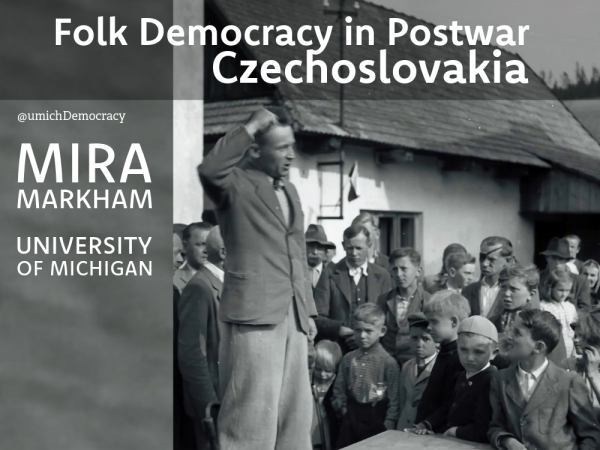
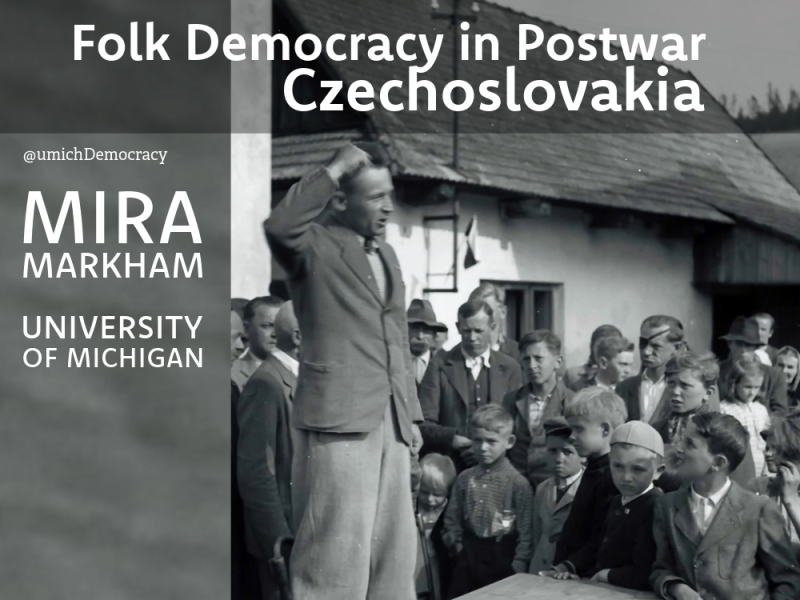
During the Second World War, Czechoslovakia’s political leaders rejected the liberal democratic system of the interwar period and sought to renew their state’s independence on a new basis of national unity, social equality, and political participation. Upon liberation in 1945, members of the antifascist resistance worked at the local level to reestablish national sovereignty and lay the foundations of this new order — lidová demokracie, which might be translated as “folk democracy” rather than the traditional “people’s democracy.” Like folk songs or folk art, folk democracy was understood to represent the creative efforts of the common people, unmediated by party elites or state institutions. In the remote, rural region of Moravian Wallachia, a stronghold of the Czech partisan movement under Nazi occupation, folk democracy promised both material benefits and symbolic recognition. Local Communists appealed to this vision first to win support among Wallachians and then to consolidate one-party rule after their leaders’ seizure of power in February 1948. Thereafter, however, the legacy of folk democracy both inspired resistance and impeded Communist attempts to reorder local society along ideological lines.
Attend in person or via Zoom. Zoom registration at https://myumi.ch/XypxJ
If there is anything we can do to make this event accessible to you, please contact us at [email protected]. Please be aware that advance notice is necessary as some accommodations may require more time for the university to arrange.
Attend in person or via Zoom. Zoom registration at https://myumi.ch/XypxJ
If there is anything we can do to make this event accessible to you, please contact us at [email protected]. Please be aware that advance notice is necessary as some accommodations may require more time for the university to arrange.

Explore Similar Events
-
Loading Similar Events...
