Presented By: Department of Molecular, Cellular, and Developmental Biology
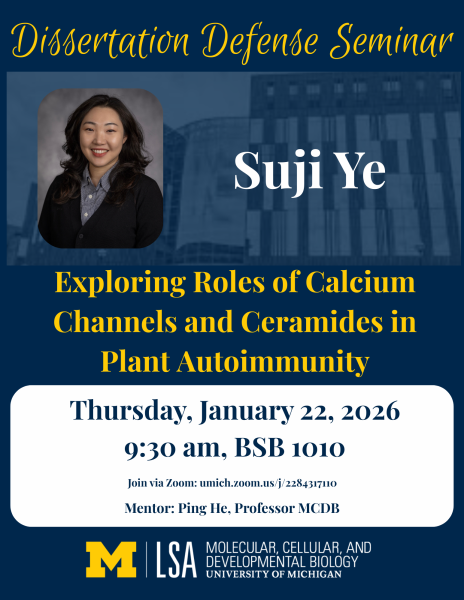
Dissertation Defense Seminar: Suji Ye
Exploring Roles of Calcium Channels and Ceramides in Plant Autoimmunity

Plants rely on a two-tiered immune system, consisting of pattern-triggered immunity (PTI initiated by cell-surface pattern recognition receptors (PRRs) and effector-triggered immunity (ETI) activated by intracellular NOD-like (NLR) immune receptors. These two types of immunity are essential for protecting plants from pathogen invasion balancing growth and defense to maintain immune homeostasis.
Calcium (Ca2• ) is a secondary messenger that plays an essential role in plant immunity by transmitting immune signals from PRR and NLR receptors to downstream immune response upon pathogen perception and regulating processes such as transcriptional reprogramming, reactive oxygen species production, and kinase activation. However, imbalanced Ca2 signaling can induce autoimmunity, causing cell death in plants.
We are interested in how Ca2• signaling is integrated into a regulatory network that maintains immune homeostasis. In this thesis, I characterized three closely related cyclic nucleotide-gated ion channels (CNGCs) acting as Ca2 channels to suppress plant autoimmunity and regulate reproductive development. In Arabidopsis thaliana, 20 CNGCs are classified into five groups (I, II, III, IVa, and IVb) based on sequence homology. Structurally, Arabidopsis CNGCs contain six transmembrane domains, a P-loop domain for ion selection, a cyclic nucleotide-binding domain (CNBD), and a calmodulin-binding domain (CaMBD) for channel activity regulation. Our lab previously demonstrated that activation of CNGC19 and CNGC20, upon phosphorylation by the receptor kinase BAK-to-life 2 (BTL2), induces massive intracellular Ca2• influx, leading to autoimmunity, due to perturbation of the shared PRR-coreceptors BAK1/SERK4. In addition, the chimeric CNGC11 and CNGC12, which likely form an active calcium channel, also cause autoimmunity. I systematically characterized CNGC11, CNGC12, and their closest homolog CNGC3 by generating single, double, and triple mutants with CRISPR-Cas gene editing. Importantly, neither CNGC3, 11, nor 12 single or double mutants altered plant growth and immune responses. However, the cngc3/11/12 triple mutants exhibited growth defects with varying levels of cell death. In addition, the cngc3 single mutants showed infertility, with shorter siliques and fewer seeds, despite normal stamen and pistil structures. Using an Agrobacterium-mediated VIGS (virus-induced gene silencing) approach, I show that the EDS1(ENHANCED DISEASE SUSCEPTIBILITY 1)-PAD4 (PHYTOALEXIN DEFICIENT 4)-ADR1s (ACTIVATED DISEASE RESISTANCE 1) module, which plays a central role in toll/interleukin-1 receptor NLR (TNL)-mediated immunity, is essential for the RNAi-CNGC3/11/12-induced cell death. RNA-sequencing analysis further suggests the involvement of additional Ca2 channels, pumps, and TIR-domain-containing proteins in cngc3/11/12 cell death. These results suggest that the depletion of CNGC3, 11, and 12 activates additional Ca2+ channels, which further activate the TIR-EDS1-PAD4-ADR1s module to induce cell death.
Ceramides are a class of sphingolipids known to induce programmed cell death in plants and animals with unclear mechanisms. Mutation of ceramide kinase ACD5, which results in the accumulation of high levels of ceramides, induces spontaneous cell death in plants. Using VIGS, I found that RNAi-ACD5-induced cell death depends on the NLR SUMM2 and other components of the SUMM2 signaling pathway. In addition, ceramide levels are elevated in autoimmune mutants when SUMM2 is activated. Furthermore, ceramides activate the phosphatase activity of Protein Phosphatase 5 (PP5) and promote PP5 interaction with the co-chaperone protein HOP1, which are essential for SUMM2 activation. Collectively, our findings reveal a mechanism by which ceramides promote cell death in plants through activation of a phosphatase that subsequently activates NLR immune receptors.
In summary, our studies underscore the importance of maintaining balanced Ca2+ signaling and ceramide levels for immune homeostasis in plants.
Calcium (Ca2• ) is a secondary messenger that plays an essential role in plant immunity by transmitting immune signals from PRR and NLR receptors to downstream immune response upon pathogen perception and regulating processes such as transcriptional reprogramming, reactive oxygen species production, and kinase activation. However, imbalanced Ca2 signaling can induce autoimmunity, causing cell death in plants.
We are interested in how Ca2• signaling is integrated into a regulatory network that maintains immune homeostasis. In this thesis, I characterized three closely related cyclic nucleotide-gated ion channels (CNGCs) acting as Ca2 channels to suppress plant autoimmunity and regulate reproductive development. In Arabidopsis thaliana, 20 CNGCs are classified into five groups (I, II, III, IVa, and IVb) based on sequence homology. Structurally, Arabidopsis CNGCs contain six transmembrane domains, a P-loop domain for ion selection, a cyclic nucleotide-binding domain (CNBD), and a calmodulin-binding domain (CaMBD) for channel activity regulation. Our lab previously demonstrated that activation of CNGC19 and CNGC20, upon phosphorylation by the receptor kinase BAK-to-life 2 (BTL2), induces massive intracellular Ca2• influx, leading to autoimmunity, due to perturbation of the shared PRR-coreceptors BAK1/SERK4. In addition, the chimeric CNGC11 and CNGC12, which likely form an active calcium channel, also cause autoimmunity. I systematically characterized CNGC11, CNGC12, and their closest homolog CNGC3 by generating single, double, and triple mutants with CRISPR-Cas gene editing. Importantly, neither CNGC3, 11, nor 12 single or double mutants altered plant growth and immune responses. However, the cngc3/11/12 triple mutants exhibited growth defects with varying levels of cell death. In addition, the cngc3 single mutants showed infertility, with shorter siliques and fewer seeds, despite normal stamen and pistil structures. Using an Agrobacterium-mediated VIGS (virus-induced gene silencing) approach, I show that the EDS1(ENHANCED DISEASE SUSCEPTIBILITY 1)-PAD4 (PHYTOALEXIN DEFICIENT 4)-ADR1s (ACTIVATED DISEASE RESISTANCE 1) module, which plays a central role in toll/interleukin-1 receptor NLR (TNL)-mediated immunity, is essential for the RNAi-CNGC3/11/12-induced cell death. RNA-sequencing analysis further suggests the involvement of additional Ca2 channels, pumps, and TIR-domain-containing proteins in cngc3/11/12 cell death. These results suggest that the depletion of CNGC3, 11, and 12 activates additional Ca2+ channels, which further activate the TIR-EDS1-PAD4-ADR1s module to induce cell death.
Ceramides are a class of sphingolipids known to induce programmed cell death in plants and animals with unclear mechanisms. Mutation of ceramide kinase ACD5, which results in the accumulation of high levels of ceramides, induces spontaneous cell death in plants. Using VIGS, I found that RNAi-ACD5-induced cell death depends on the NLR SUMM2 and other components of the SUMM2 signaling pathway. In addition, ceramide levels are elevated in autoimmune mutants when SUMM2 is activated. Furthermore, ceramides activate the phosphatase activity of Protein Phosphatase 5 (PP5) and promote PP5 interaction with the co-chaperone protein HOP1, which are essential for SUMM2 activation. Collectively, our findings reveal a mechanism by which ceramides promote cell death in plants through activation of a phosphatase that subsequently activates NLR immune receptors.
In summary, our studies underscore the importance of maintaining balanced Ca2+ signaling and ceramide levels for immune homeostasis in plants.
Related Links

Explore Similar Events
-
Loading Similar Events...
