Presented By: African Studies Center
ASC Event. Big Text Analysis in IsiXhosa: Religion, Politics, and Nationhood in the IsiXhosa Press, 1870-1890
Jonathan Schoots, University of Witwatersrand, South Africa
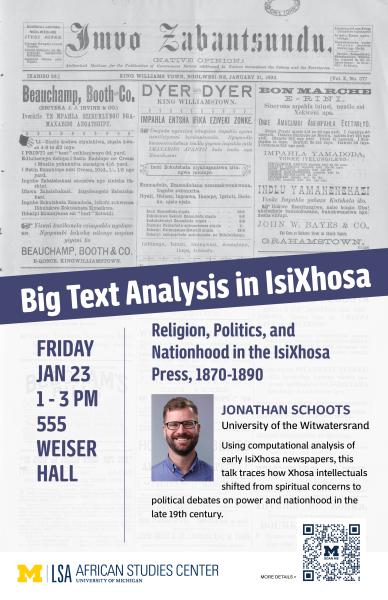

This talk explores how African language digital archives and new methods of computational text analysis can bring fresh insights for reconstructing African intellectual lineages and tracing historical developments.
The talk details the creation of a digital archive of the earliest African language newspapers in South Africa and shows how Xhosa language computational text analysis can be used to bring a ‘distant reading’ to this archive. Where much previous work has focused on individual African thinkers, this approach allows us to see a collective intellectual community co-creating foundational ideas that grounded new intellectual and political responses to colonialism. I demonstrate this by examining changing discourse among early Xhosa intellectuals, journalists, and political activists writing in these papers. I examine how early discourse from missionary-educated Xhosa communities shifted from a focus on spiritual concerns to political engagement, revealing a surprisingly early reorientation from ‘other worldly’ to ‘worldly’ concerns and sources of power. I also examine how competing conceptions of nationhood emerged in the Xhosa language, and trace how these conceptions rose and fell in these early years.
Jonathan Schoots is a historical and political sociologist specializing in the study of colonialism and empire, political movements, and knowledge production, with a particular focus on South Africa. His research employs both qualitative and computational methods to explore conditions that facilitate the emergence of new political frameworks. His work has focused on the intellectuals, organizations, and newspapers that played a pivotal role in shaping political thought and practice during the emergence of African nationalism in South Africa.
Schoots is a lecturer (assistant professor) in the Department of Sociology at Wits University. He has published work in theory and society, poetics, development in practice and other venues. He received his Ph.D. from the University of Chicago (2021).
The talk details the creation of a digital archive of the earliest African language newspapers in South Africa and shows how Xhosa language computational text analysis can be used to bring a ‘distant reading’ to this archive. Where much previous work has focused on individual African thinkers, this approach allows us to see a collective intellectual community co-creating foundational ideas that grounded new intellectual and political responses to colonialism. I demonstrate this by examining changing discourse among early Xhosa intellectuals, journalists, and political activists writing in these papers. I examine how early discourse from missionary-educated Xhosa communities shifted from a focus on spiritual concerns to political engagement, revealing a surprisingly early reorientation from ‘other worldly’ to ‘worldly’ concerns and sources of power. I also examine how competing conceptions of nationhood emerged in the Xhosa language, and trace how these conceptions rose and fell in these early years.
Jonathan Schoots is a historical and political sociologist specializing in the study of colonialism and empire, political movements, and knowledge production, with a particular focus on South Africa. His research employs both qualitative and computational methods to explore conditions that facilitate the emergence of new political frameworks. His work has focused on the intellectuals, organizations, and newspapers that played a pivotal role in shaping political thought and practice during the emergence of African nationalism in South Africa.
Schoots is a lecturer (assistant professor) in the Department of Sociology at Wits University. He has published work in theory and society, poetics, development in practice and other venues. He received his Ph.D. from the University of Chicago (2021).
Related Links
Co-Sponsored By

Explore Similar Events
-
Loading Similar Events...
