Presented By: Earth and Environmental Sciences
Lucas Gomes Dissertation Defense
Extinction and Environmental Change on the Plio-Pleistocene Florida Platform: Insights from Clumped Isotopic and Trace Elemental Sclerochronology
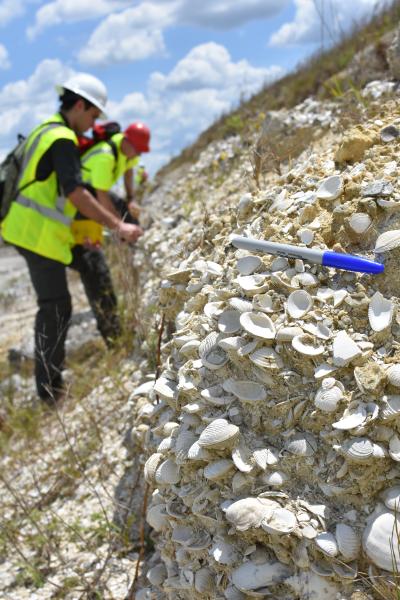

Past extinction events throughout Earth’s history have arisen during periods of major environmental change, offering unique lessons about how ecosystems function and respond to environmental pressures. By studying the environmental mechanisms that forced extinction and ecological change in the geologic record, we can better prepare for and mitigate biodiversity loss in the face of present-day global environmental crises. Shallow marine ecosystems on the Florida Platform underwent a dramatic transformation over the past ~4 million years, part of a “regional mass extinction” documented broadly around the Plio-Pleistocene West Atlantic. In this dissertation, I resolve major gaps in the marine environmental record of the Plio-Pleistocene Florida Platform using stratigraphic, paleontological, and geochemical approaches, enabling clearer evaluation of the environmental perturbations responsible for this regional extinction event.
The oxygen isotope composition of water (δ18Owater) is a useful tracer of the hydrological cycle and a critical parameter in carbonate-based (δ18Ocarb) paleotemperature studies. In Chapter 2, I examine the controls on coastal δ18Owater variability along the U.S. Eastern Seaboard by mapping salinity–δ18Owater mixing relationships in estuaries from Maine to Florida. Relatively invariant marine δ18Owater signatures primarily track the prevailing coastal water mass, while freshwater δ18Owater varies widely in response to regional gradients in precipitation (δ18Oprecip) signatures and evaporative intensity. Additional triple oxygen isotope (Δʹ17O) measurements of Florida river waters indicate a remarkable degree of evaporative isotope enrichment. This modern isotopic framework can be used to constrain assumptions about ancient δ18Owater compositions across this region and better interpret fossil δ18Ocarb records from coastal marine paleoenvironments.
In Chapters 3 and 4, I present two new study sites containing fossil-rich Plio-Pleistocene sedimentary exposures in southwest (Florida Shell Quarry) and eastern Florida (Beeline Quarry), respectively. Detailed lithostratigraphic and biostratigraphic characterization through each of these sections enable the detailed reconstruction of local depositional paleoenvironments and relative sea-level fluctuations. The development of these new sections and their careful integration within the historical Plio-Pleistocene stratigraphic framework of peninsular Florida establishes a foundation for renewed study of Florida’s paleoecological evolution over the past ~4 Myr. At Beeline Quarry (Chapter 4), I further apply clumped isotope (Δ47) thermometry to fossil shells to reconstruct water temperatures and δ18Owater compositions during deposition of the Nashua Fm. (Early Pleistocene) and Fort Thompson Fm. (Late Pleistocene). Surprisingly cool temperatures and depleted δ18Owater values in both units relative to modern coastal waters likely reflect persistent influence of submarine groundwater discharge along the Atlantic Coast of Florida.
In Chapter 5, I reconstruct parallel records of marine climates and planktonic productivity across the six major Plio-Pleistocene formations of southwest Florida and use them to evaluate longstanding hypotheses that the regional extinction event was driven by (i) cooling marine climates and/or (ii) declining primary production. Marine climate seasonality and planktonic productivity were quantified by measuring Δ47 and Ba/Ca ratios, respectively, along the growth axes of fossil mollusk shells. The Δ47-temperature record reveals that remarkably cool Pliocene marine climates (similar to present-day North Carolina) warmed rapidly in the Early Pleistocene, directly contradicting earlier cooling hypotheses and suggesting that rapid warming may have instead contributed to faunal turnover. Independently, the Ba/Ca-derived productivity record indicates that high productivity persisted until the Early–Middle Pleistocene, after which it collapsed, broadly supporting the productivity-driven extinction hypothesis. Altogether, this work greatly refines our understanding of the co-evolution of life and environments on the Plio-Pleistocene Florida Platform.
The oxygen isotope composition of water (δ18Owater) is a useful tracer of the hydrological cycle and a critical parameter in carbonate-based (δ18Ocarb) paleotemperature studies. In Chapter 2, I examine the controls on coastal δ18Owater variability along the U.S. Eastern Seaboard by mapping salinity–δ18Owater mixing relationships in estuaries from Maine to Florida. Relatively invariant marine δ18Owater signatures primarily track the prevailing coastal water mass, while freshwater δ18Owater varies widely in response to regional gradients in precipitation (δ18Oprecip) signatures and evaporative intensity. Additional triple oxygen isotope (Δʹ17O) measurements of Florida river waters indicate a remarkable degree of evaporative isotope enrichment. This modern isotopic framework can be used to constrain assumptions about ancient δ18Owater compositions across this region and better interpret fossil δ18Ocarb records from coastal marine paleoenvironments.
In Chapters 3 and 4, I present two new study sites containing fossil-rich Plio-Pleistocene sedimentary exposures in southwest (Florida Shell Quarry) and eastern Florida (Beeline Quarry), respectively. Detailed lithostratigraphic and biostratigraphic characterization through each of these sections enable the detailed reconstruction of local depositional paleoenvironments and relative sea-level fluctuations. The development of these new sections and their careful integration within the historical Plio-Pleistocene stratigraphic framework of peninsular Florida establishes a foundation for renewed study of Florida’s paleoecological evolution over the past ~4 Myr. At Beeline Quarry (Chapter 4), I further apply clumped isotope (Δ47) thermometry to fossil shells to reconstruct water temperatures and δ18Owater compositions during deposition of the Nashua Fm. (Early Pleistocene) and Fort Thompson Fm. (Late Pleistocene). Surprisingly cool temperatures and depleted δ18Owater values in both units relative to modern coastal waters likely reflect persistent influence of submarine groundwater discharge along the Atlantic Coast of Florida.
In Chapter 5, I reconstruct parallel records of marine climates and planktonic productivity across the six major Plio-Pleistocene formations of southwest Florida and use them to evaluate longstanding hypotheses that the regional extinction event was driven by (i) cooling marine climates and/or (ii) declining primary production. Marine climate seasonality and planktonic productivity were quantified by measuring Δ47 and Ba/Ca ratios, respectively, along the growth axes of fossil mollusk shells. The Δ47-temperature record reveals that remarkably cool Pliocene marine climates (similar to present-day North Carolina) warmed rapidly in the Early Pleistocene, directly contradicting earlier cooling hypotheses and suggesting that rapid warming may have instead contributed to faunal turnover. Independently, the Ba/Ca-derived productivity record indicates that high productivity persisted until the Early–Middle Pleistocene, after which it collapsed, broadly supporting the productivity-driven extinction hypothesis. Altogether, this work greatly refines our understanding of the co-evolution of life and environments on the Plio-Pleistocene Florida Platform.

Explore Similar Events
-
Loading Similar Events...
