Presented By: Ecology and Evolutionary Biology
EEB Thursday Seminar Series - Commonness, rarity, and biodiversity on Indo-Pacific coral reefs: Confronting ecological theory with data in species-rich systems
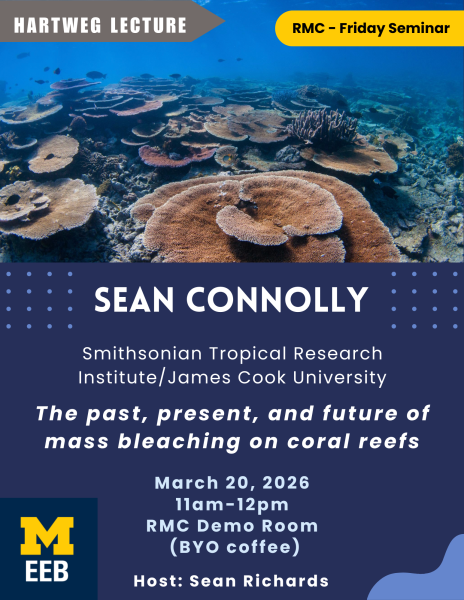
Sean Connolly, Smithsonian Tropical Research Institute/James Cook University

Seminar Summary - Ecologists have long sought to understand spatial and temporal patterns in abundance and biodiversity, but the classical approach to developing theory to explain such patterns cannot work in species-rich systems, due to the “curse of dimensionality” – a tendency for the parameters needed to draw inferences about a community to grow faster than the number of observations, as species richness increases.
In this talk, I will summarize one strand of my lab’s research program, which aims to explore potential solutions to the curse of dimensionality, test them with empirical data – mainly from coral reefs – and use them to unveil the factors that structure marine assemblages. I will begin by summarizing our earlier work developing a robust test of neutral theory of biodiversity, the most aggressively simplifying of biodiversity theories. I will then present work extending an alternative, intermediate-complexity mathematical theory that evaluates the dynamics of species’ relative abundances to quantify the relative importance of deterministic and stochastic processes that generate patterns in community structure; when applied to coral reef fishes on the Great Barrier Reef, that work reveals that reef fish communities are highly niche-structured, but that this niche structure is eroded by volatility in coral cover. Finally, I will present work relaxing the simplifying assumptions of the former theory, which uses dimension-reduction approaches to allow for considerable heterogeneity among species in both interaction strengths and responses to environmental fluctuations. When applied to reef fishes on the GBR, we find a classically Gleasonian community structure, where the dynamics of relative abundance are driven by conspecific density-dependence and “response diversity” – differential responses of species’ population dynamics to environmental fluctuations, but where between-species interactions have negligible impacts on community dynamics. I will conclude with some thoughts on where community ecology stands, in terms of its ability to rigorously confront theoretical models with empirical data to answer the fundamental questions that have long motivated research in this field.
In this talk, I will summarize one strand of my lab’s research program, which aims to explore potential solutions to the curse of dimensionality, test them with empirical data – mainly from coral reefs – and use them to unveil the factors that structure marine assemblages. I will begin by summarizing our earlier work developing a robust test of neutral theory of biodiversity, the most aggressively simplifying of biodiversity theories. I will then present work extending an alternative, intermediate-complexity mathematical theory that evaluates the dynamics of species’ relative abundances to quantify the relative importance of deterministic and stochastic processes that generate patterns in community structure; when applied to coral reef fishes on the Great Barrier Reef, that work reveals that reef fish communities are highly niche-structured, but that this niche structure is eroded by volatility in coral cover. Finally, I will present work relaxing the simplifying assumptions of the former theory, which uses dimension-reduction approaches to allow for considerable heterogeneity among species in both interaction strengths and responses to environmental fluctuations. When applied to reef fishes on the GBR, we find a classically Gleasonian community structure, where the dynamics of relative abundance are driven by conspecific density-dependence and “response diversity” – differential responses of species’ population dynamics to environmental fluctuations, but where between-species interactions have negligible impacts on community dynamics. I will conclude with some thoughts on where community ecology stands, in terms of its ability to rigorously confront theoretical models with empirical data to answer the fundamental questions that have long motivated research in this field.

Explore Similar Events
-
Loading Similar Events...
