Presented By: Department of Molecular, Cellular, and Developmental Biology
MCDB Seminar> Microenvironmental sensing by intestinal stem cells promotes adult Drosophila intestinal regeneration
Dr. Parthive Patel- University of Bristol UK
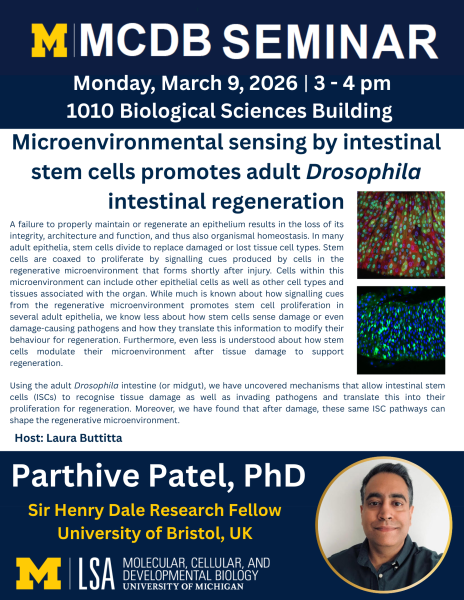

A failure to properly maintain or regenerate an epithelium results in the loss of its integrity, architecture and function, and thus also organismal homeostasis. In many adult epithelia, stem cells divide to replace damaged or lost tissue cell types. Stem cells are coaxed to proliferate by signalling cues produced by cells in the regenerative microenvironment that forms shortly after injury. Cells within this microenvironment can include other epithelial cells as well as other cell types and tissues associated with the organ. While much is known about how signalling cues from the regenerative microenvironment promotes stem cell proliferation in several adult epithelia, we know less about how stem cells sense damage or even damage-causing pathogens and how they translate this information to modify their behaviour for regeneration. Furthermore, even less is understood about how stem cells modulate their microenvironment after tissue damage to support regeneration.
Using the adult Drosophila intestine (or midgut), we have uncovered mechanisms that allow intestinal stem cells (ISCs) to recognise tissue damage as well as invading pathogens and translate this into their proliferation for regeneration. Moreover, we have found that after damage, these same ISC pathways can shape the regenerative microenvironment.
Host: Laura Buttitta
Using the adult Drosophila intestine (or midgut), we have uncovered mechanisms that allow intestinal stem cells (ISCs) to recognise tissue damage as well as invading pathogens and translate this into their proliferation for regeneration. Moreover, we have found that after damage, these same ISC pathways can shape the regenerative microenvironment.
Host: Laura Buttitta
Related Links

Explore Similar Events
-
Loading Similar Events...
