Presented By: Ecology and Evolutionary Biology
EEB Tuesday Seminar Series: Context-dependent collaboration and conflict in microbial mutualisms
Mackenzie Caple, Postdoctoral Fellow, Eastern Michigan University (Emily Grman's lab)
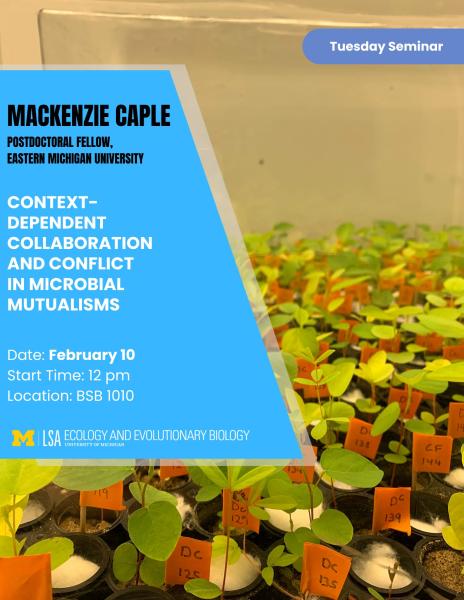

Description: Resource context often has a large effect on the ecology and evolution of nutritional mutualisms, such as the symbiosis between leguminous plants and rhizobium bacteria. Increased soil nitrogen, for example, causes rhizobia to become less mutualistic, but this may be due to direct or indirect effects. I experimentally evolved soil microbial communities to disentangle three possible drivers of reduced mutualism-- soil nitrogen, light, and host availability-- as well as whether mutualism quality would recover after fertilization cessation. Additionally, I investigated possible non-additive effects of adding a second symbiont, arbuscular mycorrhizal fungi, to the legume-rhizobium system, because mycorrhizae are an additional carbon sink for plant hosts.
Co-Sponsored By

Explore Similar Events
-
Loading Similar Events...
