Presented By: Science, Technology and Society
Technology and Slavery in the Ancient Mediterranean
Colin Webster, UC Davis

Moses Finley (1965) famously argued that enslavement hindered technological development in antiquity, on the grounds that cheap labor disincentivized automation. Many scholars have argued that Finley’s economic model was too simplistic and ultimately incorrect, or they demonstrated just how much technological development did, in fact, take place across the ancient Mediterranean (Greene 2000, Oleson 2008). Nevertheless, even with his thesis significantly undermined, the specific interactions of slavery and technology have been lost. Working from recent scholarship that has emphasized the huge variety of slaving systems in Classical Greece, the Hellenistic Kingdoms, and the Roman Empire (Porter 2025, Larsen and Letteney 2025, Vlassopoulos 2023), as well as frameworks that conceptualize technology beyond tools for accelerating efficiency, this talk examines how different types of technology rose and fell with the expansion of various types of enslavement, including in the fields of mining, manufacturing, farming, infrastructure, and medicine. Moreover, by treating enslaved peoples as technologically proficient individuals, who came from different regional traditions, it acknowledges how enslavement distributed expertise across the ancient world. Overall, it outlines how we might conceptualize the question of technology and freedom, even in our current era, where the future seems to hinge on this debate.
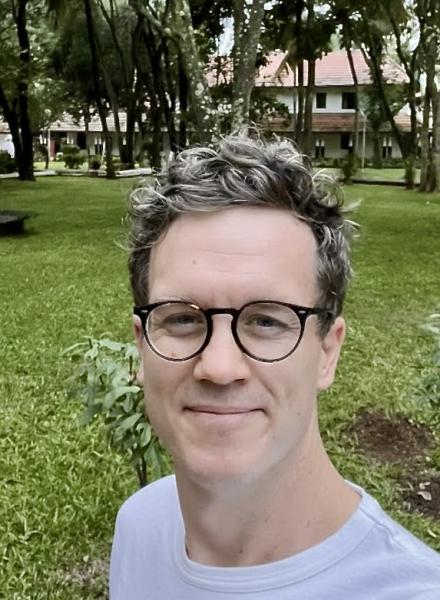
Dr. Webster investigates science, technology, medicine, and philosophy in the ancient world. His current research projects include a study of medicinal plant exchange from the Mediterranean to India, and an evaluation of enslavement's impact on technological development in antiquity. His first book, Tools and the Organism (Chicago) won the Charles J. Goodwin Award of Merit and has been shortlisted for the William H. Welch Medal.
Dr. Webster investigates science, technology, medicine, and philosophy in the ancient world. His current research projects include a study of medicinal plant exchange from the Mediterranean to India, and an evaluation of enslavement's impact on technological development in antiquity. His first book, Tools and the Organism (Chicago) won the Charles J. Goodwin Award of Merit and has been shortlisted for the William H. Welch Medal.
Related Links
Co-Sponsored By

Explore Similar Events
-
Loading Similar Events...
