Presented By: Department of Molecular, Cellular, and Developmental Biology
MCDB Dissertation Defense Seminar> The Nucleoid as a Global Regulator for Spatial Organization in Bacteria
Claire Dudley
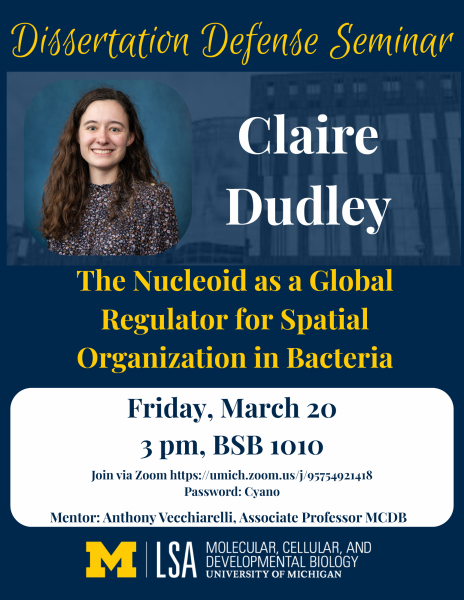

Unlike eukaryotes, bacteria store their DNA un-encased in the cytoplasm of the cell. Through this lack of compartmentalization, the bacterial DNA or nucleoid, is free to act as a platform for both organization and coordination of complex bacterial structures and processes. A lack of a membrane boundary also increases the influence that the metabolic state of the cell can have on the DNA. The ParA family of ATPases is a well characterized family of positioning systems that is known to use the nucleoid as a matrix to organize chromosomes, plasmids, chemotaxis arrays, and bacterial microcompartments (BMCs). One of the best characterized BMCs is the carboxysome. Carboxysomes are proteinaceous structures that encapsulate the enzyme ribulose-1,5-bisphosphate carboxylase/oxygenase (RuBisCO). Cyanobacteria and some chemoautotrophs use carboxysomes to enhance carbon fixation, maximizing the amount of carbon that can later be turned into biomass. Our group has worked to characterize the ParA-like positioning system, the maintenance of carboxysome distribution (Mcd) system, that organizes carboxysomes along the length of the cell. This is a two-component system, with the ParA-like ATPase, McdA, and its partner protein McdB, that interacts with carboxysomes. When McdA binds the nucleoid non-specifically in its ATP-bound state, McdB-coated carboxysomes stimulate the hydrolysis of ATP, causing McdA to dissociate from the nucleoid. This creates dynamic gradients of McdA, with McdB bound carboxysomes constantly chasing higher concentrations of McdA, thereby distributing carboxysomes along the nucleoid.
We have worked to characterize both McdA and McdB and their role in carboxysome positioning, however, until my thesis work, we did not consider the contribution of the nucleoid in the organization of carboxysomes. As a result, current models treat the nucleoid as a benign matrix for positioning by the McdAB system. Also, the McdAB system has been primarily studied in exponential cells grown under continuous light conditions. However, the natural environment of cyanobacteria fluctuates, with changing amounts of nutrient availability. Cells often change the compaction state of their DNA in response to environmental changes, so we used several environmental conditions, to induce changes in nucleoid architecture, to assess effects on the McdAB system and carboxysome organization. We found that the nucleoid is not a passive matrix and can contribute to carboxysome positioning during times of reduced McdAB localization. These findings likely apply to other cargoes that use the nucleoid as a positioning scaffold, and it is necessary to reassess how we understand subcellular organization in bacteria under this new paradigm.
While we have investigated carboxysome organization and its McdAB positioning system, we have largely not considered other subcellular structures that could influence carboxysome distribution. Polyphosphate granules are a storage form of phosphate that is conserved across all domains of life and have been implicated in diverse cellular processes, including the regulation of bacterial chromatin. Through electron microscopy studies, carboxysomes and polyphosphate (polyP) granules have been shown to physically interact. The exact mechanism of this relationship and the significance of this association have not been investigated. We find that polyP influences both nucleoid compaction state and carboxysome positioning in the model cyanobacterium Synechococcus elongatus PCC 7942. Together, this work highlights the broader roles of both the nucleoid and other subcellular structures in the organization of the model BMC, the carboxysome.
We have worked to characterize both McdA and McdB and their role in carboxysome positioning, however, until my thesis work, we did not consider the contribution of the nucleoid in the organization of carboxysomes. As a result, current models treat the nucleoid as a benign matrix for positioning by the McdAB system. Also, the McdAB system has been primarily studied in exponential cells grown under continuous light conditions. However, the natural environment of cyanobacteria fluctuates, with changing amounts of nutrient availability. Cells often change the compaction state of their DNA in response to environmental changes, so we used several environmental conditions, to induce changes in nucleoid architecture, to assess effects on the McdAB system and carboxysome organization. We found that the nucleoid is not a passive matrix and can contribute to carboxysome positioning during times of reduced McdAB localization. These findings likely apply to other cargoes that use the nucleoid as a positioning scaffold, and it is necessary to reassess how we understand subcellular organization in bacteria under this new paradigm.
While we have investigated carboxysome organization and its McdAB positioning system, we have largely not considered other subcellular structures that could influence carboxysome distribution. Polyphosphate granules are a storage form of phosphate that is conserved across all domains of life and have been implicated in diverse cellular processes, including the regulation of bacterial chromatin. Through electron microscopy studies, carboxysomes and polyphosphate (polyP) granules have been shown to physically interact. The exact mechanism of this relationship and the significance of this association have not been investigated. We find that polyP influences both nucleoid compaction state and carboxysome positioning in the model cyanobacterium Synechococcus elongatus PCC 7942. Together, this work highlights the broader roles of both the nucleoid and other subcellular structures in the organization of the model BMC, the carboxysome.
Related Links

Explore Similar Events
-
Loading Similar Events...
