Presented By: Ecology and Evolutionary Biology
EEB Tuesday Seminar Series- Spontaneous mutation rate and spectrum are modulated by organismal fitness
Shuting Ding, Postdoctoral Research Fellow (visiting), Department of Ecology and Evolutionary Biology, University of Michigan
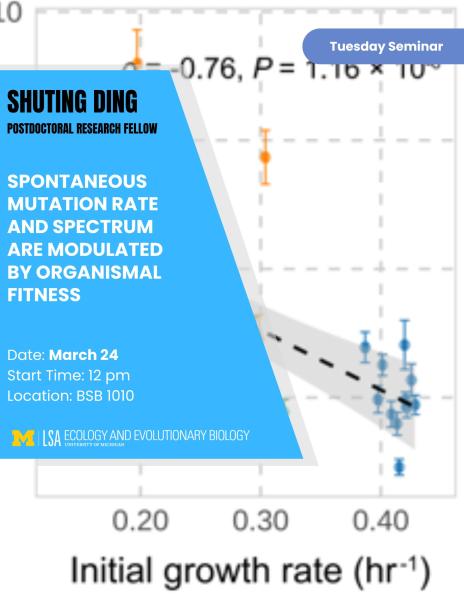

Description: Understanding the principles governing mutagenesis is important because mutations are a fundamental driver of evolution and a cause of disease. Although mutation rates and spectra depend on genotype and environment, how these factors interact is unclear. We address this question using mutation accumulation experiments in 11 budding yeast strains across three environments that produce strong genotype-by-environment interactions in fitness. Analysis of over 9,000 accumulated mutations reveals that per-generation rates of all mutation types—single-nucleotide variations, small insertions and deletions, segmental duplications and deletions, and chromosome gains and losses—decline with increasing organismal fitness. Notably, relative mutation rates between strains tend to invert when environmental shifts reverse their relative fitness. The mutation spectrum is also partially fitness-dependent: higher-fitness strains show a lower transition-to-transversion ratio and a stronger AT mutational bias. Thus, organismal fitness shapes not only natural selection but also the quantity and composition of mutations available to selection, with broad implications for the molecular clock, adaptive evolution, and genetic load.
Co-Sponsored By

Explore Similar Events
-
Loading Similar Events...
