Presented By: Electrical and Computer Engineering
Programming Physical Systems
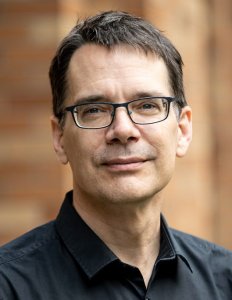
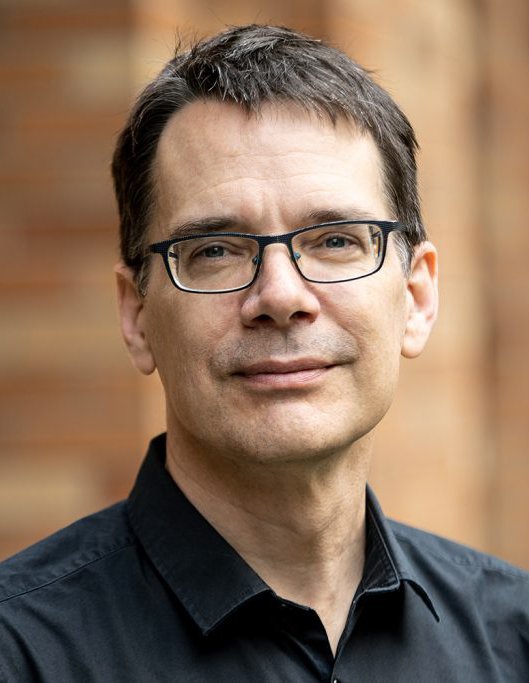
Eric Klavins, Professor and Chair of the Electrical & Computer Engineering Department, University of Washington in Seattle
Abstract:
Robots, living cells, and even semi-automated laboratories are fascinating examples of programmable systems, each with their own syntax, semantics, and opportunities for modeling and control. In robotics, my group explored grammatical and language design approaches to specifying robot behaviors, enabling autonomous distribution control of local interactions to produce global results. Closely related ideas appear in biology, where tightly orchestrated biochemical reactions within cells, and signaling between cells, give rise to robust multicellular behaviors. I will describe engineering based approaches involving modeling and programming languages to design new synthetic behaviors in individual proteins, microorganisms, consortia, and higher organisms. My experience as a computer engineer working in synthetic biology, in which experimental reproducibility and uncertainty dominate all engineering processes, led my group to develop languages and modeling approaches not only for synthetic biology, but for the entire experiential process. For example, we developed a Laboratory Operating System, that allows researchers to design experiments in a high level language that compiles down to low level operations on samples, instrument and data manipulation. Our approach, along with advances in DNA synthesis and sequencing, allowed us to scale to large data driven engineering of biological systems. I will conclude the talk with speculation about the future of physical programming languages and their applications to grounding AI in experimental reality.
Bio:
Eric Klavins is the Professor and Chair of the Electrical & Computer Engineering Department at the University of Washington in Seattle. He received his Ph.D. in computer science and engineering in 2001 from the University of Michigan, Ann Arbor. From 2001 to 2003 he was a postdoctoral scholar in the Control and Dynamical Systems Department at the California Institute of Technology. In 2003 Eric joined Electrical Engineering at the University of Washington in Seattle. He holds adjunct appointments in Computer Science and Engineering, Bioengineering, and Digital Arts. Eric’s research interests include control systems, modeling, and programming languages with applications to robotics, laboratory automation, and synthetic biology.
Robots, living cells, and even semi-automated laboratories are fascinating examples of programmable systems, each with their own syntax, semantics, and opportunities for modeling and control. In robotics, my group explored grammatical and language design approaches to specifying robot behaviors, enabling autonomous distribution control of local interactions to produce global results. Closely related ideas appear in biology, where tightly orchestrated biochemical reactions within cells, and signaling between cells, give rise to robust multicellular behaviors. I will describe engineering based approaches involving modeling and programming languages to design new synthetic behaviors in individual proteins, microorganisms, consortia, and higher organisms. My experience as a computer engineer working in synthetic biology, in which experimental reproducibility and uncertainty dominate all engineering processes, led my group to develop languages and modeling approaches not only for synthetic biology, but for the entire experiential process. For example, we developed a Laboratory Operating System, that allows researchers to design experiments in a high level language that compiles down to low level operations on samples, instrument and data manipulation. Our approach, along with advances in DNA synthesis and sequencing, allowed us to scale to large data driven engineering of biological systems. I will conclude the talk with speculation about the future of physical programming languages and their applications to grounding AI in experimental reality.
Bio:
Eric Klavins is the Professor and Chair of the Electrical & Computer Engineering Department at the University of Washington in Seattle. He received his Ph.D. in computer science and engineering in 2001 from the University of Michigan, Ann Arbor. From 2001 to 2003 he was a postdoctoral scholar in the Control and Dynamical Systems Department at the California Institute of Technology. In 2003 Eric joined Electrical Engineering at the University of Washington in Seattle. He holds adjunct appointments in Computer Science and Engineering, Bioengineering, and Digital Arts. Eric’s research interests include control systems, modeling, and programming languages with applications to robotics, laboratory automation, and synthetic biology.
Related Links

Explore Similar Events
-
Loading Similar Events...
