Presented By: Residential College [RC]
Exhibition: Wayward Images
Angela Chen, Aaron Turner, Ricky Weaver
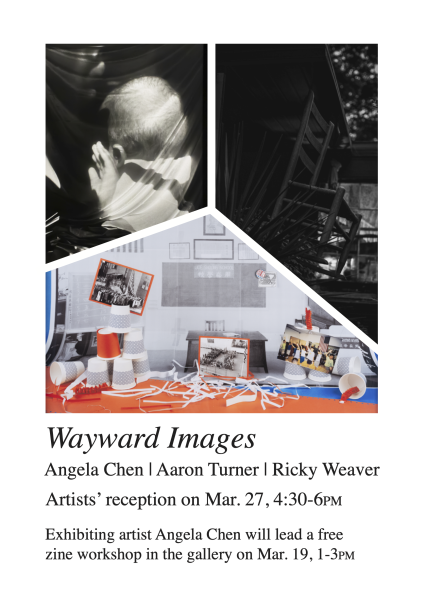

March 9-April 3, 2026
--
The public is cordially invited to an artist's reception on Wednesday, March 27th at 4:30 pm in the RC Art Gallery.
--
Public Workshop: On March 19th from 1 to 3pm, join exhibiting artist Stamps School of Art & Design Assistant Professor Angela Chen for a collaborative bookmaking workshop! Drawing on the themes from her latest book and exhibition After School 課後, participants are invited to critique educational systems by cutting up old textbooks and creating new photocopy collages. All materials will be provided, but participants are welcome to bring their own texts to deconstruct!
--
Angela Chen - Artist Statement: Angela Chen’s After School brings together collage, sculpture, and new and historical photographs to unpack the culture of after school tutoring centers in California. Known as 補習班 (buxiban) in Chinese, after schools are referred to colloquially as “cram schools” and by scholars as “shadow education.” Operating simultaneously as spaces of community, care, and control, these schools can be demanding and factory-like; but they also deliver essential childcare services to busy parents, many of whom are new immigrants. As a child and young adult, Chen attended and worked at Futurelink School, a buxiban and her parents’ business. Located in the San Gabriel Valley, CA, Futurelink served hundreds of primarily East Asian students, providing them with homework help and supplemental English and math lessons. Inspired by Futurelink’s vast archive of photographs, workbooks, objects, and advertisements, After School explores the role of education in Asian American enclaves and challenges stereotypes about Asian American students. Assemblages combine Futurelink photographs with photographs of California Chinese schools during the Chinese Exclusion era to reflect on the ongoing legacies of racism, segregation, and US immigration policy within the Asian American experience.
Aaron Turner - Artist Statement: Aaron Turner’s Black Alchemy (2014 - Present) speaks to the broad spectrum of identity and speculative aesthetics, drawing from lived experience, archives, American history, and art history. He uses the light in combination with the Darkroom, alternative and 19th-century printing processes, the view camera (4x5 & 8x10), geometric abstraction, assemblage, and monochromatic pictorial experimentation to respond to internal questions about representation, the discursive enterprise, and the artists' role in the studio space.
Black Alchemy provides a lens through which he sees the world while simultaneously considering the past, present, and future, translating knowledge and perspective outside the intellectual studio space.
Ricky Weaver - Artist Statement: Ricky Weaver’s work co-conspires with the poetics and temporality of Black feminist metaphysics embeded in the Black Quotidian. These images locate a code that can be traced back to the Middle Passage—one that disrupts the paradigmatic ways of archiving Blackness and outsmarts surveillance technologies as such. Her application of scripture, hymn, and colloquial passages come together in acts of dark sousveillance to recall language that implies worlds that don’t require an escape. She addresses the sonic, linguistic, and visual as a way to posture the body as a central apparatus for storing, downloading, and transferring archives.
--
The public is cordially invited to an artist's reception on Wednesday, March 27th at 4:30 pm in the RC Art Gallery.
--
Public Workshop: On March 19th from 1 to 3pm, join exhibiting artist Stamps School of Art & Design Assistant Professor Angela Chen for a collaborative bookmaking workshop! Drawing on the themes from her latest book and exhibition After School 課後, participants are invited to critique educational systems by cutting up old textbooks and creating new photocopy collages. All materials will be provided, but participants are welcome to bring their own texts to deconstruct!
--
Angela Chen - Artist Statement: Angela Chen’s After School brings together collage, sculpture, and new and historical photographs to unpack the culture of after school tutoring centers in California. Known as 補習班 (buxiban) in Chinese, after schools are referred to colloquially as “cram schools” and by scholars as “shadow education.” Operating simultaneously as spaces of community, care, and control, these schools can be demanding and factory-like; but they also deliver essential childcare services to busy parents, many of whom are new immigrants. As a child and young adult, Chen attended and worked at Futurelink School, a buxiban and her parents’ business. Located in the San Gabriel Valley, CA, Futurelink served hundreds of primarily East Asian students, providing them with homework help and supplemental English and math lessons. Inspired by Futurelink’s vast archive of photographs, workbooks, objects, and advertisements, After School explores the role of education in Asian American enclaves and challenges stereotypes about Asian American students. Assemblages combine Futurelink photographs with photographs of California Chinese schools during the Chinese Exclusion era to reflect on the ongoing legacies of racism, segregation, and US immigration policy within the Asian American experience.
Aaron Turner - Artist Statement: Aaron Turner’s Black Alchemy (2014 - Present) speaks to the broad spectrum of identity and speculative aesthetics, drawing from lived experience, archives, American history, and art history. He uses the light in combination with the Darkroom, alternative and 19th-century printing processes, the view camera (4x5 & 8x10), geometric abstraction, assemblage, and monochromatic pictorial experimentation to respond to internal questions about representation, the discursive enterprise, and the artists' role in the studio space.
Black Alchemy provides a lens through which he sees the world while simultaneously considering the past, present, and future, translating knowledge and perspective outside the intellectual studio space.
Ricky Weaver - Artist Statement: Ricky Weaver’s work co-conspires with the poetics and temporality of Black feminist metaphysics embeded in the Black Quotidian. These images locate a code that can be traced back to the Middle Passage—one that disrupts the paradigmatic ways of archiving Blackness and outsmarts surveillance technologies as such. Her application of scripture, hymn, and colloquial passages come together in acts of dark sousveillance to recall language that implies worlds that don’t require an escape. She addresses the sonic, linguistic, and visual as a way to posture the body as a central apparatus for storing, downloading, and transferring archives.
Related Links

Explore Similar Events
-
Loading Similar Events...
