Presented By: Survey Research Center
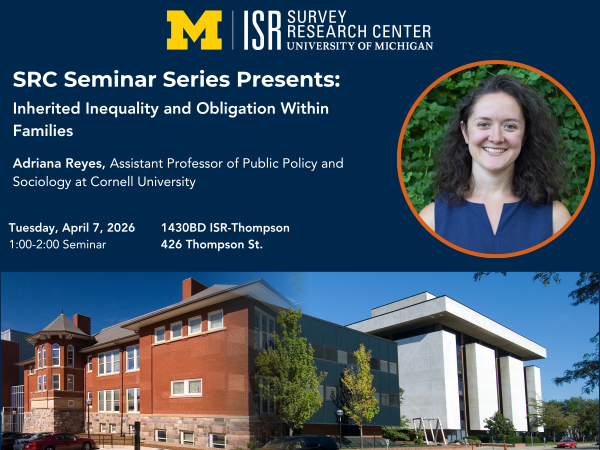
SRC Seminar Series Presents: Inherited Inequality and Obligation Within Families
Adriana Reyes, Assistant Professor of Public Policy and Sociology at Cornell University

Abstract
Inheritances represent a major channel of economic transmission across generations, shaping both inequality between families and disparities within them. Yet much research on stratification treats families as unified actors that collectively pass resources to the next generation, overlooking how parents actually allocate resources among their children. Using family fixed‑effects models and data from the Health and Retirement Study, we examine how inter vivos transfers and bequests are distributed within families. We find that children who receive more financial support during their parents’ lifetimes are also more likely to receive a bequest and a larger one. Rather than compensating for earlier imbalances, bequests appear to amplify existing inequalities among siblings. These findings highlight key mechanisms in the reproduction of advantage and offer insights for policies seeking to reduce wealth inequality across generations.
Biography
Adriana Reyes is an Assistant Professor of Public Policy and Sociology at Cornell University. Her research examines family demography and health disparities across the life course, with a focus on how family ties serve as social capital and how they reinforce inequalities across race and class. Her work explores the ways intergenerational relationships, living arrangements, and caregiving expectations shape individuals’ social and economic well‑being. Professor Reyes’ current projects investigate racial and ethnic differences in intergenerational family relations, the financial and health implications of household composition, and evolving attitudes toward caregiving.
Inheritances represent a major channel of economic transmission across generations, shaping both inequality between families and disparities within them. Yet much research on stratification treats families as unified actors that collectively pass resources to the next generation, overlooking how parents actually allocate resources among their children. Using family fixed‑effects models and data from the Health and Retirement Study, we examine how inter vivos transfers and bequests are distributed within families. We find that children who receive more financial support during their parents’ lifetimes are also more likely to receive a bequest and a larger one. Rather than compensating for earlier imbalances, bequests appear to amplify existing inequalities among siblings. These findings highlight key mechanisms in the reproduction of advantage and offer insights for policies seeking to reduce wealth inequality across generations.
Biography
Adriana Reyes is an Assistant Professor of Public Policy and Sociology at Cornell University. Her research examines family demography and health disparities across the life course, with a focus on how family ties serve as social capital and how they reinforce inequalities across race and class. Her work explores the ways intergenerational relationships, living arrangements, and caregiving expectations shape individuals’ social and economic well‑being. Professor Reyes’ current projects investigate racial and ethnic differences in intergenerational family relations, the financial and health implications of household composition, and evolving attitudes toward caregiving.
Related Links
Co-Sponsored By

Explore Similar Events
-
Loading Similar Events...
