Presented By: Ecology and Evolutionary Biology
EEB Student Thesis Defense - The Effects of Land-Use History and Hurricane Disturbance on Soil Microbial Function in a Tropical Forest
Manar Talab
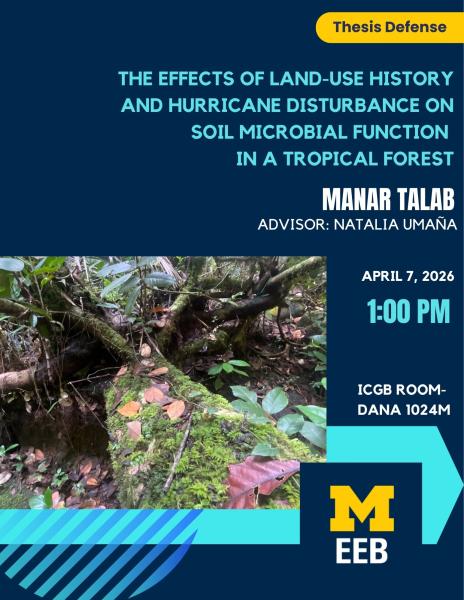

Advisor: Natalia Umaña
Defense summary: Soil microbes drive essential ecosystem processes like decomposition and nutrient cycling, but how they respond to different types of disturbance remains unclear—especially in tropical forests facing both historical land use and increasing storm intensity. In this talk, I explore how long-term land-use legacies (“press” disturbances) compare to hurricane impacts (“pulse” disturbances) in shaping soil microbial functioning in Puerto Rico. I show that land-use legacies have stronger and more persistent effects on soil conditions, enzyme activity, and nutrient cycling than more recent hurricane disturbance. In contrast, microbial functioning was largely similar between hurricane-disturbed and undisturbed soils, suggesting resilience to episodic events. These results highlight the lasting impact of human land use and suggest that legacy effects may play a larger role than natural disturbances in shaping ecosystem responses to global change.
Defense summary: Soil microbes drive essential ecosystem processes like decomposition and nutrient cycling, but how they respond to different types of disturbance remains unclear—especially in tropical forests facing both historical land use and increasing storm intensity. In this talk, I explore how long-term land-use legacies (“press” disturbances) compare to hurricane impacts (“pulse” disturbances) in shaping soil microbial functioning in Puerto Rico. I show that land-use legacies have stronger and more persistent effects on soil conditions, enzyme activity, and nutrient cycling than more recent hurricane disturbance. In contrast, microbial functioning was largely similar between hurricane-disturbed and undisturbed soils, suggesting resilience to episodic events. These results highlight the lasting impact of human land use and suggest that legacy effects may play a larger role than natural disturbances in shaping ecosystem responses to global change.
Co-Sponsored By

Explore Similar Events
-
Loading Similar Events...
