Presented By: Ecology and Evolutionary Biology
EEB Student Dissertation Defense - Dynamics of body form evolution in lizards and snakes
Natasha Stepanova
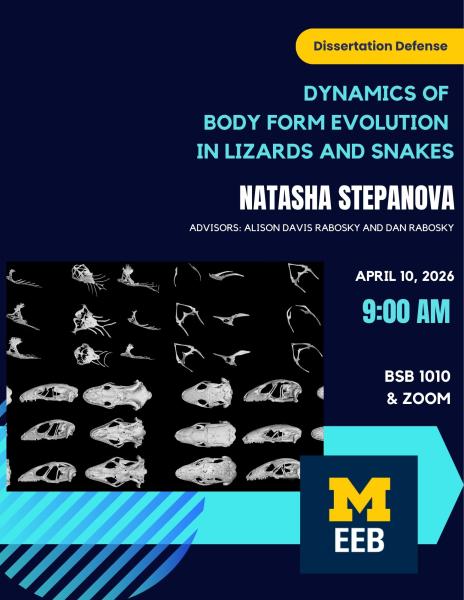

Abstract: Covariation among traits underlies the evolution of most phenotypes in nature. The non-independence of trait values is obvious from two common observations: 1) traits function modularly within body plans to create interacting units, and 2) traits show evolutionary conservatism across closely related taxa, varying far more in size than in shape along allometric lines. However, different mechanisms generating covariance can produce the same patterns of trait distribution across species, so the relative impact of evolutionary, developmental, or genetic constraints versus adaptive evolution in phenotypic change is critical for understanding the morphological diversity we observe in the world around us. In this dissertation, I explored how the evolutionary relationships between traits have shifted across different phylogenetic scales, with a focus on limb reduction and body elongation as major body plan changes in squamate reptiles (lizards and snakes). Squamates have evolved limb-reduced, elongate body plans an estimated 26-50 independent times, making them a powerful system to test hypotheses about trait evolution. First, I investigated how the multivariate evolutionary process, as described by the evolutionary variance-covariance matrix, shifts between and within two clades of scincid lizard. I found that although the two clades had similar covariance matrices, a genus of Australian lizards (Ctenotus) had a distinct evolutionary covariance structure, indicating that these evolutionary relationships can change at relatively short timescales. Next, I tested how limb reduction influences evolutionary integration within and between the limb girdles in lizards. I found that it decreased evolutionary integration, supporting the hypothesis that reduction and loss of function results in more independent evolution of traits. I suggested that developmental integration may mediate this reduction in evolutionary integration. Finally, I collected a large dataset of vertebral counts across lizards and snakes to test the relationship between body size and vertebral number (termed pleomerism). I found that non-elongate clades had no pleomerism and although most elongate clades showed pleomerism, several elongate clades upset the predicted pattern of coupling between body size and vertebral number. This result showed that well-established patterns do not necessarily apply in all groups and that clade heterogeneity must be considered in studies of trait evolution in large groups. Taken together, my dissertation demonstrates how evolutionary relationships between traits can shift at relatively short timescales as well as between clades and how integrating both function and development is vital for understanding patterns of phenotypic evolution.
Advisors: Alison Davis Rabosky and Dan Rabosky
Advisors: Alison Davis Rabosky and Dan Rabosky
Co-Sponsored By

Explore Similar Events
-
Loading Similar Events...
