Presented By: University of Michigan Biological Station
“Making Steel Knives from Sands Found on Douglas Lake”
Dr. John Verhoeven, Iowa State University
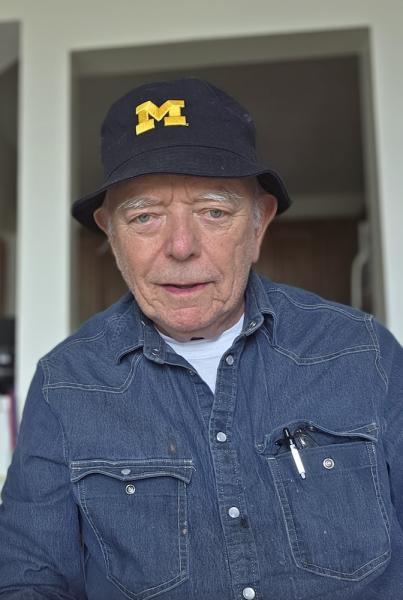

Dr. John Verhoeven is a metallurgical engineer, U-M alumnus and Distinguished Emeritus Professor at Iowa State University who lives along Douglas Lake, near the University of Michigan Biological Station.
As part of the 2026 Summer Lecture Series at the University of Michigan Biological Station (UMBS), Verhoeven will give a free, public talk titled, “Making Steel Knives from Sands Found on Douglas Lake.”
Since retiring, he has continued to do research with colleagues in northern Michigan. They recently found magnetic black sand on Douglas Lake, reduced it to iron and made kitchen knives.
Their experiments measuring the composition of the sand in an electron microscope show that it comes from what geologists call OUI deposits of the Mid-Continental Rift. Verhoeven said the source rock from which the sand eroded — Fe-Ti oxide ultramafic intrusions (OUI) — was brought to the surface from magma in Earth’s core 1.1 billion years ago when tectonic plates separated.
Here is a more detailed description of the lecture from Verhoeven: “Bladesmith Tim Zowada, who lives near Petoskey, smelts the magnetic black sand he collects on Lake Superior near White Fish Point into iron and makes knives. Working with Tim, we discovered that the source rock from which the sand eroded contains Ti. This was a new discovery because geologists had assumed the source rock was the same as the iron ore used to make the Taconite which is shipped through the Soo Locks to supply US steel mills. It does not contain Ti. With the help of geologist Marcia Bjornerud, we have shown that the source rock is what geologists call: Fe-Ti oxide ultramafic intrusions (OUIs). These rocks where brought to the surface from the magma in Earth’s core 1.1 billion years ago when tectonic plates separated and the mid-continental rift (MCR) formed. The rift runs through the Lake Superior region, and our experiments show the Ti minerals of Tim’s sand matches the composition from OUI drillings collected near Lake Superior. With the help of my neighbor, Mike Johnson, we have recently found magnetic black sand on Douglas Lake and Tim has reduced it to iron and made a few small kitchen knives which will be passed around. Our experiments measuring the composition of the sand in an electron microscope in my shop show that it also comes from OUI deposits of the MCR. Douglas Lake also lies on the MCR. The implications of these results will be discussed.”
Verhoeven grew up in Monroe, Michigan, and attended the University of Michigan, where he earned a bachelor of science degree in chemical engineering as well as his master’s and Ph.D. in metallurgical engineering.
He spent his professional career at Iowa State University, doing research in the DOE lab and teaching in the Materials Science Department.
Verhoeven has published two books on metallurgy, 220 peer-reviewed journal papers and obtained 18 patents.
He built home and shop on Douglas Lake in 1991 and has continued doing research there since retirement in 2000.
The University of Michigan Biological Station serves as a gathering place to learn from the natural world, advance research and education, and inspire action. We leverage over a century of research and transformative experiences to drive discoveries and solutions to benefit Michigan and beyond.
Founded in 1909, UMBS supports long-term research and education through immersive, field-based courses and features state-of-the-art equipment and facilities for data collection and analysis to help any field researcher be productive. It is where students and scientists from across the globe live and work as a community to learn from the place.
The Summer Lecture Series is a tradition at UMBS, where we explore scientific topics with distinguished guest speakers from across the country so the community can learn about our natural world.
The free, public talks are on Wednesdays at 7 p.m. in the spring and summer in Gates Lecture Hall at the University of Michigan Biological Station, located at 9133 Biological Rd. in Pellston, Michigan — about 20 miles south of the Mackinac Bridge.
As part of the 2026 Summer Lecture Series at the University of Michigan Biological Station (UMBS), Verhoeven will give a free, public talk titled, “Making Steel Knives from Sands Found on Douglas Lake.”
Since retiring, he has continued to do research with colleagues in northern Michigan. They recently found magnetic black sand on Douglas Lake, reduced it to iron and made kitchen knives.
Their experiments measuring the composition of the sand in an electron microscope show that it comes from what geologists call OUI deposits of the Mid-Continental Rift. Verhoeven said the source rock from which the sand eroded — Fe-Ti oxide ultramafic intrusions (OUI) — was brought to the surface from magma in Earth’s core 1.1 billion years ago when tectonic plates separated.
Here is a more detailed description of the lecture from Verhoeven: “Bladesmith Tim Zowada, who lives near Petoskey, smelts the magnetic black sand he collects on Lake Superior near White Fish Point into iron and makes knives. Working with Tim, we discovered that the source rock from which the sand eroded contains Ti. This was a new discovery because geologists had assumed the source rock was the same as the iron ore used to make the Taconite which is shipped through the Soo Locks to supply US steel mills. It does not contain Ti. With the help of geologist Marcia Bjornerud, we have shown that the source rock is what geologists call: Fe-Ti oxide ultramafic intrusions (OUIs). These rocks where brought to the surface from the magma in Earth’s core 1.1 billion years ago when tectonic plates separated and the mid-continental rift (MCR) formed. The rift runs through the Lake Superior region, and our experiments show the Ti minerals of Tim’s sand matches the composition from OUI drillings collected near Lake Superior. With the help of my neighbor, Mike Johnson, we have recently found magnetic black sand on Douglas Lake and Tim has reduced it to iron and made a few small kitchen knives which will be passed around. Our experiments measuring the composition of the sand in an electron microscope in my shop show that it also comes from OUI deposits of the MCR. Douglas Lake also lies on the MCR. The implications of these results will be discussed.”
Verhoeven grew up in Monroe, Michigan, and attended the University of Michigan, where he earned a bachelor of science degree in chemical engineering as well as his master’s and Ph.D. in metallurgical engineering.
He spent his professional career at Iowa State University, doing research in the DOE lab and teaching in the Materials Science Department.
Verhoeven has published two books on metallurgy, 220 peer-reviewed journal papers and obtained 18 patents.
He built home and shop on Douglas Lake in 1991 and has continued doing research there since retirement in 2000.
The University of Michigan Biological Station serves as a gathering place to learn from the natural world, advance research and education, and inspire action. We leverage over a century of research and transformative experiences to drive discoveries and solutions to benefit Michigan and beyond.
Founded in 1909, UMBS supports long-term research and education through immersive, field-based courses and features state-of-the-art equipment and facilities for data collection and analysis to help any field researcher be productive. It is where students and scientists from across the globe live and work as a community to learn from the place.
The Summer Lecture Series is a tradition at UMBS, where we explore scientific topics with distinguished guest speakers from across the country so the community can learn about our natural world.
The free, public talks are on Wednesdays at 7 p.m. in the spring and summer in Gates Lecture Hall at the University of Michigan Biological Station, located at 9133 Biological Rd. in Pellston, Michigan — about 20 miles south of the Mackinac Bridge.
Related Links

Explore Similar Events
-
Loading Similar Events...
