Presented By: University of Michigan Biological Station
“Making a Migratory Monarch”
Dr. André Green, University of Michigan
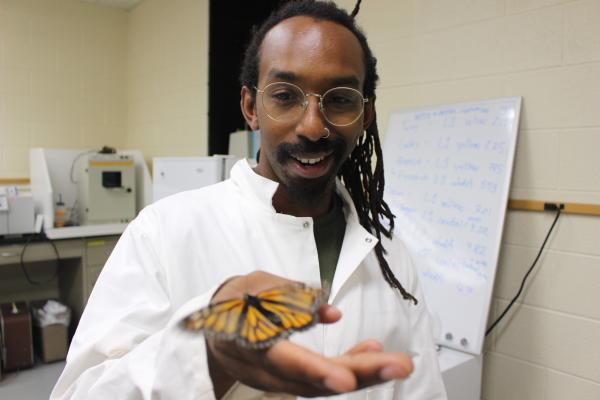

As part of the 2026 Summer Lecture Series at the University of Michigan Biological Station (UMBS), Dr. André Green will give a free, public talk titled, “Making a Migratory Monarch.”
Green is an assistant professor of ecology and evolutionary biology at the University of Michigan who studies the unique features of monarch butterfly migration.
He also teaches a course at UMBS titled “Eco-Evo-Devo: How Genome and Environment Affect Organismal Development,” that has undergraduate students use cutting-edge molecular genetics techniques (including CRISPR) to illustrate fundamental concepts in eco-evo-devo while leveraging the remarkable biodiversity at UMBS.
Monarch butterflies (Danaus plexippus) are renowned for their annual transcontinental migration where they fly thousands of miles each fall to overwinter at specific sites in central Mexico.
How did this phenotype evolve?
The mechanisms (behavioral, genetic, and molecular) required for migrants to perform this trip, particularly to naïvely identify their overwintering sites with remarkably high fidelity, are unknown.
In his talk at UMBS, Green will discuss his lab’s efforts that aim to extend our understanding of how this occurs.
His team integrates development, genomics, behavior, and physiology in both laboratory and natural settings.
Green earned a Ph.D. in biology from Harvard University and a bachelor of science degree in biology from Massachusetts Institute of Technology.
The University of Michigan Biological Station serves as a gathering place to learn from the natural world, advance research and education, and inspire action. We leverage over a century of research and transformative experiences to drive discoveries and solutions to benefit Michigan and beyond.
Founded in 1909, UMBS supports long-term research and education through immersive, field-based courses and features state-of-the-art equipment and facilities for data collection and analysis to help any field researcher be productive. It is where students and scientists from across the globe live and work as a community to learn from the place.
The Summer Lecture Series is a tradition at UMBS, where we explore scientific topics with distinguished guest speakers from across the country so the community can learn about our natural world.
The free, public talks are on Wednesdays at 7 p.m. in the spring and summer in Gates Lecture Hall at the University of Michigan Biological Station, located at 9133 Biological Rd. in Pellston, Michigan — about 20 miles south of the Mackinac Bridge.
Green is an assistant professor of ecology and evolutionary biology at the University of Michigan who studies the unique features of monarch butterfly migration.
He also teaches a course at UMBS titled “Eco-Evo-Devo: How Genome and Environment Affect Organismal Development,” that has undergraduate students use cutting-edge molecular genetics techniques (including CRISPR) to illustrate fundamental concepts in eco-evo-devo while leveraging the remarkable biodiversity at UMBS.
Monarch butterflies (Danaus plexippus) are renowned for their annual transcontinental migration where they fly thousands of miles each fall to overwinter at specific sites in central Mexico.
How did this phenotype evolve?
The mechanisms (behavioral, genetic, and molecular) required for migrants to perform this trip, particularly to naïvely identify their overwintering sites with remarkably high fidelity, are unknown.
In his talk at UMBS, Green will discuss his lab’s efforts that aim to extend our understanding of how this occurs.
His team integrates development, genomics, behavior, and physiology in both laboratory and natural settings.
Green earned a Ph.D. in biology from Harvard University and a bachelor of science degree in biology from Massachusetts Institute of Technology.
The University of Michigan Biological Station serves as a gathering place to learn from the natural world, advance research and education, and inspire action. We leverage over a century of research and transformative experiences to drive discoveries and solutions to benefit Michigan and beyond.
Founded in 1909, UMBS supports long-term research and education through immersive, field-based courses and features state-of-the-art equipment and facilities for data collection and analysis to help any field researcher be productive. It is where students and scientists from across the globe live and work as a community to learn from the place.
The Summer Lecture Series is a tradition at UMBS, where we explore scientific topics with distinguished guest speakers from across the country so the community can learn about our natural world.
The free, public talks are on Wednesdays at 7 p.m. in the spring and summer in Gates Lecture Hall at the University of Michigan Biological Station, located at 9133 Biological Rd. in Pellston, Michigan — about 20 miles south of the Mackinac Bridge.
Related Links

Explore Similar Events
-
Loading Similar Events...
