Presented By: Biomedical Engineering
Biomedical Engineering (BME 500) Seminar Series
"Tissue-Inspired Synthetic Biomaterials and Applications in Cancer," with Shelly R. Peyton, Ph.D.

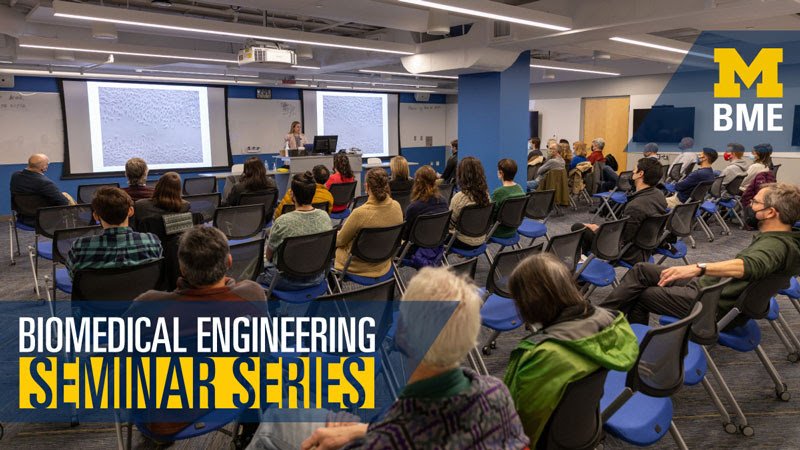
Tissue-Inspired Synthetic Biomaterials and Applications in Cancer
Abstract:
Most environments available to study how human cells behave are two-dimensional (2D). In real tissue, cells live surrounded by a three-dimensional (3D) extracellular matrix (ECM), which provides structure, drives cell function, and is dynamically remodeled by the cells within. A major limitation of the few examples of 3D cell culture environments that do exist (typically made from assemblages of proteins) is that their constituents are undefined, and they have unacceptable batch-to-batch variability. On the other end of the spectrum, the major drawbacks to using engineered, synthetic environments is their over-simplicity and lack of resemblance to real tissue. My lab’s unique approach to biomaterial design is that we create cheap and easy-to-use, yet complex representations of the ECM of specific tissues. My lab’s tissue-customized environments are hydrogels from synthetic polymers that replicate a tissue’s 3D geometry, the stiffness of that tissue, and all the integrin-binding and protease-degradable components of the ECM of the tissue of interest. We made biomaterial designs for brain, bone marrow, omentum, and lung, and we have applied our approach to several complex problems in biology (e.g., astrocyte reactivity, mesenchymal stem cell differentiation, ovarian cancer, etc.).
In this seminar, I’ll discuss how we use our engineering principles to create these environments and show how we’ve begun to use them to study grand challenges in cancer biology. One of the overwhelming challenges in treating metastatic cancer is that tumors in the brain, lung, skeleton, and liver are typically drug resistant, and we do not have a good understanding of why these tumors evade therapy. The biomaterials we have built over the years are well suited for drug screening applications and to study how the extracellular microenvironment regulates the metastatic spread of cancer.
Bio:
Shelly Peyton is Professor and Department Chair of Biomedical Engineering at Tufts University. She received her B.S. in Chemical Engineering from Northwestern University in 2002 and went on to obtain her MS and PhD in Chemical Engineering from the University of California, Irvine in 2007. She was then an NIH Kirschstein post-doctoral fellow in the Biological Engineering department at MIT before starting her academic appointment in Chemical Engineering at the University of Massachusetts Amherst in 2011. At UMass she was named the Barry and Afsaneh Siadat Professional Development Professor, Armstrong Professor, Conti Fellow, and Provost Professor before moving to Tufts University to become chair of Biomedical Engineering in 2024. At Tufts, the Peyton lab is an interdisciplinary group of engineers and biologists that create bioinspired and dynamic models of human tissue with both synthetic biomaterials and decellularized tissues. They use these tissue models to 1) understand the physical relationship between metastatic cancer cells and the tissues to which they spread, 2) uncover the role of the extracellular matrix and its dynamics in drug resistant cancers, and 3) quantify how forces from traumatic brain injury damage cells within the brain. Shelly’s honors include a Pew Biomedical Scholarship, an NIH New Innovator Award, an NSF CAREER award, Biomedical Engineering Society fellow, and an American Institute for Medical and Biological Engineering fellow. Outside of her research and her Chair’s role, Shelly is passionate about graduate student training and diversifying the academy. She was awarded an Outstanding Teaching Award and a Diversity Award from the College of Engineering at UMass, has led an REU Site, co-directed a Biotechnology (BTP) NIH T32 training program, and was lead PI of a PREP program at UMass. Since 2013, the Peyton has continuously run an NSF- and privately funded program called Engineering the Cell, which pays high school students with no prior research experience to work in the Peyton lab for 5 weeks every summer. Outside of her work, Shelly is an avid cyclist, enjoys board games, lego, travel, and coaches ultimate frisbee.
Abstract:
Most environments available to study how human cells behave are two-dimensional (2D). In real tissue, cells live surrounded by a three-dimensional (3D) extracellular matrix (ECM), which provides structure, drives cell function, and is dynamically remodeled by the cells within. A major limitation of the few examples of 3D cell culture environments that do exist (typically made from assemblages of proteins) is that their constituents are undefined, and they have unacceptable batch-to-batch variability. On the other end of the spectrum, the major drawbacks to using engineered, synthetic environments is their over-simplicity and lack of resemblance to real tissue. My lab’s unique approach to biomaterial design is that we create cheap and easy-to-use, yet complex representations of the ECM of specific tissues. My lab’s tissue-customized environments are hydrogels from synthetic polymers that replicate a tissue’s 3D geometry, the stiffness of that tissue, and all the integrin-binding and protease-degradable components of the ECM of the tissue of interest. We made biomaterial designs for brain, bone marrow, omentum, and lung, and we have applied our approach to several complex problems in biology (e.g., astrocyte reactivity, mesenchymal stem cell differentiation, ovarian cancer, etc.).
In this seminar, I’ll discuss how we use our engineering principles to create these environments and show how we’ve begun to use them to study grand challenges in cancer biology. One of the overwhelming challenges in treating metastatic cancer is that tumors in the brain, lung, skeleton, and liver are typically drug resistant, and we do not have a good understanding of why these tumors evade therapy. The biomaterials we have built over the years are well suited for drug screening applications and to study how the extracellular microenvironment regulates the metastatic spread of cancer.
Bio:
Shelly Peyton is Professor and Department Chair of Biomedical Engineering at Tufts University. She received her B.S. in Chemical Engineering from Northwestern University in 2002 and went on to obtain her MS and PhD in Chemical Engineering from the University of California, Irvine in 2007. She was then an NIH Kirschstein post-doctoral fellow in the Biological Engineering department at MIT before starting her academic appointment in Chemical Engineering at the University of Massachusetts Amherst in 2011. At UMass she was named the Barry and Afsaneh Siadat Professional Development Professor, Armstrong Professor, Conti Fellow, and Provost Professor before moving to Tufts University to become chair of Biomedical Engineering in 2024. At Tufts, the Peyton lab is an interdisciplinary group of engineers and biologists that create bioinspired and dynamic models of human tissue with both synthetic biomaterials and decellularized tissues. They use these tissue models to 1) understand the physical relationship between metastatic cancer cells and the tissues to which they spread, 2) uncover the role of the extracellular matrix and its dynamics in drug resistant cancers, and 3) quantify how forces from traumatic brain injury damage cells within the brain. Shelly’s honors include a Pew Biomedical Scholarship, an NIH New Innovator Award, an NSF CAREER award, Biomedical Engineering Society fellow, and an American Institute for Medical and Biological Engineering fellow. Outside of her research and her Chair’s role, Shelly is passionate about graduate student training and diversifying the academy. She was awarded an Outstanding Teaching Award and a Diversity Award from the College of Engineering at UMass, has led an REU Site, co-directed a Biotechnology (BTP) NIH T32 training program, and was lead PI of a PREP program at UMass. Since 2013, the Peyton has continuously run an NSF- and privately funded program called Engineering the Cell, which pays high school students with no prior research experience to work in the Peyton lab for 5 weeks every summer. Outside of her work, Shelly is an avid cyclist, enjoys board games, lego, travel, and coaches ultimate frisbee.
Related Links

Explore Similar Events
-
Loading Similar Events...
