Presented By: Ecology and Evolutionary Biology
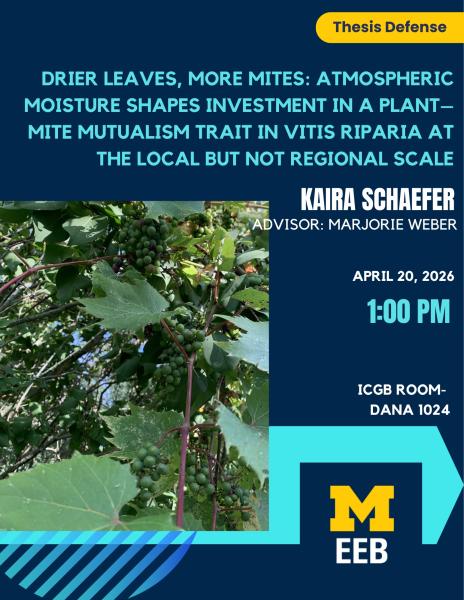
EEB Student Thesis Defense - Drier leaves, more mites: atmospheric moisture shapes investment in a plant–mite mutualism trait in Vitis riparia at the local but not regional scale
Kaira Schaefer, Frontiers MS Student

Abstract:
The stress gradient hypothesis predicts that organisms will invest more in mutualistic interactions under increasing abiotic stress. Here, we examine whether stress associated with reduced atmospheric moisture impacts plant investment in mite domatia, small structures on leaves that mediate a mutualism between plants and defensive mites using riverbank grape (Vitis riparia). We tested prediction of the stress gradient hypothesis at two scales: a local scale using a humidity gradient created by distance from an island lake, and a region scale spanning a precipitation gradient across Michigan’s lower peninsula. At each scale, we measured domatia size, density, and abundance, as well as mite abundance and leaf fungal hyphal load. At the local scale, domatia trichome density was significantly higher in less humid environments, consistent with the stress gradient hypothesis, and mite abundance increased with both humidity and domatia density. At the regional scale, mite abundance increased significantly with precipitation, but no relationship was detected between precipitation and any measure of domatia investment or fungal load. Together, these results suggest that the stress gradient hypothesis partially applies to the plant–mite mutualism in this system, but that its expression depends on scale and the range of moisture conditions experienced.
The stress gradient hypothesis predicts that organisms will invest more in mutualistic interactions under increasing abiotic stress. Here, we examine whether stress associated with reduced atmospheric moisture impacts plant investment in mite domatia, small structures on leaves that mediate a mutualism between plants and defensive mites using riverbank grape (Vitis riparia). We tested prediction of the stress gradient hypothesis at two scales: a local scale using a humidity gradient created by distance from an island lake, and a region scale spanning a precipitation gradient across Michigan’s lower peninsula. At each scale, we measured domatia size, density, and abundance, as well as mite abundance and leaf fungal hyphal load. At the local scale, domatia trichome density was significantly higher in less humid environments, consistent with the stress gradient hypothesis, and mite abundance increased with both humidity and domatia density. At the regional scale, mite abundance increased significantly with precipitation, but no relationship was detected between precipitation and any measure of domatia investment or fungal load. Together, these results suggest that the stress gradient hypothesis partially applies to the plant–mite mutualism in this system, but that its expression depends on scale and the range of moisture conditions experienced.
Co-Sponsored By

Explore Similar Events
-
Loading Similar Events...
