Presented By: University of Michigan Biological Station
“U-M’s Biodiversity Museums: Preserved for Good”
Dr. Alison Davis Rabosky, University of Michigan
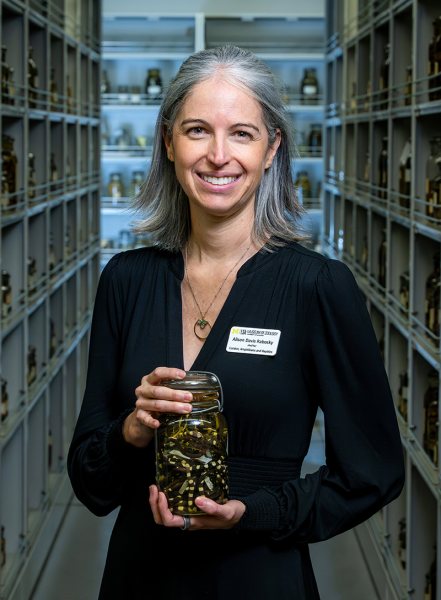

As part of the 2026 Summer Lecture Series at the University of Michigan Biological Station (UMBS), Dr. Alison Davis Rabosky will give a free, public talk titled, “U-M’s Biodiversity Museums: Preserved for Good.”
Rabosky is the director of the University of Michigan Museum of Zoology and an associate professor in the U-M Department of Ecology and Evolutionary Biology. Her research explores how biodiversity evolves across space and time, with a particular focus on snakes, color evolution, and the power of natural history collections to answer questions about our changing world.
She is especially interested in how museums can serve society through research, education, conservation, and public engagement — viewing biodiversity collections not as static archives, but as living scientific resources for the future.
Natural history collections of preserved specimens are among humanity’s greatest long-term scientific projects: vast collaborative efforts to document life on Earth across centuries, continents, and generations.
In this talk, Rabosky will explore how U-M’s biodiversity collections allow scientists to ask questions that cannot be answered any other way, from tracking environmental change and emerging disease to reconstructing the evolution of life itself.
Drawing from work at the University of Michigan Museum of Zoology, the talk will highlight how museums are evolving through new technologies, global collaborations, and interdisciplinary research to serve the people of Michigan and beyond.
The University of Michigan Biological Station serves as a gathering place to learn from the natural world, advance research and education, and inspire action. We leverage over a century of research and transformative experiences to drive discoveries and solutions to benefit Michigan and beyond.
Founded in 1909, UMBS supports long-term research and education through immersive, field-based courses and features state-of-the-art equipment and facilities for data collection and analysis to help any field researcher be productive. It is where students and scientists from across the globe live and work as a community to learn from the place.
The Summer Lecture Series is a tradition at UMBS, where we explore scientific topics with distinguished guest speakers from across the country so the community can learn about our natural world.
The free, public talks are on Wednesdays at 7 p.m. in the spring and summer in Gates Lecture Hall at the University of Michigan Biological Station, located at 9133 Biological Rd. in Pellston, Michigan — about 20 miles south of the Mackinac Bridge.
Rabosky is the director of the University of Michigan Museum of Zoology and an associate professor in the U-M Department of Ecology and Evolutionary Biology. Her research explores how biodiversity evolves across space and time, with a particular focus on snakes, color evolution, and the power of natural history collections to answer questions about our changing world.
She is especially interested in how museums can serve society through research, education, conservation, and public engagement — viewing biodiversity collections not as static archives, but as living scientific resources for the future.
Natural history collections of preserved specimens are among humanity’s greatest long-term scientific projects: vast collaborative efforts to document life on Earth across centuries, continents, and generations.
In this talk, Rabosky will explore how U-M’s biodiversity collections allow scientists to ask questions that cannot be answered any other way, from tracking environmental change and emerging disease to reconstructing the evolution of life itself.
Drawing from work at the University of Michigan Museum of Zoology, the talk will highlight how museums are evolving through new technologies, global collaborations, and interdisciplinary research to serve the people of Michigan and beyond.
The University of Michigan Biological Station serves as a gathering place to learn from the natural world, advance research and education, and inspire action. We leverage over a century of research and transformative experiences to drive discoveries and solutions to benefit Michigan and beyond.
Founded in 1909, UMBS supports long-term research and education through immersive, field-based courses and features state-of-the-art equipment and facilities for data collection and analysis to help any field researcher be productive. It is where students and scientists from across the globe live and work as a community to learn from the place.
The Summer Lecture Series is a tradition at UMBS, where we explore scientific topics with distinguished guest speakers from across the country so the community can learn about our natural world.
The free, public talks are on Wednesdays at 7 p.m. in the spring and summer in Gates Lecture Hall at the University of Michigan Biological Station, located at 9133 Biological Rd. in Pellston, Michigan — about 20 miles south of the Mackinac Bridge.
Related Links

Explore Similar Events
-
Loading Similar Events...
