Presented By: Summer Institute in Survey Research Techniques
June 2 - July 30, 2026 T/TH Course - Sampling in Practice
Yajuan Si - Institute for Social Research, University of Michigan.
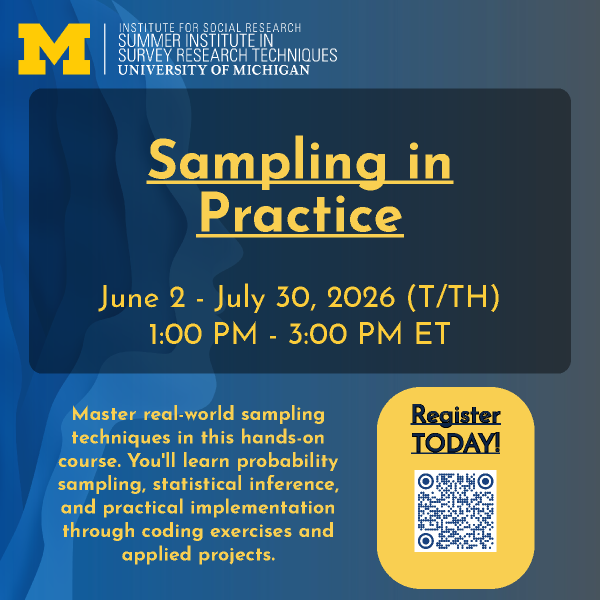

June 2-July 30, 2026, T/TH
1:00pm - 3:00pm
A live course via Zoom. Registration and payment are required a minimum of two weeks prior to the start of the course.
Founded in 1948, the Summer Institute in Survey Research Techniques is designed specifically to meet the needs of professionals and graduate students seeking to deepen their expertise in survey methodology and data collection. Offered through the Michigan Program in Survey and Data Science within the Institute for Social Research at the University of Michigan, the program provides a rigorous and flexible curriculum that blends theoretical foundations with practical application — entirely online.
Sampling in Practice
Unlocking the art and science of sampling with an applied, hands-on approach, the course Sampling in Practice is designed for applied practitioners who want to master real-world sampling techniques through active learning and practical programming. Students will learn about probability sampling methods, including simple random sampling, stratification, systematic selection, cluster sampling, probability proportional to size sampling, and multistage sampling. We will also cover sampling cost models, sampling error estimation techniques, non-sampling errors, missing data, and nonprobability samples. The course emphasizes practical implementation, featuring interactive coding exercises and in-class examples to reinforce each concept. A culminating project will give students the opportunity to integrate multiple techniques into a comprehensive sample design and demonstrate the profession in designing surveys, selecting subjects, analyzing sample data, and solving real sampling problems using modern statistical tools.
Why take this course?
The course is crafted for students and practitioners eager:
To build proficiency in modern sampling techniques through active engagement and practical coding experience
To understand the basic ideas, concepts and principles of probability sampling from an applied perspective
To be able to identify and appropriately apply sampling techniques to survey design problems
To understand and be able to assess the impact of the sample design on survey estimates
To be able to compute the sample size for a variety of sample designs
To learn how to design and select a probability sample involving complex sampling techniques in a survey project, and receive expert feedback on a sampling report.
Yajuan Si is a Research Associate Professor in the Michigan Program in Survey and Data Science, located within in the Institute for Social Research at the University of Michigan. She holds a Ph.D. in statistical science from Duke and received postdoctoral training at Columbia. Yajuan’s research focuses on methodology development, from data analysis to study design, in streams of Bayesian statistics, linking design- and model-based approaches for survey inference, data integration, missing data analysis, confidentiality protection, and causal inference, with applications in the social and health sciences. More information can be found here: https://websites.umich.edu/~yajuan/.
1:00pm - 3:00pm
A live course via Zoom. Registration and payment are required a minimum of two weeks prior to the start of the course.
Founded in 1948, the Summer Institute in Survey Research Techniques is designed specifically to meet the needs of professionals and graduate students seeking to deepen their expertise in survey methodology and data collection. Offered through the Michigan Program in Survey and Data Science within the Institute for Social Research at the University of Michigan, the program provides a rigorous and flexible curriculum that blends theoretical foundations with practical application — entirely online.
Sampling in Practice
Unlocking the art and science of sampling with an applied, hands-on approach, the course Sampling in Practice is designed for applied practitioners who want to master real-world sampling techniques through active learning and practical programming. Students will learn about probability sampling methods, including simple random sampling, stratification, systematic selection, cluster sampling, probability proportional to size sampling, and multistage sampling. We will also cover sampling cost models, sampling error estimation techniques, non-sampling errors, missing data, and nonprobability samples. The course emphasizes practical implementation, featuring interactive coding exercises and in-class examples to reinforce each concept. A culminating project will give students the opportunity to integrate multiple techniques into a comprehensive sample design and demonstrate the profession in designing surveys, selecting subjects, analyzing sample data, and solving real sampling problems using modern statistical tools.
Why take this course?
The course is crafted for students and practitioners eager:
To build proficiency in modern sampling techniques through active engagement and practical coding experience
To understand the basic ideas, concepts and principles of probability sampling from an applied perspective
To be able to identify and appropriately apply sampling techniques to survey design problems
To understand and be able to assess the impact of the sample design on survey estimates
To be able to compute the sample size for a variety of sample designs
To learn how to design and select a probability sample involving complex sampling techniques in a survey project, and receive expert feedback on a sampling report.
Yajuan Si is a Research Associate Professor in the Michigan Program in Survey and Data Science, located within in the Institute for Social Research at the University of Michigan. She holds a Ph.D. in statistical science from Duke and received postdoctoral training at Columbia. Yajuan’s research focuses on methodology development, from data analysis to study design, in streams of Bayesian statistics, linking design- and model-based approaches for survey inference, data integration, missing data analysis, confidentiality protection, and causal inference, with applications in the social and health sciences. More information can be found here: https://websites.umich.edu/~yajuan/.
Cost
- 2,000
Related Links
Co-Sponsored By

Explore Similar Events
-
Loading Similar Events...
