Presented By: Quantum Research Institute
Quantum Research Institute | Heterogeneous Materials Integration for Photonic Integrated Circuits
Prof. Richard Mirin - University of California Santa Barbara
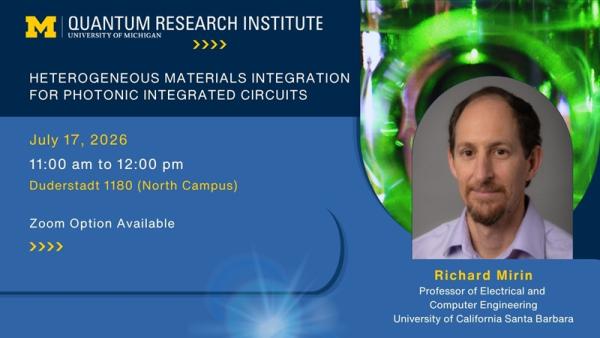

In-Person: Duderstadt 1180 (North Campus)
Zoom: https://umich.zoom.us/j/95879021951?jst=2
Abstract
Wafer-bonding is a key enabling technology for the development of complex photonic integrated circuits (PICs) that utilize the best properties of various materials. III-V semiconductors are especially important for such PICs because they offer a wide variety of bandgaps, very high gain under electrical injection, large optical nonlinearity, and wide transparency regions. I will describe some of the projects done by the Quantum Nanophotonics Group at NIST/Boulder over the past several years that utilize wafer-bonding to make novel optoelectronic devices, including chip-scale nonlinear optics and the demonstration of integrated semiconductor lasers at wavelengths less than 1000 nm.
Bio:
Prof. Richard Mirin received a BS in EECS from UC Berkeley in 1990 and an MS and PhD in ECE from UC Santa Barbara in 1992 and 1996, respectively. In the fall of 1996, he joined the Optoelectronics Division of the National Institute of Standards and Technology (NIST) in Boulder, CO. In January 2026, he returned to the ECE Dept at UC Santa Barbara. Prof. Mirin is a Fellow of Optica and IEEE and an Associate Editor of Optica.
Zoom: https://umich.zoom.us/j/95879021951?jst=2
Abstract
Wafer-bonding is a key enabling technology for the development of complex photonic integrated circuits (PICs) that utilize the best properties of various materials. III-V semiconductors are especially important for such PICs because they offer a wide variety of bandgaps, very high gain under electrical injection, large optical nonlinearity, and wide transparency regions. I will describe some of the projects done by the Quantum Nanophotonics Group at NIST/Boulder over the past several years that utilize wafer-bonding to make novel optoelectronic devices, including chip-scale nonlinear optics and the demonstration of integrated semiconductor lasers at wavelengths less than 1000 nm.
Bio:
Prof. Richard Mirin received a BS in EECS from UC Berkeley in 1990 and an MS and PhD in ECE from UC Santa Barbara in 1992 and 1996, respectively. In the fall of 1996, he joined the Optoelectronics Division of the National Institute of Standards and Technology (NIST) in Boulder, CO. In January 2026, he returned to the ECE Dept at UC Santa Barbara. Prof. Mirin is a Fellow of Optica and IEEE and an Associate Editor of Optica.

Livestream Information
ZoomJuly 17, 2026 (Friday) 11:00am
Meeting ID: 958790219512
Explore Similar Events
-
Loading Similar Events...
