Presented By: Earth and Environmental Sciences
Tara Lonsdorf Dissertation Defense
Climatic and Topographic Controls on Meteoric Waters of the North American Cordillera: New Insights from Stable Isotopes
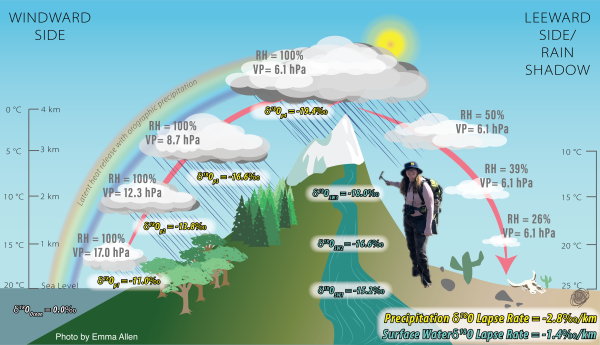

Stable isotope paleoaltimetry relies on the predictable relationship between topography and δ18O of meteoric waters, under assumptions that simple orographic lifting is the primary control on isotopic fractionation. However, in continental interiors, teleconnections between topography and hydroclimate may also affect meteoric δ18O, complicating interpretations of paleotopography. This uncertainty is particularly problematic for paleotopographic reconstructions of the North American Cordillera (NAC), where paleoelevation estimates underpin hypotheses in geodynamics, evolutionary biology and paleoclimatology. To improve stable isotope paleoaltimetry reconstructions of the NAC from the Cretaceous to the present, this dissertation reevaluates three fundamental components of stable isotope paleoaltimetry.
First, Chapter 2 addresses challenges to defining surface water isotopic lapse rates (‰/km), which translate isotopic shifts to elevation change. Using ~6,000 published surface water isotopic measurements, I empirically characterize the spatial variability of >400 local surface water isotopic lapse rates in the NAC. Lapse rate magnitudes generally correlate with regional (Basin and Range; Rocky Mountains) aridity, but the underlying processes (elevation-dependent precipitation; snowpack sublimation) are not generalizable between regions. Rather, processes governing lapse rate magnitudes are sensitive to regional physiography, including the rain shadow cast by Sierra Nevadas and the relief between the Front Range and the Great Plains. Problematically, these relationships suggest that defining surface water isotopic lapse rates requires a priori knowledge of paleotopography, challenging applications of stable isotopes to paleoelevation reconstructions in arid continental interiors.
Next, Chapter 3 investigates how evolving mountains route and block air masses, producing or removing rain shadows. Specifically, I focus on resolving the timing and magnitude of hydroclimate transitions coincident with orographic collapse of the central Sevier hinterland across the Eocene-Oligocene transition. To reconstruct hydroclimate change, I report isotopic measurements (δ18O, δ13C) of fossil tooth enamel and revise sedimentation rates of Eocene through-Miocene-aged strata from Sage Creek Basin, southwestern Montana. Coupled isotopic depletion and decreasing grain size at ~32 Ma coincided with high-magnitude extension of metamorphic core complexes and associated surface lowering. This result is surprising, because negative isotopic shifts are typically associated with orographic uplift, rather than
orographic collapse. I infer that surface lowering removed a rain shadow between the Pacific Ocean and southwestern Montana, quadrupling contributions of cold, isotopically-depleted precipitation in the foreland. This hypothesis suggests that isotopic shifts in evolving orogens may be complex and unintuitive, requiring interpretations using multiple hydroclimate proxies and uplift records.
Finally, Chapter 4 investigates whether estimates of carbonate formation temperatures, necessary for reconstructing meteoric water δ18O, may be biased by cryptic hydrothermal origins in active orogenic belts. I evaluate the formation temperatures of the McKnight Canyon
limestone unit — an unusual synorogenic oncolite precipitated at the onset of Laramide uplift (~73.3 Ma) in southwestern Montana — using geochemical indicators of carbonate formation temperatures, including dual-clumped isotope thermometry. Extreme Δ48 disequilibrium suggests precipitation as a sulfate-reducing microbialite from hydrothermal spring waters at ~35–45 °C, which may reasonably be misinterpreted as reflecting ambient temperature under a hothouse climate in the Cretaceous. Accurately reconstructing δ18O in uplifting mountain belts, where hydrothermal springs are common, may thus require calibrating the “dual-clumped isotope thermometer” for hydrothermal travertines. Collectively, these studies suggest that stable isotope paleoaltimetry in the NAC and other continental interiors is more complicated than previously recognized. Nonetheless, δ18O in conjunction with other paleoenvironmental proxy records may yield rich insights into the causes and consequences of topographic change through geologic time.
First, Chapter 2 addresses challenges to defining surface water isotopic lapse rates (‰/km), which translate isotopic shifts to elevation change. Using ~6,000 published surface water isotopic measurements, I empirically characterize the spatial variability of >400 local surface water isotopic lapse rates in the NAC. Lapse rate magnitudes generally correlate with regional (Basin and Range; Rocky Mountains) aridity, but the underlying processes (elevation-dependent precipitation; snowpack sublimation) are not generalizable between regions. Rather, processes governing lapse rate magnitudes are sensitive to regional physiography, including the rain shadow cast by Sierra Nevadas and the relief between the Front Range and the Great Plains. Problematically, these relationships suggest that defining surface water isotopic lapse rates requires a priori knowledge of paleotopography, challenging applications of stable isotopes to paleoelevation reconstructions in arid continental interiors.
Next, Chapter 3 investigates how evolving mountains route and block air masses, producing or removing rain shadows. Specifically, I focus on resolving the timing and magnitude of hydroclimate transitions coincident with orographic collapse of the central Sevier hinterland across the Eocene-Oligocene transition. To reconstruct hydroclimate change, I report isotopic measurements (δ18O, δ13C) of fossil tooth enamel and revise sedimentation rates of Eocene through-Miocene-aged strata from Sage Creek Basin, southwestern Montana. Coupled isotopic depletion and decreasing grain size at ~32 Ma coincided with high-magnitude extension of metamorphic core complexes and associated surface lowering. This result is surprising, because negative isotopic shifts are typically associated with orographic uplift, rather than
orographic collapse. I infer that surface lowering removed a rain shadow between the Pacific Ocean and southwestern Montana, quadrupling contributions of cold, isotopically-depleted precipitation in the foreland. This hypothesis suggests that isotopic shifts in evolving orogens may be complex and unintuitive, requiring interpretations using multiple hydroclimate proxies and uplift records.
Finally, Chapter 4 investigates whether estimates of carbonate formation temperatures, necessary for reconstructing meteoric water δ18O, may be biased by cryptic hydrothermal origins in active orogenic belts. I evaluate the formation temperatures of the McKnight Canyon
limestone unit — an unusual synorogenic oncolite precipitated at the onset of Laramide uplift (~73.3 Ma) in southwestern Montana — using geochemical indicators of carbonate formation temperatures, including dual-clumped isotope thermometry. Extreme Δ48 disequilibrium suggests precipitation as a sulfate-reducing microbialite from hydrothermal spring waters at ~35–45 °C, which may reasonably be misinterpreted as reflecting ambient temperature under a hothouse climate in the Cretaceous. Accurately reconstructing δ18O in uplifting mountain belts, where hydrothermal springs are common, may thus require calibrating the “dual-clumped isotope thermometer” for hydrothermal travertines. Collectively, these studies suggest that stable isotope paleoaltimetry in the NAC and other continental interiors is more complicated than previously recognized. Nonetheless, δ18O in conjunction with other paleoenvironmental proxy records may yield rich insights into the causes and consequences of topographic change through geologic time.

Explore Similar Events
-
Loading Similar Events...
