Presented By: Donia Human Rights Center
Donia Human Rights Center and Artificial Intelligence Laboratory Workshop | AI & Human Rights Workshop
Multiple Speakers

Co-sponsored by the Artificial Intelligence Laboratory: https://ai.engin.umich.edu/
Registration required. Please message [email protected] with your name, e-mail, faculty or student status, and a brief indication of how your work relates to AI & Human Rights.
Location: DOW Event Space, 4320 Leinweber Computer Science and Information Building (2200 Hayward Street Ann Arbor, MI)
Presenters/facilitators:
Rada Mihalcea (Janice M. Jenkins Collegiate Professor of Computer Science and Engineering, Professor and Director, Artificial Intelligence Lab)
Peter Railton (Emeritus Gregory S. Kavka Distinguished University Professor; John Stephenson Perrin Professor; Arthur F. Thurnau Professor, UM LSA Philosophy)
Zhijing Jin (Assistant Professor at the University of Toronto, and a Research Scientist at the Max Planck Institute)
Keynotes from:
Bridgette Carr (Clinical Professor of Law; Co-director, AI Law and Policy Clinic)
Christian Schroeder de Witt (Associate Professor, Oxford University)
AI is increasingly shaping the way we address some of the world’s most pressing human rights challenges. While AI has the potential to uncover abuses, expand access to critical services, support crisis response, and identify harmful patterns at scale, it can also amplify surveillance, bias, disinformation, and exclusion.
To build AI systems that are both effective and responsible, collaboration across disciplines is essential.
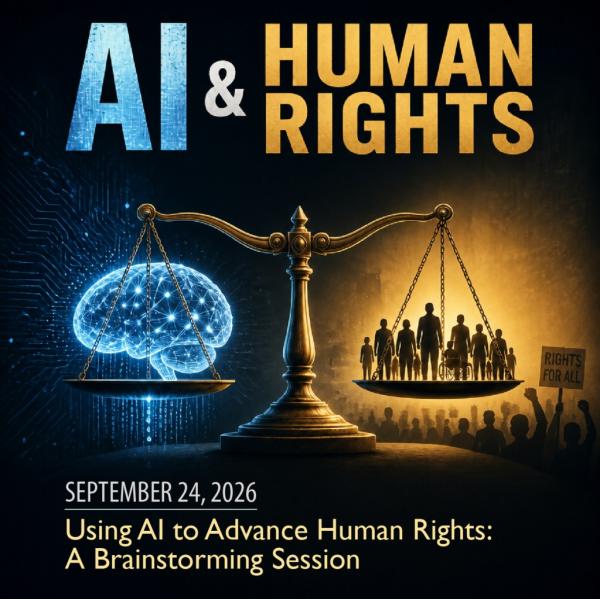
We invite you to join the AI & Human Rights Workshop on September 24, 2026, where researchers, human rights practitioners, and domain experts will explore how advances in AI can help address human rights challenges, and how these challenges can inspire new directions for AI research.
The workshop will feature brief presentations followed by interactive table discussions designed to foster collaboration across disciplines. Participants are encouraged to bring their own research questions, ideas, challenges, and perspectives to the conversation.
Presenters and facilitators include:
Rada Mihalcea, Janice M. Jenkins Collegiate Professor of Computer Science and Engineering; Director, Michigan AI Lab
Peter Railton, Emeritus Gregory S. Kavka Distinguished University Professor; John Stephenson Perrin Professor; Arthur F. Thurnau Professor, U-M Philosophy
Zhijing Jin, Assistant Professor, University of Toronto; Research Scientist, Max Planck Institute
Bridgette Carr, Clinical Professor of Law, Co-director, AI Law and Policy Clinic
Christian Schroeder de Witt, Associate Professor, University of Oxford
The ideas and discussions generated during the workshop will serve as the foundation for a white paper on the intersection of AI and Human Rights.
This workshop is co-sponsored by the Artificial Intelligence Lab, Donia Human Rights Center and the International Institute.
Please register here: https://sessions.studentlife.umich.edu/track/event/session/111088 by September 10.
Program
1:00-1:10 pm
Goals and directions
Rada Mihalcea, Michigan AI Laboratory
Sueann Caulfield, Donia Center for Human Rights
1:10-1:30 pm
Peter Railton (University of Michigan): Human Rights in a Hybrid World
1:30-1:50 pm
Christian Schroeder (Oxford University): AI for Accountability: Not All Errors Are Equal
1:50-2:10 pm
Bridgette Carr (University of Michigan): Nobody Was Looking: Debt, Coercion, and What AI Changes
2:10-2:30 pm
Zhijing Jin (University of Toronto): Synergizing Human Rights Protection with Rigorous AI Evaluation
2:30-2:50 pm
Susan Perry (American University of Paris, UNESCO Chair in AI & Human Rights): Turning AI on Its Head
2:50-3:00 pm
Coffee Break
3:00-4:25 pm
Roundtables with one lead and one note-taker (5 tables)
3:00-3:10 pm: Introduction to the Roundtable discussion format
3:10-3:15 pm: (5 min) Brief introductions (“I am X, from Dept. Y, I’m interested in the aspects of Z on Human Rights and/or AI”)
3:15-3:20 pm: (5 min) Individual thinking and notes on stickies for (i) Challenges that (could) intersect with AI
3:20-3:50 pm: (30 min) Group discussions
3:50-3:55 pm: (5 min) Individual thinking and notes on stickies for (ii) Potential AI Solutions on problems identified
3:55 pm-4:25 pm: (30 min) Group discussions
4:25-4:50 pm: (5 min / table) Report back
4:50-5:00 pm
Wrap-up
If there is anything we can do to make this event accessible to you, please contact us at [email protected]. Please be aware that advance notice is necessary as some accommodations may require more time for the university to arrange.
Registration required. Please message [email protected] with your name, e-mail, faculty or student status, and a brief indication of how your work relates to AI & Human Rights.
Location: DOW Event Space, 4320 Leinweber Computer Science and Information Building (2200 Hayward Street Ann Arbor, MI)
Presenters/facilitators:
Rada Mihalcea (Janice M. Jenkins Collegiate Professor of Computer Science and Engineering, Professor and Director, Artificial Intelligence Lab)
Peter Railton (Emeritus Gregory S. Kavka Distinguished University Professor; John Stephenson Perrin Professor; Arthur F. Thurnau Professor, UM LSA Philosophy)
Zhijing Jin (Assistant Professor at the University of Toronto, and a Research Scientist at the Max Planck Institute)
Keynotes from:
Bridgette Carr (Clinical Professor of Law; Co-director, AI Law and Policy Clinic)
Christian Schroeder de Witt (Associate Professor, Oxford University)
AI is increasingly shaping the way we address some of the world’s most pressing human rights challenges. While AI has the potential to uncover abuses, expand access to critical services, support crisis response, and identify harmful patterns at scale, it can also amplify surveillance, bias, disinformation, and exclusion.
To build AI systems that are both effective and responsible, collaboration across disciplines is essential.
We invite you to join the AI & Human Rights Workshop on September 24, 2026, where researchers, human rights practitioners, and domain experts will explore how advances in AI can help address human rights challenges, and how these challenges can inspire new directions for AI research.
The workshop will feature brief presentations followed by interactive table discussions designed to foster collaboration across disciplines. Participants are encouraged to bring their own research questions, ideas, challenges, and perspectives to the conversation.
Presenters and facilitators include:
Rada Mihalcea, Janice M. Jenkins Collegiate Professor of Computer Science and Engineering; Director, Michigan AI Lab
Peter Railton, Emeritus Gregory S. Kavka Distinguished University Professor; John Stephenson Perrin Professor; Arthur F. Thurnau Professor, U-M Philosophy
Zhijing Jin, Assistant Professor, University of Toronto; Research Scientist, Max Planck Institute
Bridgette Carr, Clinical Professor of Law, Co-director, AI Law and Policy Clinic
Christian Schroeder de Witt, Associate Professor, University of Oxford
The ideas and discussions generated during the workshop will serve as the foundation for a white paper on the intersection of AI and Human Rights.
This workshop is co-sponsored by the Artificial Intelligence Lab, Donia Human Rights Center and the International Institute.
Please register here: https://sessions.studentlife.umich.edu/track/event/session/111088 by September 10.
Program
1:00-1:10 pm
Goals and directions
Rada Mihalcea, Michigan AI Laboratory
Sueann Caulfield, Donia Center for Human Rights
1:10-1:30 pm
Peter Railton (University of Michigan): Human Rights in a Hybrid World
1:30-1:50 pm
Christian Schroeder (Oxford University): AI for Accountability: Not All Errors Are Equal
1:50-2:10 pm
Bridgette Carr (University of Michigan): Nobody Was Looking: Debt, Coercion, and What AI Changes
2:10-2:30 pm
Zhijing Jin (University of Toronto): Synergizing Human Rights Protection with Rigorous AI Evaluation
2:30-2:50 pm
Susan Perry (American University of Paris, UNESCO Chair in AI & Human Rights): Turning AI on Its Head
2:50-3:00 pm
Coffee Break
3:00-4:25 pm
Roundtables with one lead and one note-taker (5 tables)
3:00-3:10 pm: Introduction to the Roundtable discussion format
3:10-3:15 pm: (5 min) Brief introductions (“I am X, from Dept. Y, I’m interested in the aspects of Z on Human Rights and/or AI”)
3:15-3:20 pm: (5 min) Individual thinking and notes on stickies for (i) Challenges that (could) intersect with AI
3:20-3:50 pm: (30 min) Group discussions
3:50-3:55 pm: (5 min) Individual thinking and notes on stickies for (ii) Potential AI Solutions on problems identified
3:55 pm-4:25 pm: (30 min) Group discussions
4:25-4:50 pm: (5 min / table) Report back
4:50-5:00 pm
Wrap-up
If there is anything we can do to make this event accessible to you, please contact us at [email protected]. Please be aware that advance notice is necessary as some accommodations may require more time for the university to arrange.
Co-Sponsored By

Explore Similar Events
-
Loading Similar Events...
