Presented By: Weiser Center for Europe and Eurasia
WCEE Exhibition. The Art of Memory, Paintings by Felix Lembersky
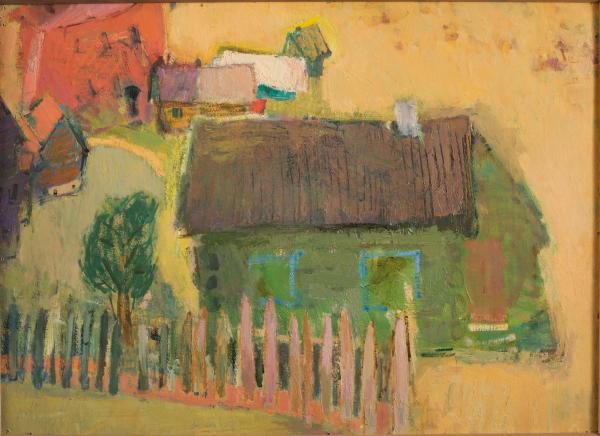

Felix Lembersky (1913-1970) was a painter, theater stage designer, teacher, and leader of artistic groups. He began his career within the Soviet Avant-Garde in Ukraine before studying realist painting in Leningrad (now Saint Petersburg). Throughout his life he worked across realist and modernist styles that fell outside of Soviet-mandated Socialist Realism. His Execution: Babyn Yar series (ca. 1944-52) is the earliest known artistic representation of Babyn Yar, a Holocaust massacre site in Kyiv. For political reasons, these paintings, along with his later nonconformist work, were barred from exhibition in the Soviet Union.
Having witnessed two world wars, the 1917 revolution, and political terror, Lembersky reflected on these experiences with candor while imbuing his work with hope and optimism. He was drawn to vulnerable, neglected, and marginalized people: children, the elderly, ethnic minorities, and industrial workers subjected to harsh labor and dangerous conditions. Regardless of their circumstances, Lembersky portrayed his subjects with empathy, dignity, and admiration.
“For my father, honesty and integrity meant more than anything else. Art was an expression of freedom, individuality, and personalized creativity, without which it ceased to be art.”
— Galina Lembersky, daughter
Exhibit curated by Yelena Lembersky, granddaughter of Felix Lembersky, and Geneviève Zubrzycki, WCEE Director.
Works on loan from the private collection of Yelena Lembersky.
Contact [email protected] to schedule a viewing.
If there is anything we can do to make this event accessible to you, please contact us at [email protected]. Please be aware that advance notice is necessary as some accommodations may require more time for the university to arrange.
Having witnessed two world wars, the 1917 revolution, and political terror, Lembersky reflected on these experiences with candor while imbuing his work with hope and optimism. He was drawn to vulnerable, neglected, and marginalized people: children, the elderly, ethnic minorities, and industrial workers subjected to harsh labor and dangerous conditions. Regardless of their circumstances, Lembersky portrayed his subjects with empathy, dignity, and admiration.
“For my father, honesty and integrity meant more than anything else. Art was an expression of freedom, individuality, and personalized creativity, without which it ceased to be art.”
— Galina Lembersky, daughter
Exhibit curated by Yelena Lembersky, granddaughter of Felix Lembersky, and Geneviève Zubrzycki, WCEE Director.
Works on loan from the private collection of Yelena Lembersky.
Contact [email protected] to schedule a viewing.
If there is anything we can do to make this event accessible to you, please contact us at [email protected]. Please be aware that advance notice is necessary as some accommodations may require more time for the university to arrange.
Co-Sponsored By

Explore Similar Events
-
Loading Similar Events...
Back to Main Content
0 upcoming occurrences
0 expired occurrences
0 expired occurrences
Show Past Occurrences
