Presented By: Nuclear Engineering & Radiological Sciences
NERS Colloquium: Extending Electron Emission Models Beyond Planar, Single Mechanism Devices
Allen L. Garner, Purdue University

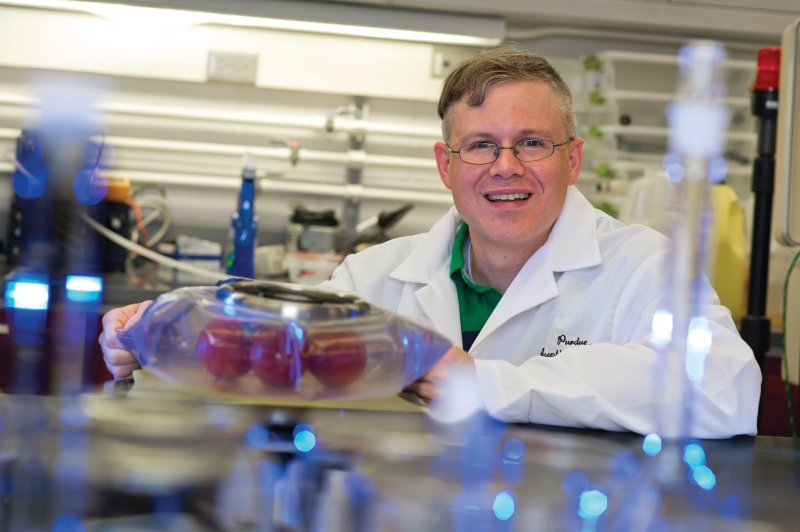
Dr. Allen L. Garner, a professor of nuclear engineering at Purdue University and U-M NERS alumnus, will discuss new mathematical approaches to modeling electron emission and current flow in complex geometries. His research explores how different electron emission mechanisms interact with space-charge limitations, offering alternatives to computationally expensive simulations. These models have applications in high-power microwaves, directed energy, radiation devices, and semiconductor manufacturing.
Abstract:
Electron emission physics is important in high-power microwaves, directed energy, high-power radiation devices, and sheath physics in plasma processing in the semiconductor industry. Electrons may be emitted due to strong electric fields by field emission (FE) or high cathode temperatures by thermal emission (TE). Jensen developed a mathematical framework to link FE, TE, and photoemission. Regardless of source, only so much current may be emitted into a gap. The resulting space-charge-limited current density (SCLCD) was derived over a century ago for a one-dimensional (1D) vacuum planar diode by Child and Langmuir, while Mott and Gurney derived an analogous law for semiconductors three decades later. Extensions to more realistic geometries and intermediate conditions between the Child-Langmuir (CLL) and Mott-Gurney (MGL) laws, as well as FE and TE, are challenging, often requiring detailed and computationally expensive simulations. This seminar describes approaches to model multidimensional, nonplanar geometries with multiple emission mechanisms and apply these models to practical conditions.
First, we summarize geometric approaches to generalize SCLCD calculations. We apply variational calculus (VC) to extremize the current in the gap, conformal mapping of the space-charge electric potential to translate the solution from Cartesian coordinates to the geometry of interest, and Lie point symmetries (i.e., point transformations) to derive exact solutions for multiple 1D geometries. We further derive a universal relationship between vacuum electric potential and space-charge limited potential that yields SCLCD for multidimensional diodes with any geometry and apply it to derive the SCLCD for a tip-to-tip geometry and for arrays of tips, demonstrating reasons for disagreements between theory and particle-in-cell simulations. Since all these approaches depend on electric potential, we demonstrate the importance of the spatial variation of electric potential in a collisional gap and how it relates to the collision frequency. We further demonstrate the utility of these equations to calculate the collision frequency in a gap.
Next, we describe our application of “nexus” theory to describe the transition between source currents (e.g., FE or TE) and the SCLCD. We combine nexus theory with point transformation to generalize SCLCD and the transitions between the source currents and SCLCD for nonplanar diodes. Using current-voltage curves from molecular dynamics simulations, we demonstrate how to combine nexus theory and charge-free electric potential to calculate emission area for any mechanism and geometry.
Bio:
Dr. Allen L. Garner received the B.S. degree (with high honors) in nuclear engineering from the University of Illinois, Urbana-Champaign, in 1996. He received an M.S.E. in nuclear engineering from the University of Michigan in 1997, an M.S. in electrical engineering from Old Dominion University in 2003, and a Ph.D. in nuclear engineering from the University of Michigan in 2006. He was an active duty Naval officer from 1997 to 2003 and is currently a Captain in the United States Navy Reserves. From 2006 to 2012, he was an electromagnetic physicist at GE Global Research Center. He joined the School of Nuclear Engineering at Purdue University in 2012, where he is currently a Professor.
The NERS Colloquia Series invites leading researchers, industry experts, and thought leaders from across the nuclear engineering and radiological sciences community to share their insights with students, faculty, and guests. Covering a wide range of topics—from cutting-edge research and emerging technologies to policy, education, and professional development—the weekly talks offer an opportunity to explore current issues and innovations shaping the future of the field.
Abstract:
Electron emission physics is important in high-power microwaves, directed energy, high-power radiation devices, and sheath physics in plasma processing in the semiconductor industry. Electrons may be emitted due to strong electric fields by field emission (FE) or high cathode temperatures by thermal emission (TE). Jensen developed a mathematical framework to link FE, TE, and photoemission. Regardless of source, only so much current may be emitted into a gap. The resulting space-charge-limited current density (SCLCD) was derived over a century ago for a one-dimensional (1D) vacuum planar diode by Child and Langmuir, while Mott and Gurney derived an analogous law for semiconductors three decades later. Extensions to more realistic geometries and intermediate conditions between the Child-Langmuir (CLL) and Mott-Gurney (MGL) laws, as well as FE and TE, are challenging, often requiring detailed and computationally expensive simulations. This seminar describes approaches to model multidimensional, nonplanar geometries with multiple emission mechanisms and apply these models to practical conditions.
First, we summarize geometric approaches to generalize SCLCD calculations. We apply variational calculus (VC) to extremize the current in the gap, conformal mapping of the space-charge electric potential to translate the solution from Cartesian coordinates to the geometry of interest, and Lie point symmetries (i.e., point transformations) to derive exact solutions for multiple 1D geometries. We further derive a universal relationship between vacuum electric potential and space-charge limited potential that yields SCLCD for multidimensional diodes with any geometry and apply it to derive the SCLCD for a tip-to-tip geometry and for arrays of tips, demonstrating reasons for disagreements between theory and particle-in-cell simulations. Since all these approaches depend on electric potential, we demonstrate the importance of the spatial variation of electric potential in a collisional gap and how it relates to the collision frequency. We further demonstrate the utility of these equations to calculate the collision frequency in a gap.
Next, we describe our application of “nexus” theory to describe the transition between source currents (e.g., FE or TE) and the SCLCD. We combine nexus theory with point transformation to generalize SCLCD and the transitions between the source currents and SCLCD for nonplanar diodes. Using current-voltage curves from molecular dynamics simulations, we demonstrate how to combine nexus theory and charge-free electric potential to calculate emission area for any mechanism and geometry.
Bio:
Dr. Allen L. Garner received the B.S. degree (with high honors) in nuclear engineering from the University of Illinois, Urbana-Champaign, in 1996. He received an M.S.E. in nuclear engineering from the University of Michigan in 1997, an M.S. in electrical engineering from Old Dominion University in 2003, and a Ph.D. in nuclear engineering from the University of Michigan in 2006. He was an active duty Naval officer from 1997 to 2003 and is currently a Captain in the United States Navy Reserves. From 2006 to 2012, he was an electromagnetic physicist at GE Global Research Center. He joined the School of Nuclear Engineering at Purdue University in 2012, where he is currently a Professor.
The NERS Colloquia Series invites leading researchers, industry experts, and thought leaders from across the nuclear engineering and radiological sciences community to share their insights with students, faculty, and guests. Covering a wide range of topics—from cutting-edge research and emerging technologies to policy, education, and professional development—the weekly talks offer an opportunity to explore current issues and innovations shaping the future of the field.

Explore Similar Events
-
Loading Similar Events...
