Presented By: Michigan Robotics
Human-Robot Shared Planning and Control Through Two-Way Haptic Communication
Robotics PhD Defense, Hannah Baez

Co-chairs: Brent Gillespie and Nadine Sarter
Abstract:
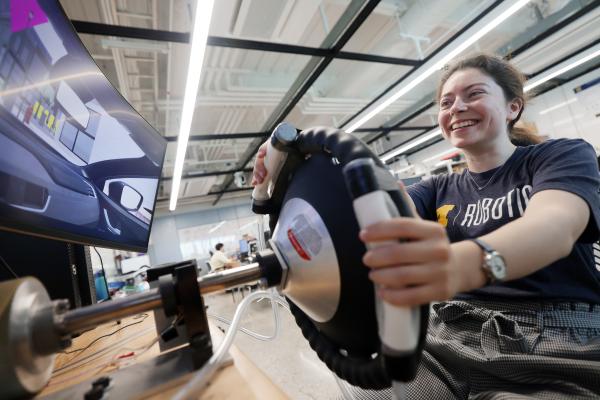
As semi-autonomous vehicles enter widespread use, their designs still depend on a human supervisor as the ultimate guarantor of safety, yet that passive supervisory role introduces risks of its own. People struggle to maintain vigilance over long periods of time, making quick interventions difficult when the automation fails, and as a consequence of ceding control to automation, are susceptible to losing driving skills with time. Haptic Shared Control (HSC) offers an alternative: driver and automation remain mechanically coupled through a shared steering wheel, each continuously feeling the other's torque. This keeps the driver in the control loop and replaces the demands of passive vigilance with those of active steering. However, when the driver and automation hold conflicting navigation plans, HSC results in physical control conflicts, known as "steering fights". Existing solutions rely on algorithms that infer intent of the human driver or employ one-way visual and auditory displays to inform the driver of automation intent. These approaches can overload the visual field and give the driver no way to actively negotiate intent with the automation. This dissertation addresses the limitations in HSC by establishing a theoretical and physical framework for pre-action negotiation by the members of human-automation teams while they are engaged in control sharing. Drawing on human factors teaming principles, I present an interface which physically separates real-time vehicle steering from strategic plan negotiation under the driver’s grip.
I implement the framework using a Gooey interface: a soft, pneumatic, shape-changing interface positioned on the steering wheel and designed for non-visual, two-way intent communication through continuous inflation displays and squeeze-based negotiation. Across controlled driving simulator experiments involving 30 participants, enabling two-way negotiation in the grip axis eliminated steering fights, significantly reduced cumulative lateral tracking error during plan disagreements, and lowered driver torque and braking effort. Bidirectional negotiation also significantly accelerated trust recovery following a period of clustered automation faults compared to one-way displays and standard HSC baselines.
Finally, I synthesize these empirical findings into general design principles for haptic coordination interfaces. This work shows how explicit pre-action negotiation, carried on an active channel capable of bidirectional communication and grounding, builds shared mental models, reduces cognitive load, and sustains resilient trust in human-robot teams.
Abstract:
As semi-autonomous vehicles enter widespread use, their designs still depend on a human supervisor as the ultimate guarantor of safety, yet that passive supervisory role introduces risks of its own. People struggle to maintain vigilance over long periods of time, making quick interventions difficult when the automation fails, and as a consequence of ceding control to automation, are susceptible to losing driving skills with time. Haptic Shared Control (HSC) offers an alternative: driver and automation remain mechanically coupled through a shared steering wheel, each continuously feeling the other's torque. This keeps the driver in the control loop and replaces the demands of passive vigilance with those of active steering. However, when the driver and automation hold conflicting navigation plans, HSC results in physical control conflicts, known as "steering fights". Existing solutions rely on algorithms that infer intent of the human driver or employ one-way visual and auditory displays to inform the driver of automation intent. These approaches can overload the visual field and give the driver no way to actively negotiate intent with the automation. This dissertation addresses the limitations in HSC by establishing a theoretical and physical framework for pre-action negotiation by the members of human-automation teams while they are engaged in control sharing. Drawing on human factors teaming principles, I present an interface which physically separates real-time vehicle steering from strategic plan negotiation under the driver’s grip.
I implement the framework using a Gooey interface: a soft, pneumatic, shape-changing interface positioned on the steering wheel and designed for non-visual, two-way intent communication through continuous inflation displays and squeeze-based negotiation. Across controlled driving simulator experiments involving 30 participants, enabling two-way negotiation in the grip axis eliminated steering fights, significantly reduced cumulative lateral tracking error during plan disagreements, and lowered driver torque and braking effort. Bidirectional negotiation also significantly accelerated trust recovery following a period of clustered automation faults compared to one-way displays and standard HSC baselines.
Finally, I synthesize these empirical findings into general design principles for haptic coordination interfaces. This work shows how explicit pre-action negotiation, carried on an active channel capable of bidirectional communication and grounding, builds shared mental models, reduces cognitive load, and sustains resilient trust in human-robot teams.
Related Links

Explore Similar Events
-
Loading Similar Events...
