Presented By: Classical Studies
Τhe Greek Poet of the 21st Century between Melancholic Rupture and Insurgent Utopia
Presented by Athina Rossoglou, Greek Ministry of Foreign Affairs
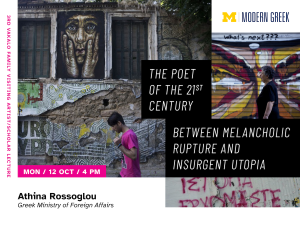

3rd Vakalo Family Visiting Artist/Scholar Lecture
This lecture examines the poet of the twenty-first century as a social and political subject, focusing on contemporary Greek poetry as it emerges through the interviews included in the online ten-year project Reading Greece implemented by the Greek Ministry of Foreign Affairs. Drawing on poets’ own reflections, it explores how today’s poets position themselves not as a detached aesthetic figure, but as an engaged agent, deeply implicated in the historical, political, and affective landscapes of their time. Contemporary Greek poets articulate a dynamic dialogue with the past, engaging with personal and collective histories, past traumas, and the longue durée of Greek cultural memory. In their work, poetry becomes a site where language registers the immediate pressures of socio-political reality: austerity, precarity, migration, gendered and racialized violence, and the restructuring of public space. The poet of the twenty-first century emerges as a figure who inhabits contradiction, between private vulnerability and public intervention, historical burden and utopian projection. This lecture argues that contemporary Greek poetry offers not only aesthetic innovation but also a form of political thinking: a practice that interrogates reality, reclaims history, and reimagines the collective horizon.
Athina Rossoglou is a graduate of the Department of Foreign Languages, Translation and Interpreting at the Ionian University. She has pursued studies in European Civilization and holds a postgraduate degree in Public History. She is currently a doctoral candidate at the Ionian University. Her research examines Greek poetry of the 21st century, with particular emphasis on the ways in which it engages with the concepts of history, nationhood, public space, and identity formation. She serves as a Press Attaché at the Greek Ministry of Foreign Affairs, where she was responsible for the “Reading Greece” project for a period of ten years, an initiative aimed at the promotion and international dissemination of contemporary Greek literature.
This lecture examines the poet of the twenty-first century as a social and political subject, focusing on contemporary Greek poetry as it emerges through the interviews included in the online ten-year project Reading Greece implemented by the Greek Ministry of Foreign Affairs. Drawing on poets’ own reflections, it explores how today’s poets position themselves not as a detached aesthetic figure, but as an engaged agent, deeply implicated in the historical, political, and affective landscapes of their time. Contemporary Greek poets articulate a dynamic dialogue with the past, engaging with personal and collective histories, past traumas, and the longue durée of Greek cultural memory. In their work, poetry becomes a site where language registers the immediate pressures of socio-political reality: austerity, precarity, migration, gendered and racialized violence, and the restructuring of public space. The poet of the twenty-first century emerges as a figure who inhabits contradiction, between private vulnerability and public intervention, historical burden and utopian projection. This lecture argues that contemporary Greek poetry offers not only aesthetic innovation but also a form of political thinking: a practice that interrogates reality, reclaims history, and reimagines the collective horizon.
Athina Rossoglou is a graduate of the Department of Foreign Languages, Translation and Interpreting at the Ionian University. She has pursued studies in European Civilization and holds a postgraduate degree in Public History. She is currently a doctoral candidate at the Ionian University. Her research examines Greek poetry of the 21st century, with particular emphasis on the ways in which it engages with the concepts of history, nationhood, public space, and identity formation. She serves as a Press Attaché at the Greek Ministry of Foreign Affairs, where she was responsible for the “Reading Greece” project for a period of ten years, an initiative aimed at the promotion and international dissemination of contemporary Greek literature.
Co-Sponsored By

Explore Similar Events
-
Loading Similar Events...
