Presented By: Department of Molecular, Cellular, and Developmental Biology
MCDB Seminar Series> The impact of genetic cheating on mammalian reproduction and speciation
Takashi Akera, National Institutes of Health
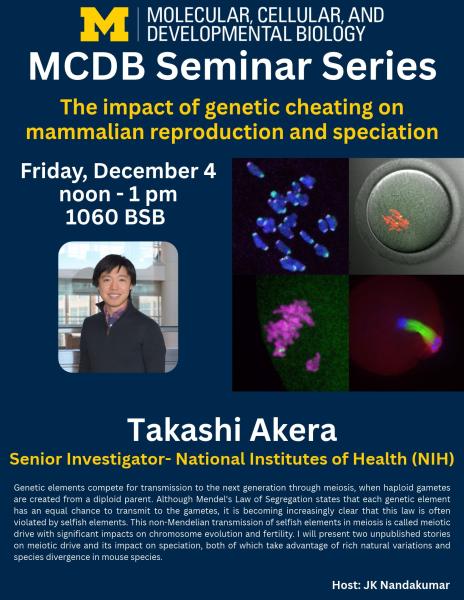

Abstract: Genetic elements compete for transmission to the next generation through meiosis, when haploid gametes are created from a diploid parent. Although Mendel's Law of Segregation states that each genetic element has an equal chance to transmit to the gametes, it is becoming increasingly clear that this law is often violated by selfish elements. This non-Mendelian transmission of selfish elements in meiosis is called meiotic drive with significant impacts on chromosome evolution and fertility. I will present two unpublished stories on meiotic drive and its impact on speciation, both of which take advantage of rich natural variations and species divergence in mouse species.
Bio: Dr. Takashi Akera graduated from the University of Tokyo with a Ph.D. in Biophysics and Biochemistry in 2014. He conducted postdoctoral research at the University of Pennsylvania in the laboratory of Dr. Michael Lampson from 2015 to 2019. He received both Holtzer Award for outstanding postdoctoral research in Cell and Developmental Biology and Kaushal Award for excellence in postdoctoral research in Genetics from the University of Pennsylvania in 2018. Dr. Akera joined the NHLBI in 2019 as an Earl Stadtman tenure-track Investigator and has made fundamental advances in the understanding of genetic cheating and its impact on mammalian reproduction and speciation. He has received the 2024 NHLBI Outstanding Mentor Award and the 2026 Vilcek Prize for Creative Promise in Biomedical Sciences.
Bio: Dr. Takashi Akera graduated from the University of Tokyo with a Ph.D. in Biophysics and Biochemistry in 2014. He conducted postdoctoral research at the University of Pennsylvania in the laboratory of Dr. Michael Lampson from 2015 to 2019. He received both Holtzer Award for outstanding postdoctoral research in Cell and Developmental Biology and Kaushal Award for excellence in postdoctoral research in Genetics from the University of Pennsylvania in 2018. Dr. Akera joined the NHLBI in 2019 as an Earl Stadtman tenure-track Investigator and has made fundamental advances in the understanding of genetic cheating and its impact on mammalian reproduction and speciation. He has received the 2024 NHLBI Outstanding Mentor Award and the 2026 Vilcek Prize for Creative Promise in Biomedical Sciences.
Related Links

Explore Similar Events
-
Loading Similar Events...
