Presented By: Ecology and Evolutionary Biology
EEB Thursday Seminar Series - Understanding adaptation to anthropogenic disturbance at a global scale
Marc Johnson, University of Toronto
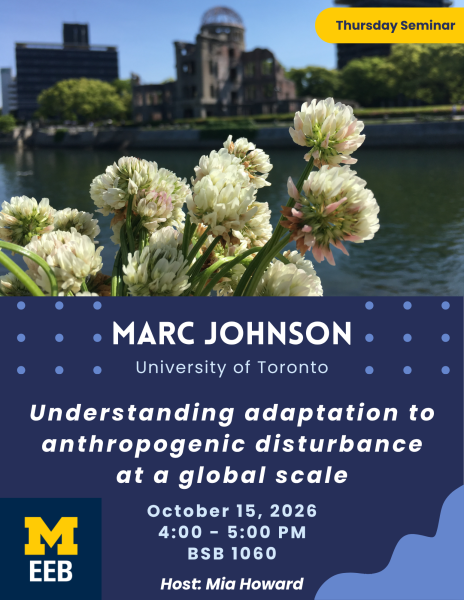

Seminar Summary - Anthropogenic disturbance is a dominant force driving evolutionary change on Earth today. From global land use change, to resource extraction and consumption, to rapid and ongoing climate change, humans are fundamentally changing our planet. While the geochemical, ecosystem and ecological consequences of anthropogenic caused environmental change are well studied and increasingly understood, the impacts on evolution are less understood. In this talk I will address this problem by seeking to answer a single general question: How does anthropogenic disturbance influence the evolution of life? As a case example, I will describe our work on the the cosmopolitan plant white clover, where we are examining how various anthropogenic disturbances affect all major mechanisms of evolution. I will describe our global studies examining whether urbanization affects phenotypic and genomic evolution. I will then explore whether invasive populations can adapt to novel environments in their invaded range, including the role of functional traits and structural variants across the genome in these adaptations. Finally, I will explore whether populations can adapt to rapid climate change through time in introduced and native ranges. The results from the white clover system provide insight into when species are likely to be able to adapt to anthropogenic disturbance, and when they may be unable to adapt. When combined with studies of other systems, it is becoming clear that anthropogenic disturbance is becoming one of the most important drivers of evolution.

Explore Similar Events
-
Loading Similar Events...
