Presented By: The Center for the Study of Complex Systems
Black-box learners for white-box epidemic models
Fan Bu
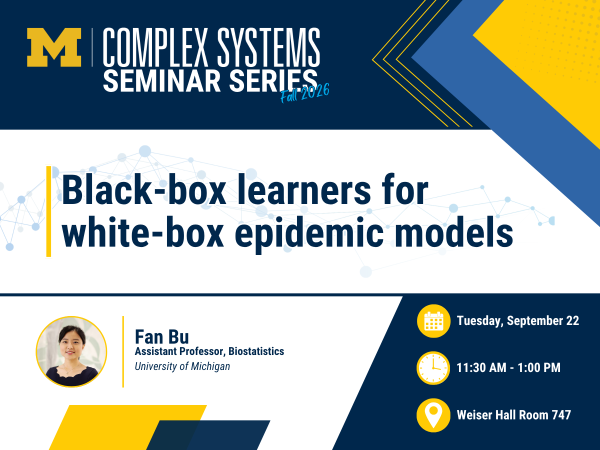

Mechanistic epidemic models are attractively interpretable, but fitting realistic models to imperfect data often involves challenging inverse problems. This talk presents two recent projects that explore hybrid approaches that combine deep learning with traditional mechanistic transmission models. First, I will discuss recent attempts of using neural posterior estimation (NPE) for simulation-based inference of stochastic epidemic models. When partial observation and large latent state spaces make likelihood-based inference computationally difficult, NPE learns to invert a stochastic simulator and approximate the posterior distribution of model parameters in a likelihood-free manner. Second, I will present a spatiotemporal epidemic-informed neural network approach based on physics-informed neural networks (PINNs). This approach incorporates a spatial interaction matrix to account for spatial or geographical dependencies in modeling epidemics across multiple regions (e.g., counties, states, etc.). The interaction matrix can be informed by external data or auxiliary information such as cross-region distance, adjacency, or mobility. These two projects provide practical examples of how flexible “black-box” machine learners can support inference for structured, interpretable “white-box” epidemic models.
https://umich.zoom.us/j/92447312412
https://umich.zoom.us/j/92447312412
Related Links
Co-Sponsored By

Explore Similar Events
-
Loading Similar Events...
