Presented By: Phillip J. Bowman Center for Scholarship to Practice
History in a Time of Forgetting
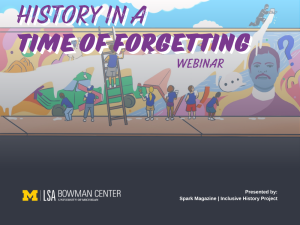

What do we — as individuals, communities, and members of a nation — choose to remember? What, or who, is erased from accounts of our shared past? And who benefits from the official and unofficial narratives constructed about the nation’s collective history?
In 2026, as the country celebrates the 250th anniversary of the signing of the Declaration of Independence, the current presidential administration has taken concerted steps to shape and disseminate a very specific version of the nation’s history. Notably, their efforts involve limiting the stories that are told about our past to conceal difficult truths, ignoring real complexities from the historical record, undermining the difficult work of historical research, and seeking to avoid the processes of interpreting and discussing the meaning of our past. But we can also see the resistance to this rewriting and its erasures in the persistence of existing histories, as well as the continued proliferation of alternate histories in a variety of spheres and locations that are not subject to governmental control.
This webinar accompanies the publication of Spark Magazine’s upcoming series, “History in a Time of Forgetting,” which grapples with what it means to engage in and uplift historical research amid the present national climate. The online webinar will feature series curators Jennifer Brady and Camron Michael Amin, from the University of Michigan's Inclusive History Project, in conversation with series contributors Elisa Alfonso, David Porter, S. Shani Saunders, and Tenisha Tevis. These writers take a range of approaches to history and remembering, exploring pop culture analysis, community storykeeping, personal history, and public pedagogy.
In 2026, as the country celebrates the 250th anniversary of the signing of the Declaration of Independence, the current presidential administration has taken concerted steps to shape and disseminate a very specific version of the nation’s history. Notably, their efforts involve limiting the stories that are told about our past to conceal difficult truths, ignoring real complexities from the historical record, undermining the difficult work of historical research, and seeking to avoid the processes of interpreting and discussing the meaning of our past. But we can also see the resistance to this rewriting and its erasures in the persistence of existing histories, as well as the continued proliferation of alternate histories in a variety of spheres and locations that are not subject to governmental control.
This webinar accompanies the publication of Spark Magazine’s upcoming series, “History in a Time of Forgetting,” which grapples with what it means to engage in and uplift historical research amid the present national climate. The online webinar will feature series curators Jennifer Brady and Camron Michael Amin, from the University of Michigan's Inclusive History Project, in conversation with series contributors Elisa Alfonso, David Porter, S. Shani Saunders, and Tenisha Tevis. These writers take a range of approaches to history and remembering, exploring pop culture analysis, community storykeeping, personal history, and public pedagogy.
Related Links
Co-Sponsored By

Explore Similar Events
-
Loading Similar Events...
