Presented By: Stone Center for Inequality Dynamics (CID)
Subjective Divorce Risk, Perceived Outside Options, and Intra-Household Allocation
Basit Zafar, University of Michigan
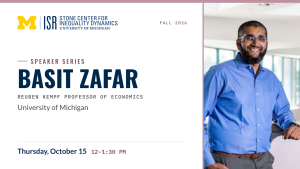

CID Speaker Series
Join the Stone Center for Inequality Dynamics as we host Basit Zafar, Reuben Kempf Professor of Economics in the University of Michigan’s LSA Department of Economics, for “Subjective Divorce Risk, Perceived Outside Options, and Intra-Household Allocation,” with Adeline Delavande, Gizem Kosar, and Alessandra Voena.
Abstract: Divorce is a central source of uncertainty for married households and a key determinant of labor supply, specialization, savings, and intra-household allocation. Using new survey data from married individuals and couples in the United States, the study elicits subjective divorce risk, expected outcomes if a marriage continues, and expected outcomes following divorce. It documents substantial heterogeneity in perceived divorce risk; measures expected effects on labor supply, fertility, health, and within-household allocation; and uses these expectations to inform a model of wives’ labor supply under divorce risk.
Please RSVP via the event page to save your seat.
Join the Stone Center for Inequality Dynamics as we host Basit Zafar, Reuben Kempf Professor of Economics in the University of Michigan’s LSA Department of Economics, for “Subjective Divorce Risk, Perceived Outside Options, and Intra-Household Allocation,” with Adeline Delavande, Gizem Kosar, and Alessandra Voena.
Abstract: Divorce is a central source of uncertainty for married households and a key determinant of labor supply, specialization, savings, and intra-household allocation. Using new survey data from married individuals and couples in the United States, the study elicits subjective divorce risk, expected outcomes if a marriage continues, and expected outcomes following divorce. It documents substantial heterogeneity in perceived divorce risk; measures expected effects on labor supply, fertility, health, and within-household allocation; and uses these expectations to inform a model of wives’ labor supply under divorce risk.
Please RSVP via the event page to save your seat.
Related Links
Co-Sponsored By

Explore Similar Events
-
Loading Similar Events...
